βM121N
IPRS Băneasa
- Also known as
- βM 121N, βM221N, βM321N
- Manufacturer
- IPRS Băneasa

- Country
- Romania

- Year
- Unknown
- Category
- Components
- Type
- Integrated circuits
- Documentation score
- 1/5
- Last edited
- 25 OCT 2026
Specifications
- Type
- linear integrated circuit
- Function
- precision preamplifier
- Equivalent / licence
- LM121, LM221, LM321 (see Variants)
- Package
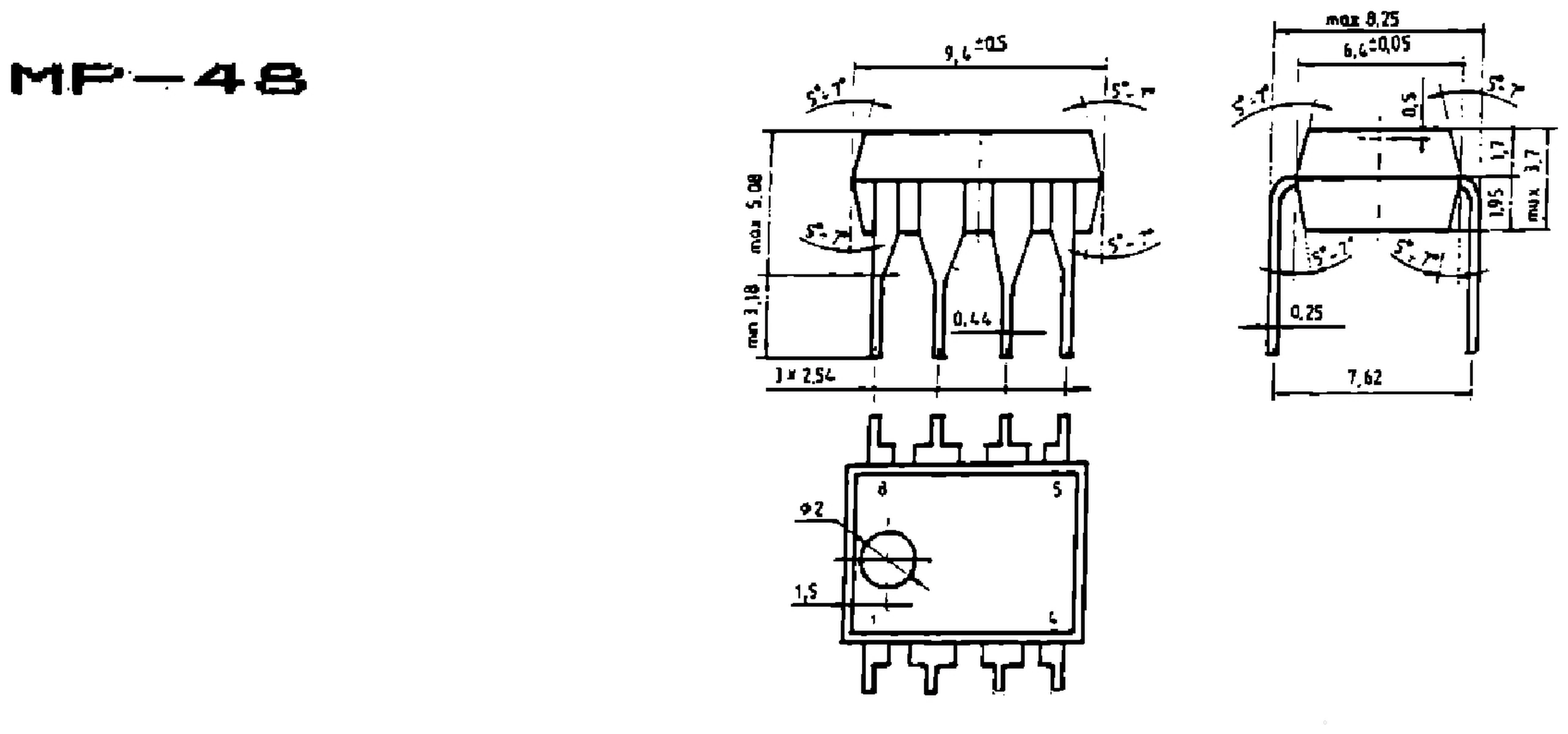
- MP-48
- Operating temperature range
- −55…+125 °C, −25…+85 °C, 0…+70 °C (see Variants)
- Input offset voltage (VIO)
- 0.7–1.5 mV (see Variants)
- Common-mode rejection ratio (CMRR)
- 120 dB
- Supply voltage rejection ratio (SVRR)
- 120 dB min.
- Input offset voltage drift (dVIO/dT)
- 1 µV/°C
Sources: [1]
Variants (3)
| Compare | ||||
|---|---|---|---|---|
| βM121N | LM121 | −55…+125 °C | 0.7 | |
| βM221N | LM221 | −25…+85 °C | 0.7 | |
| βM321N | LM321 | 0…+70 °C | 1.5 |
Click a column heading to sort. „+” adds a variant to the comparison (βM121N).
Description
The βM121N series are precision preamplifiers made by IPRS Băneasa, to be used with general purpose operational amplifiers [1].
The I.P.R.S. Băneasa Full Line Condensed Catalog (1990) lists the βM121N, βM221N and βM321N as precision preamplifiers designed to work with general purpose operational amplifiers to drastically decrease the DC errors: drift, bias current, common-mode and supply rejection are more than 50 times better than with standard op amps alone, and the added DC gain decreases the closed loop gain error [1]. The operating current is programmable from 5 to 200 µA, so that the bias current, offset current, gain and noise can be optimised for each application while keeping a very low drift; super-gain transistors are used in the input stage, so the input error currents are much lower than in conventional amplifiers at the same operating current, and the initial offset voltage is easily nulled to zero [1]. The extremely low drift improves the accuracy of almost any precision DC circuit: instrumentation amplifiers, strain gauge amplifiers and thermocouple amplifiers that would otherwise use chopper amplifiers can be made with the βM121, with low noise, full differential input, high common-mode rejection, low power drain and small size; the devices are directly interchangeable with the LM121, LM221 and LM321 types [1].
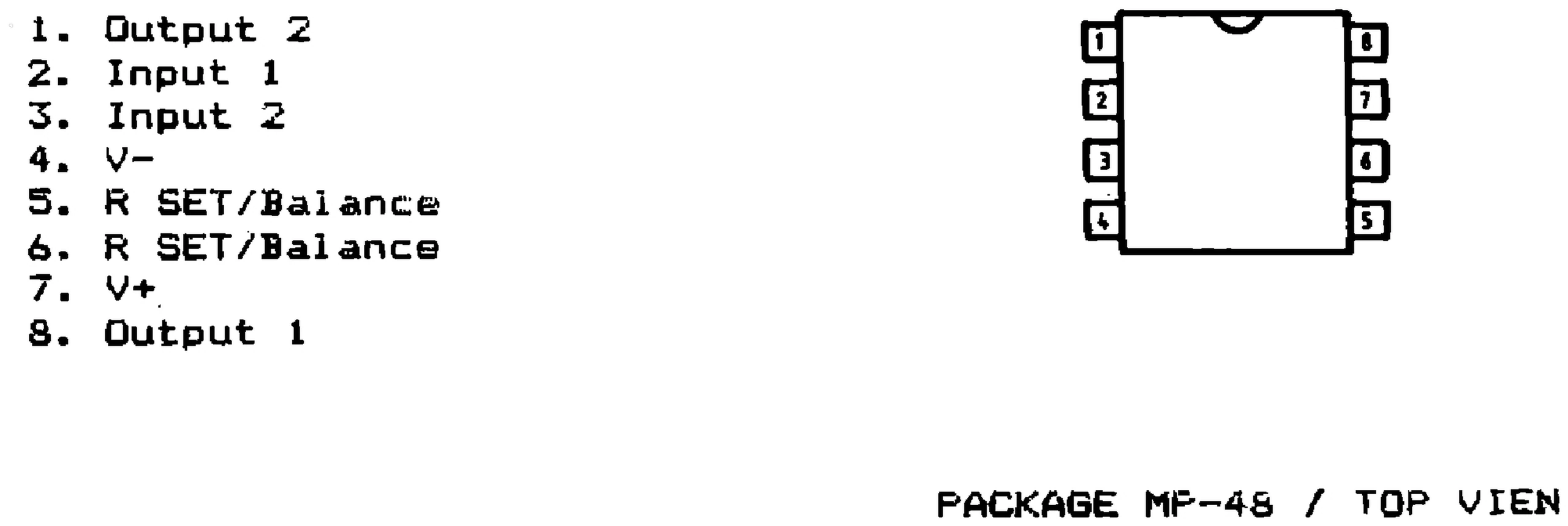
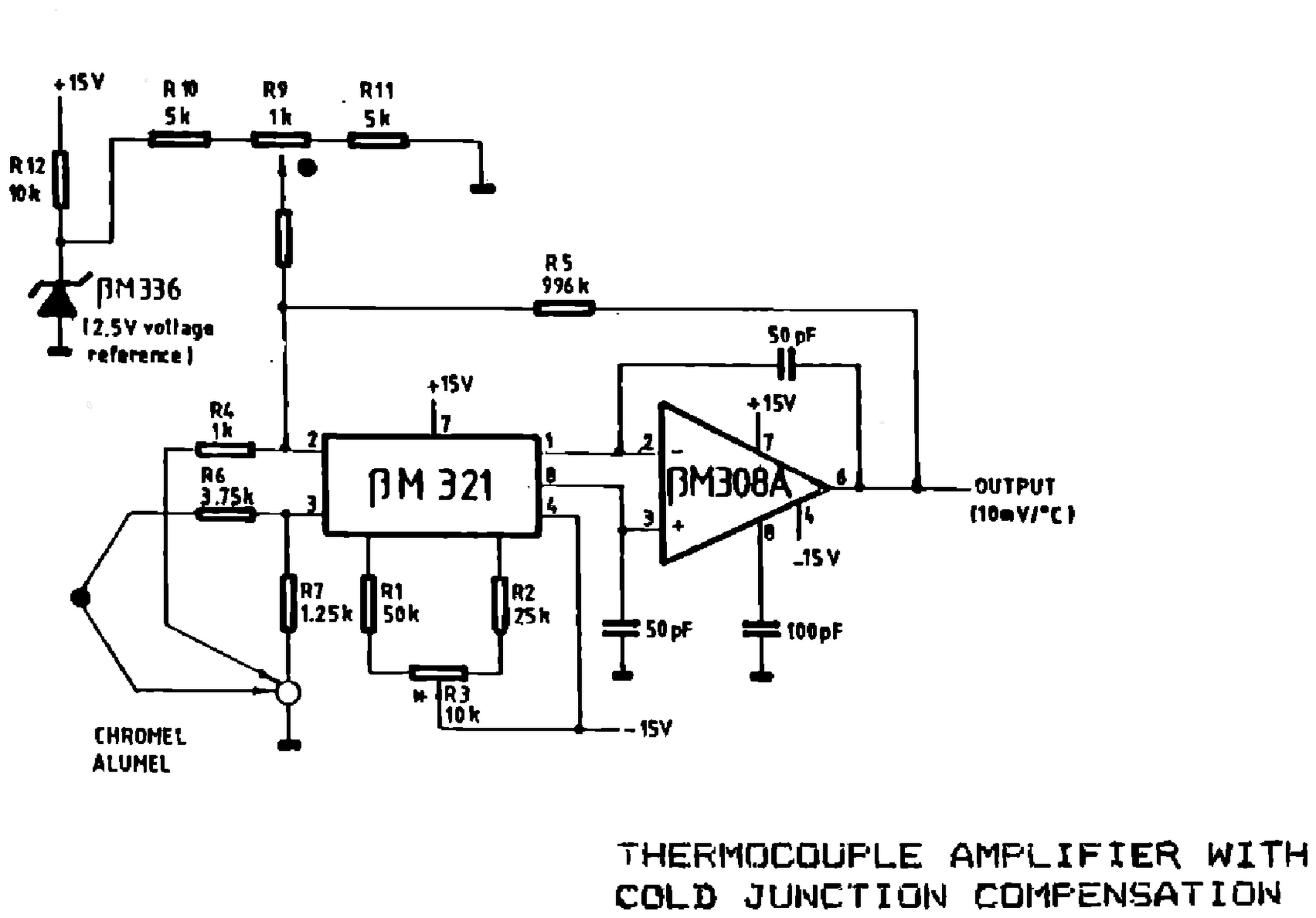
The catalog gives an operating temperature of −55…+125 °C (βM121N), −25…+85 °C (βM221N) and 0…+70 °C (βM321N), an input stage operating current Iset of 5…200 µA (programmable, Iset = 600 mV/Rset), an input offset voltage (externally adjustable to zero) of at most 0.7 mV (βM121N, βM221N) and 1.5 mV (βM321N), a typical input bias current of Iset/2000, common-mode and supply voltage rejection ratios of at least 120 dB, a typical supply current of 400 µA and an input offset voltage drift (VOS nulled externally) of at most 1 µV/°C [1]. Pins (MP-48, top view): 1 output 2, 2 input 1, 3 input 2, 4 V−, 5 RSET/balance, 6 RSET/balance, 7 V+, 8 output 1 [1]. The typical application, a thermocouple amplifier with cold junction compensation (with a βM336 2.5 V voltage reference, a βM321 and a βM308A), is in the Gallery [1].
For its calibration the catalog says to set the output to T amb [K] × 10 mV/K with the voltage reference (βM336) shorted (for example 2.98 V at 25 °C), and then to adjust for the output reading in °C [1]. Its remarks: this minimum part count application, in which the βM321 does both the signal amplification and the cold junction compensation, is possible because of the theoretical relationship between offset voltage and drift when the offset is not nulled to zero, the drift of the amplifier then compensating the thermocouple for ambient variations; the βM336 gives a temperature-stable voltage reference that offsets the output to read directly in degrees centigrade, and can be replaced by any voltage reference with the appropriate changes in the divider R9, R10, R11; the calibration does not depend on the thermocouple type, but the circuit values are for chromel-alumel and R6 and R7 must be changed for other thermocouples [1].
Gallery
 No image available
 No image available
 No image available
Documents
No documents available yet.
References
- [1]I.P.R.S. Băneasa – „Full Line Condensed Catalog”, 1990, section 2 „Linear integrated circuits”, „Industrial”, „βM 121N, βM 221N, βM 321N – Precision preamplifiers”, pp. 2-49…2-51