 No image available
BC174
IPRS Băneasa
- Manufacturer
- IPRS Băneasa

- Country
- Romania

- Year
- Unknown
- Category
- Components
- Type
- Transistors
- Documentation score
- 2/5
- Last edited
- 05 OCT 2026
Specifications
- Material
- Si
- Polarity
- NPN
- Max. power dissipation (Pc, Ptot)
- 0.3 W
- Max. collector–emitter voltage |Vce|
- 64 V
- Max. emitter–base voltage |Veb|
- 5 V
- Max. collector current |Ic|
- 0.1 A
- Max. junction temperature (Tj)
- 150 °C
- Transition frequency (ft)
- 250 MHz
- Small-signal current gain (hfe)
- 125–500
- Noise figure (NF)
- 10 dB
- Collector–emitter saturation voltage (Vce sat)
- 0.6 V
- Package
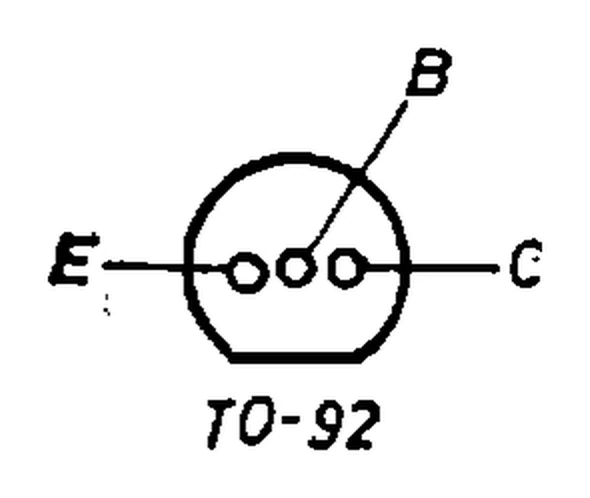
- TO-92
- Application
- low frequency, low power
Description
The BC174 is a silicon transistor made by IPRS Băneasa, one of the representative export products of its section 2500 in 1980–1985 [1]. In 1980–1985 section 2500 of IPRS exported 30% of its output by value – over 10 million components – without quality complaints; its representative export types were the 1N148 and BA244 diodes and the 2N2369A, BF173, BB126, BC171, BC172, BC173, BC174, 2N2222, 2N2222A and BF458 [1].
The Agenda radioelectronistului (2nd edition, 1989) lists the BC174 among the bipolar transistors made by IPRS Băneasa, in the group of low-frequency, low-power silicon NPN transistors, in a TO-92 package [2].
Coded as (Pro Electron system) [3]:
| Part | Meaning |
|---|---|
| B | base material with an activation energy of 1.0–1.3 eV, e.g. silicon (1.1 eV) |
| C | low-frequency, low-power transistor |
| 174 | serial number: three digits (100–999), for components for general use |
Small-signal current gain h21e measured at IC = 2 mA, VCE = 5 V; Vce sat at IC = 100 mA; ft at IC = 10 mA; noise figure at f = 1 kHz [2].
Gallery
No other images available yet.
Documents
No documents available yet.
References
- [1]N. Millea, I. Constantinescu (coord.) – „Un secol de electronică în România”, Editura Academiei Române, 2020, section VIII.1.2.5, pp. 404–408
- [2]N. Drăgulănescu – „Agenda radioelectronistului”, 2nd edition, Editura Tehnică, 1989, section 28.2.6 „Tranzistoare cu siliciu, NPN, de joasă frecvență, mică putere”, p. 525
- [3]N. Drăgulănescu – „Agenda radioelectronistului”, 2nd edition, Editura Tehnică, 1989, section 26.2 „Sistemul european PRO ELECTRON”, pp. 479–480