 No image available

Specifications
No manufacturer data yet – see the Universal Specifications below ↓
Universal Specifications (Common reference specs for all brands and equivalents)
- Type
- Diode–power pentodeFrom: [U1]
- Heater voltage (Vh)
- 55 VFrom: [U1]
- Heater current (Ih)
- 0.1 AFrom: [U1]
- Anode voltage (Va)
- 100 VFrom: [U1]
- Anode current (Ia)
- 32.5 mAFrom: [U1]
- Anode dissipation (Pa)
- 11 WFrom: [U1]
- Transconductance (gm)
- 7.5 mA/VFrom: [U1]
- Output power
- 1.35 WFrom: [U1]
- Max. heater–cathode voltage (Vhk)
- 150 VFrom: [U1]
- Grid bias (−Vg)
- 5.3 VFrom: [U1]
- Internal resistance (Ri)
- 25 kΩFrom: [U1]
- Cathode bias resistor (Rk)
- 0.14 kΩFrom: [U1]
- Anode load resistance (Ra)
- 3 kΩFrom: [U1]
- AC grid voltage (Vg~, rms)
- 3.8 VFrom: [U1]
- Distortion (d)
- 10 %From: [U1]
- Max. cathode current (Ik)
- 75 mAFrom: [U1]
- Anode–grid capacitance (Cag)
- 1.2 pFFrom: [U1]
- Max. grid resistance (Rg max)
- 1 MΩFrom: [U1]
- Screen-grid voltage (Vg2)
- 100 VFrom: [U1]
- Screen-grid current (Ig2)
- 5.5 mAFrom: [U1]
- Grid 1 – screen amplification factor (µg2g1)
- 9From: [U1]
- Screen-grid dissipation (Pg2)
- 1.9 WFrom: [U1]
- Application
- Class A amplifierFrom: [U1]
Description
No description available yet.
Universal Description (Common reference data for all brands and equivalents)
From [U1] UBL21 – catalogue of electronic tubes (1956), chapter VI – power amplifier pentodes
The general catalogue „Catalog de tuburi electronice” (Editura Tehnică, București, 1956) [U1] lists, in chapter „VI. Pentode amplificatoare de putere”, UBL21 in section „Pentode finale (S > 7 mA/V)” (output pentodes (S > 7 mA/V)), p. 256 (application: class A amplifier).
Show the table as printed (decimal comma; „—” = not given; the application is translated)
| Vf (V) | If (A) | Vhk (V) | Application | Va (V) | Ia (mA) | Vg2 (V) | Ig2 (mA) | −Vg1 (V) | S (mA/V) | Ri (kΩ) | µg2g1 | Rk (Ω) | Ra (kΩ) | Vg~ (V rms) | Pout (W) | d (%) | Pa (W) | Pg2 (W) | Ik (mA) | Cag1 (pF) | Req (kΩ) | Rg max (MΩ) |
|---|---|---|---|---|---|---|---|---|---|---|---|---|---|---|---|---|---|---|---|---|---|---|
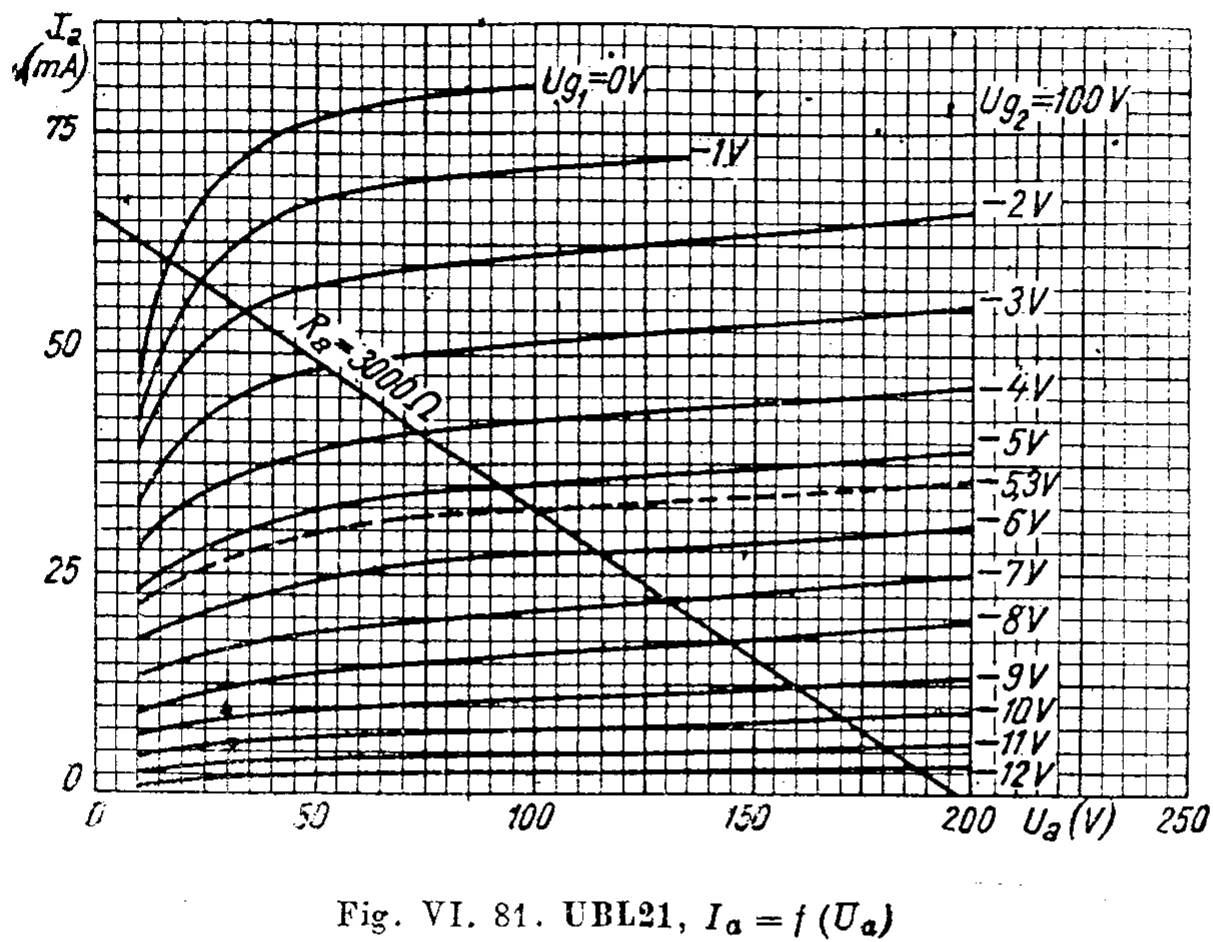
| 55 | 0,1 | 150 | Class A amplifier | 100 | 32,5 | 100 | 5,5 | 5,3 | 7,5 | 25 | 9 | 140 | 3 | 3,8 | 1,35 | 10 | 11 | 1,9 | 75 | 1,2 | diodă 200 V 0,8 mA | 1 |
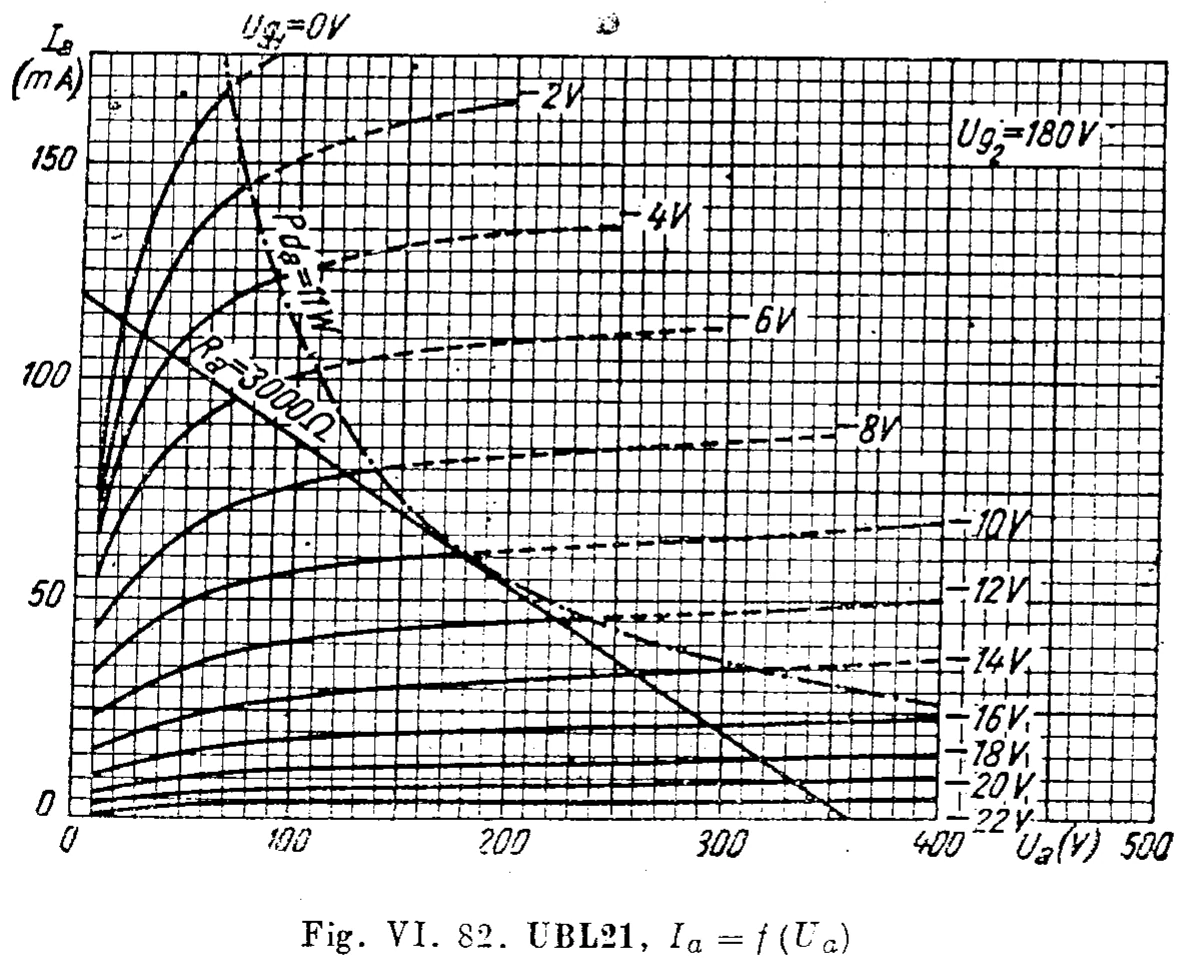
| 180 | 61 | 180 | 10 | 10 | 9 | 22 | 9 | 140 | 3 | 6,2 | 4,8 | 10 | — | — | — | — | — | — |
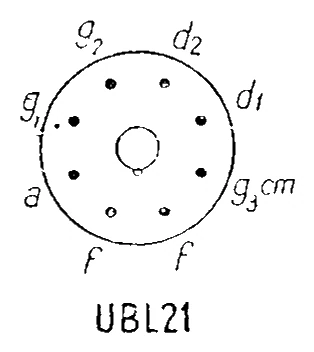
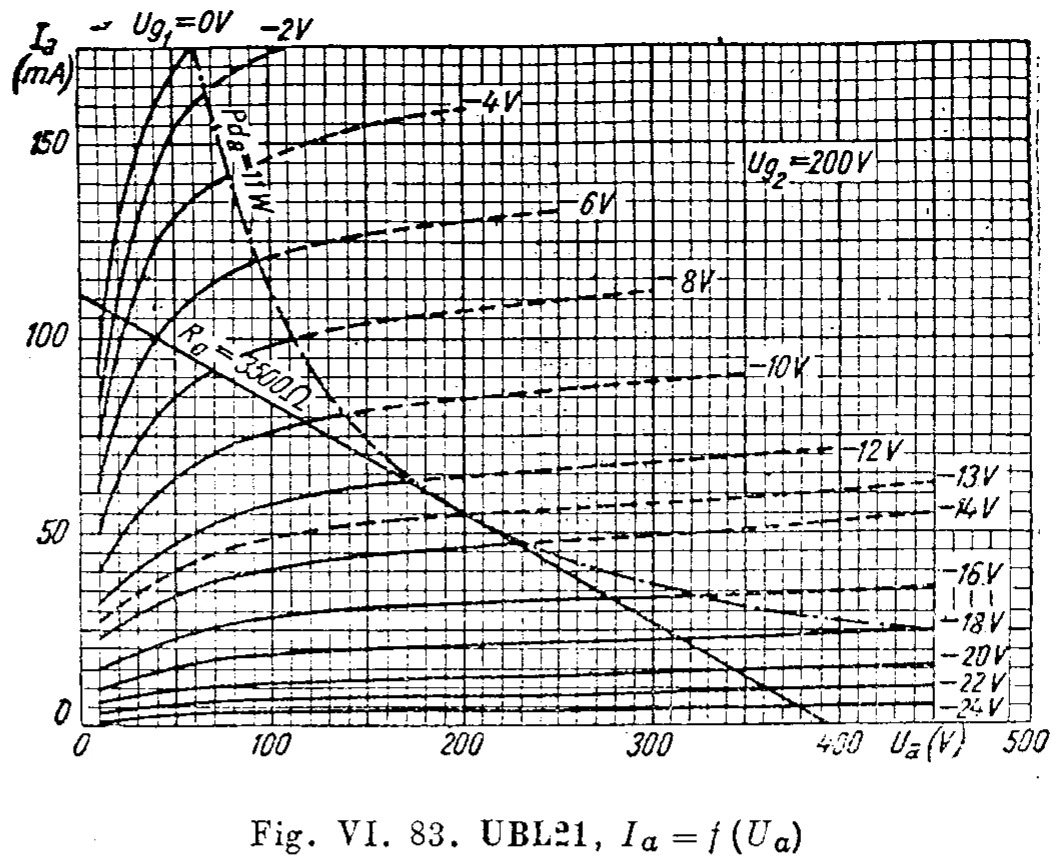
A line without heater data continues the line above it (another operating condition), as printed. Designation in the new European system (catalogue p. 14): U – heater 100 mA; B – double diode, L – power pentode; 21 – key (loktal) series (21 – pressed glass). Characteristic curves: Fig. VI.81, UBL21 (anode current vs anode voltage, „Ia = f (Ua)”); Fig. VI.82, UBL21 (anode current vs anode voltage, „Ia = f (Ua)”); Fig. VI.83, UBL21 (anode current vs anode voltage, „Ia = f (Ua)”); Fig. VI.84, UBL21 (AC grid voltage and dtot vs Pu, „Ug1~ = f (Pu); dtot = f (Pu)”); Fig. VI.85, UBL21 (AC grid voltage and dtot vs Pu, „Ug1~ = f (Pu); dtot = f (Pu)”). The base connections drawing is in Universal Drawings.
Drawing Gallery
No drawings available yet.
Photo Gallery
 No image available
 No image available
 No image available
 No image available
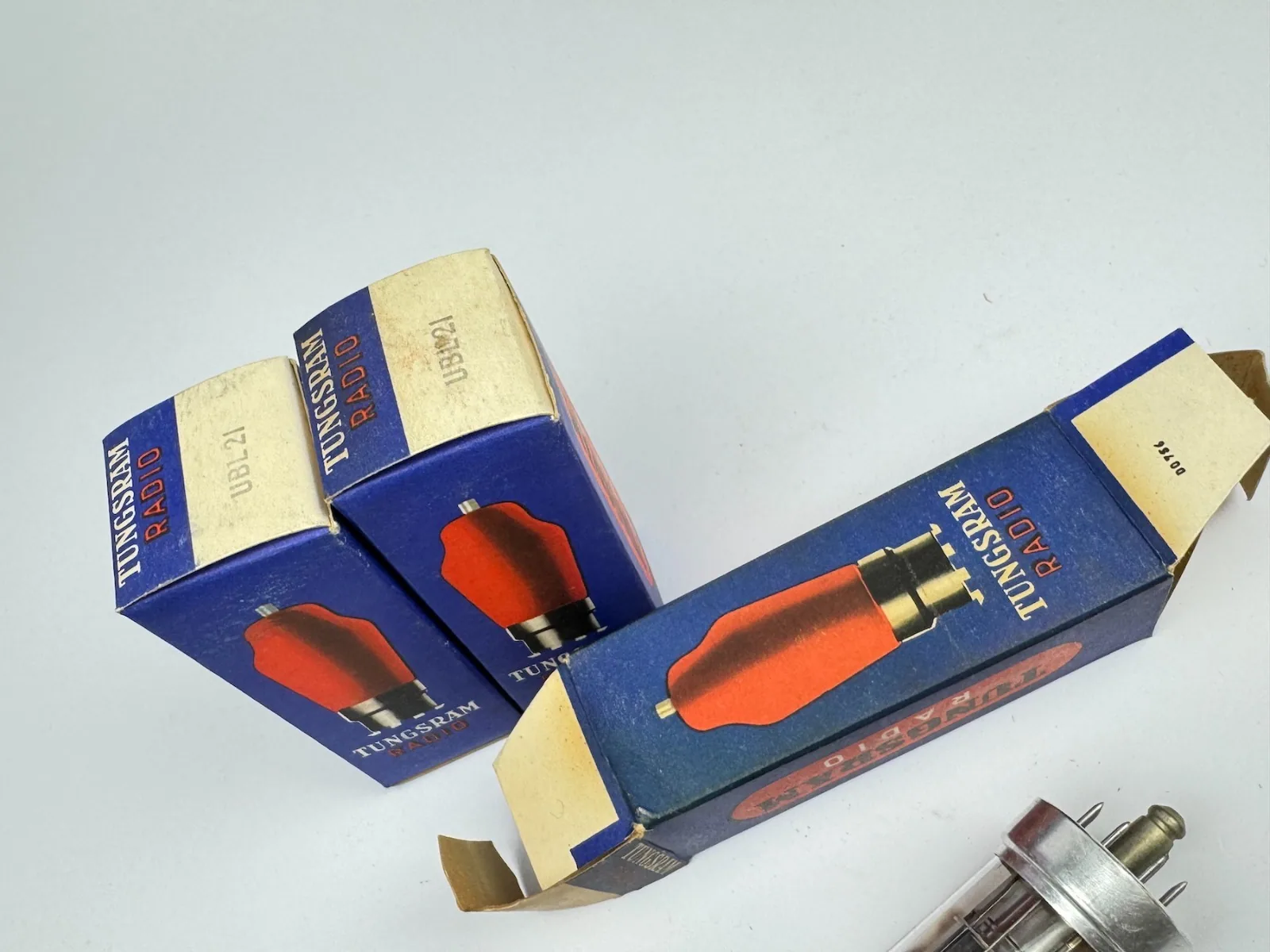 No image available
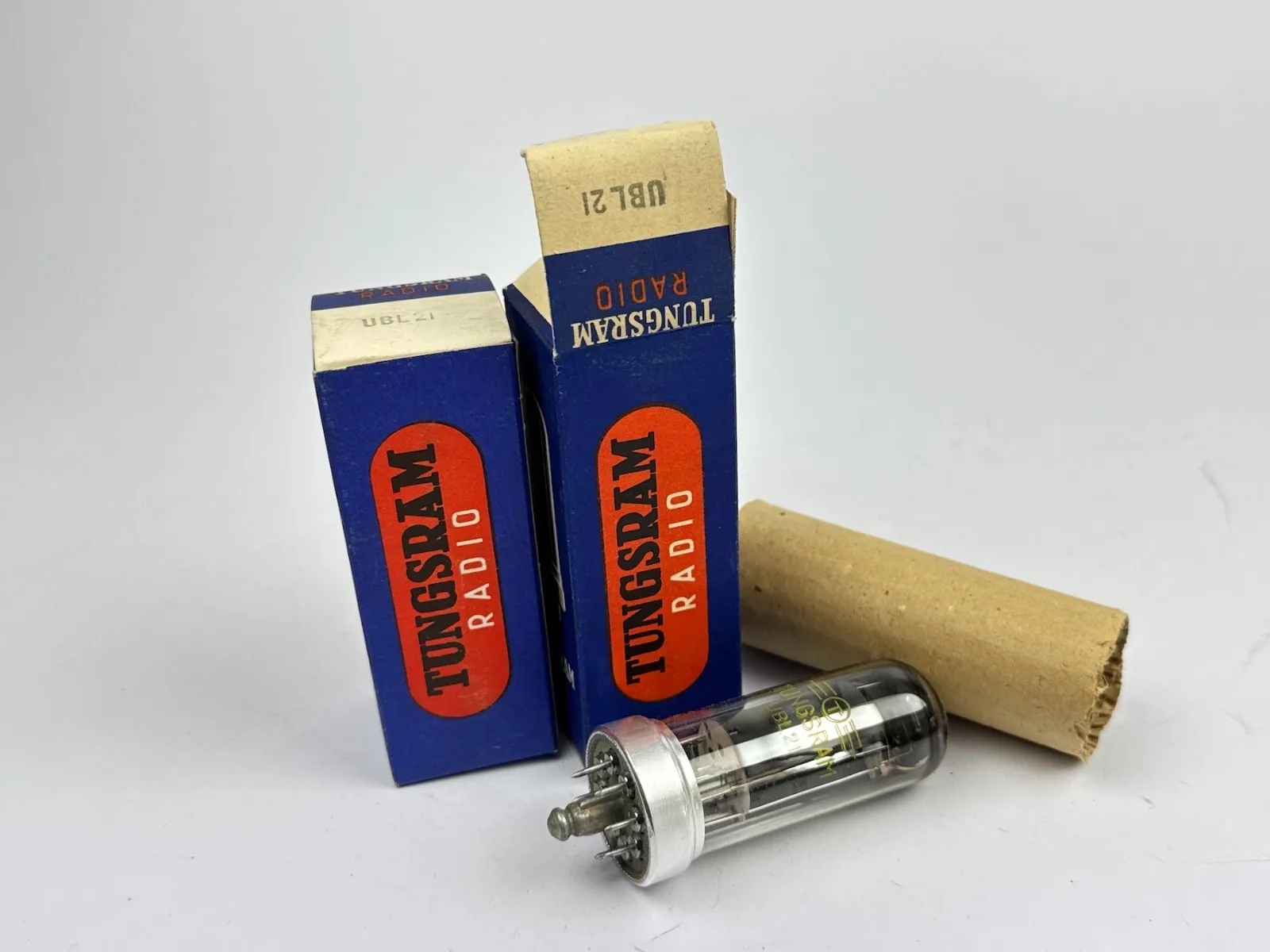 No image available
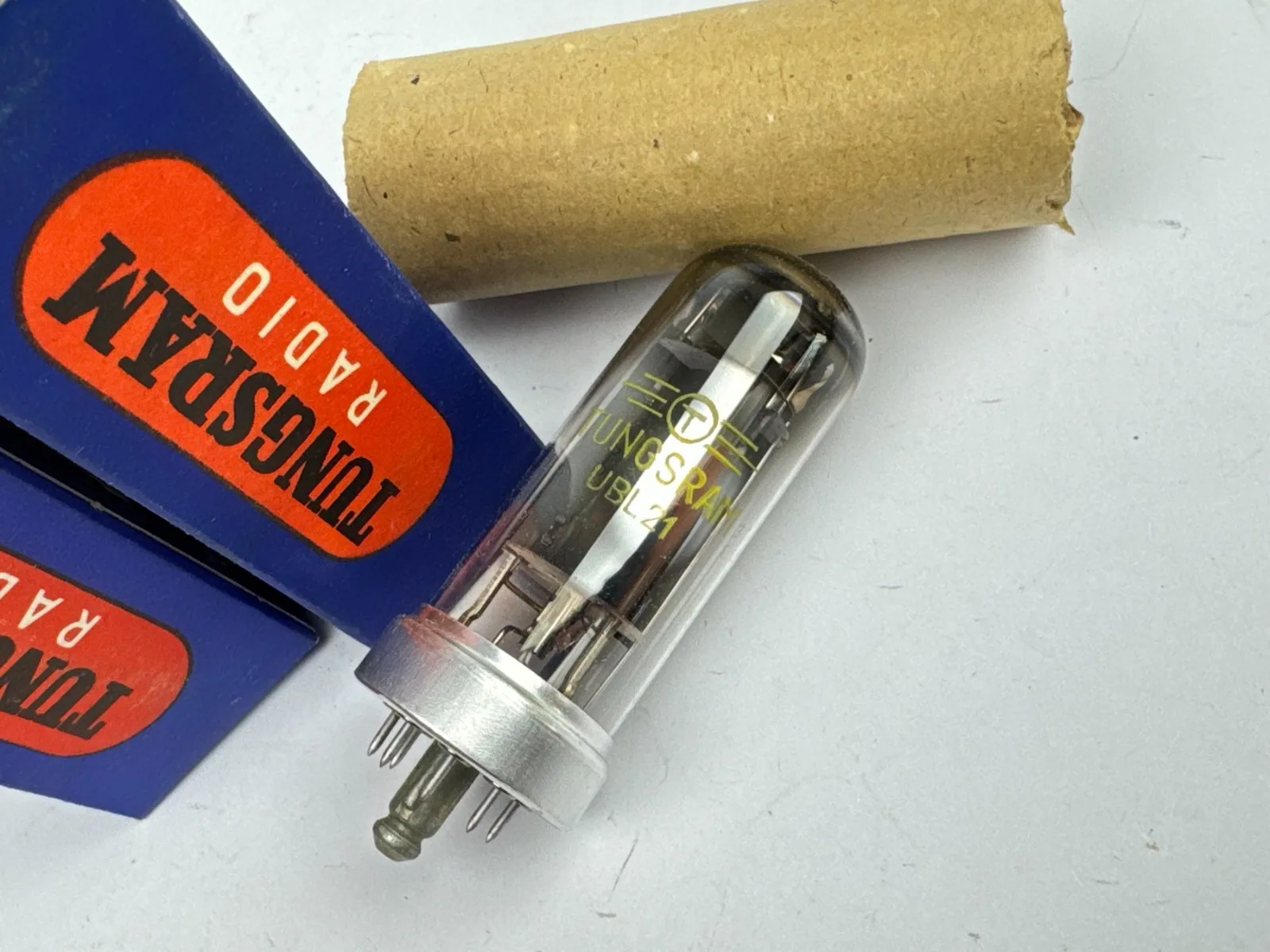 No image available
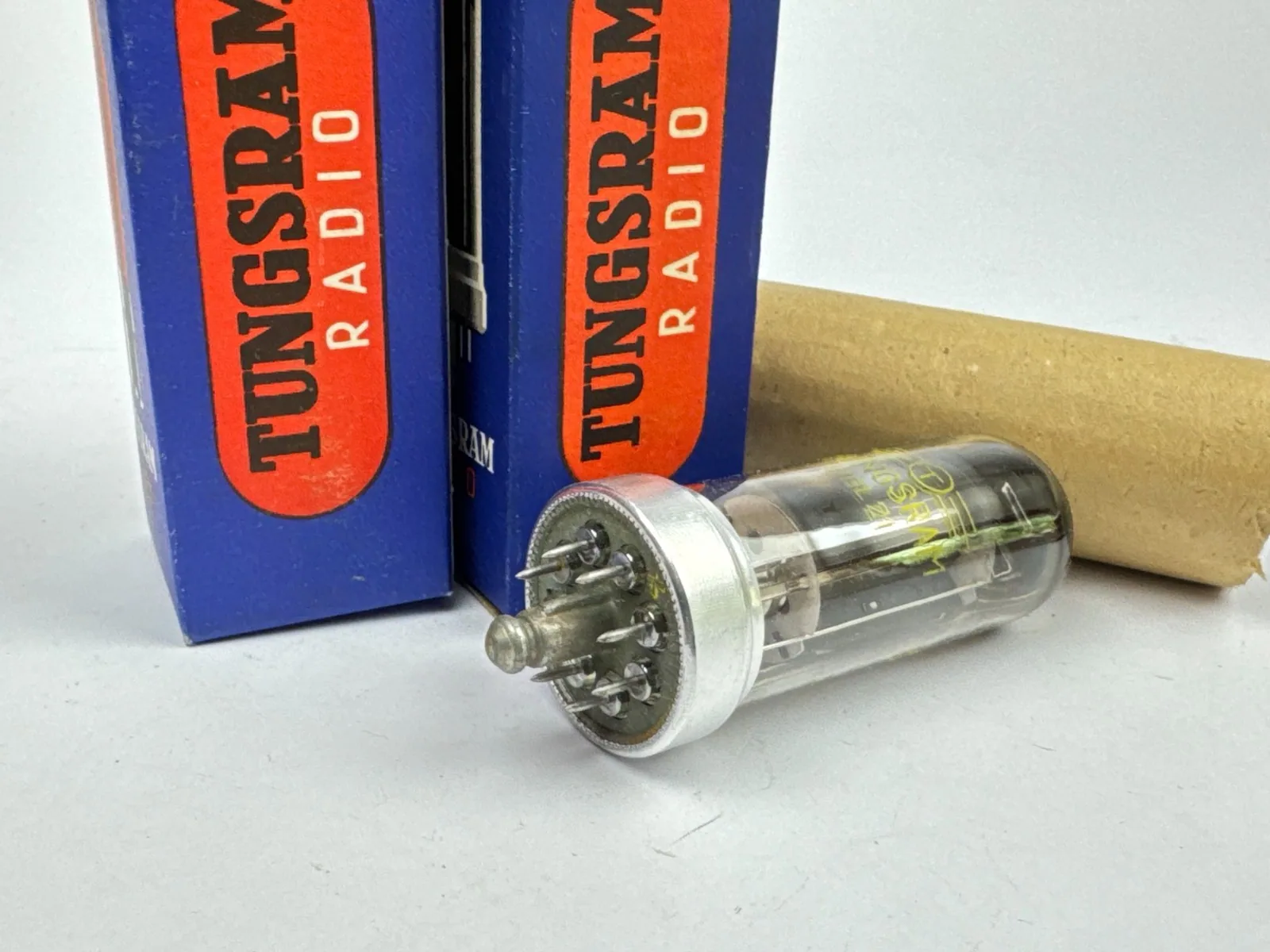 No image available
Universal Drawings (Technical drawings common to all brands and equivalents)
 No image available
 No image available
 No image available
 No image available
 No image available
 No image available
Documents
No documents available yet.
Prices
- 2026.08.30, 21.50 EUR, deinradio, eBay, 820026113295, 2x Tungsram UBL21 Röhre NOS OVP Pentode Endstufe Röhrenverstärker Verstärker
- 2026.08.15, 20.50 EUR, deinradio, eBay, 358857338599, 3x Tungsram UBL21 Röhre NOS OVP Pentode Endstufe Röhrenverstärker Verstärker
- 2026.08.02, 14.90 EUR, deinradio, eBay, 358829272688, 2x Tungsram UBL21 Röhre NOS OVP Pentode Endstufe Röhrenverstärker Verstärker
Used in (5)
References
Universal references
- [U1]A. Georgescu, I. Golea – „Catalog de tuburi electronice”, Editura Tehnică, București, 1956, cap. „VI. Pentode amplificatoare de putere”, p. 256