1Ц7С
Unknown
- Manufacturer
- Unknown
- Country
- Soviet Union

- Year
- Unknown
- Category
- Components
- Type
- Tubes
- Equivalents
- 1ВД2
- Documentation score
- 0/7
- Last edited
- 14 NOV 2026
Specifications
No manufacturer data yet – see the Universal Specifications below ↓
Universal Specifications (Common reference specs for all brands and equivalents)
- Type
- High-voltage rectifierFrom: [U1]
- Heater voltage (Vh)
- 1.25 VFrom: [U1]
- Heater current (Ih)
- 0.2 AFrom: [U1]
- Rectified current, DC (I0)
- 2 mAFrom: [U1]
- Max. peak inverse voltage (Vinv)
- 30000 VFrom: [U1]
- Max. peak anode current (Iv)
- 17 mAFrom: [U1]
- Application
- Rectifier for television sets and oscilloscopesFrom: [U1]
Description
No description available yet.
Universal Description (Common reference data for all brands and equivalents)
From [U1] 1Ц7С – catalogue of electronic tubes (1956), chapter I – diodes
The general catalogue „Catalog de tuburi electronice” (Editura Tehnică, București, 1956) [U1] lists, in chapter „I. Diode”, 1Ц7С in section „Tuburi sovietice – Diode redresoare simple pentru înaltă tensiune” (Soviet tubes, single high-voltage rectifier diodes), p. 104 (application: rectifier for television sets and oscilloscopes).
Show the table as printed (decimal comma; „—” = not given; the application is translated)
| Vf (V) | If (A) | Application | I0 (mA) | Vinv (V) | Iv (mA) |
|---|---|---|---|---|---|
| 1,25 | 0,2 | Rectifier for television sets and oscilloscopes | 2 | 30 000 | 17 |
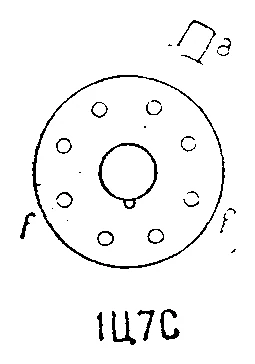
Designation in the Soviet GOST 5461-50 system (catalogue p. 10–11): 1 – heater voltage (rounded); 7 – series number; С – glass tube of normal size. In the theoretical part of the catalogue, the table of old and new Soviet designations (GOST 5461-50, p. 24–25) gives 1ВД2 → 1Ц7С. The base connections drawing is in Universal Drawings.
Drawing Gallery
No drawings available yet.
Photo Gallery
No other images available yet.
Universal Drawings (Technical drawings common to all brands and equivalents)
 No image available
Documents
No documents available yet.
Prices
N/A
References
Universal references
- [U1]A. Georgescu, I. Golea – „Catalog de tuburi electronice”, Editura Tehnică, București, 1956, cap. „I. Diode”, p. 104