6JV8
Unknown
- Manufacturer
- Unknown
- Country
- United States

- Year
- Unknown
- Category
- Components
- Type
- Tubes
- Equivalents
- N/A
- Documentation score
- 0/7
- Last edited
- 18 NOV 2026
Specifications
No manufacturer data yet – see the Universal Specifications below ↓
Universal Specifications (Common reference specs for all brands and equivalents)
- Anode voltage (Va)
- 200 VFrom: [U1]125 VFrom: [U2] (6JV8)
- Anode current (Ia)
- 4 mAFrom: [U1]22 mAFrom: [U2] (6JV8)
- Transconductance (gm)
- 4 mA/VFrom: [U1]11.5 mA/VFrom: [U2] (6JV8)
- Grid bias (−Vg)
- 2 VFrom: [U1]
- Internal resistance (Ri)
- 17.5 kΩFrom: [U1]100 kΩFrom: [U2] (6JV8)
- Amplification factor (µ)
- 70From: [U1]
- Screen-grid voltage (Vg2)
- 125 VFrom: [U2] (6JV8)
- Screen-grid current (Ig2)
- 4 mAFrom: [U2] (6JV8)
Description
No description available yet.
Universal Description (Common reference data for all brands and equivalents)
From [U1] 6JV8 – A Comprehensive Radio Valve Guide (Babani, 1963), additional triode amplifiers too late for classification
The general guide „A Comprehensive Radio Valve Guide” (B. B. Babani, Book 5, Bernards, London, 1963) [U1] lists 6JV8 in the section „Additional Triode Amplifiers Too Late for Classification”, p. 38, maker „U.S.A.”, base connections no. 3 (p. 39). Characteristics are given for single and twin triodes, those for the latter being for a single section; the conditions shown are the typical operating conditions for transformer-coupled AF amplifiers in Class A (book, p. 6). The book gives the cathode resistor Rk in ohms. The book lists it both here and among the additional screened tetrodes and pentodes on the same page, with the same base connections: the triode and the pentode section of one valve.
Show the table as printed (K = kΩ; „—” = not given)
| Filament / heater (V) | Filament / heater (A) | Anode (V) | Anode (mA) | Neg. grid (V) | ra (kΩ) | gm (mA/V) | Amp. factor | Rk (Ω) | Base type | Base ref. | Maker |
|---|---|---|---|---|---|---|---|---|---|---|---|
| 6.3 | 0.6 | 200 | 4.0 | 2.0 | 17.5K | 4.0 | 70 | — | B9A | 3 | U.S.A. |
The base connections drawing is in Universal Drawings.
From [U2] 6JV8 – A Comprehensive Radio Valve Guide (Babani, 1963), additional screened tetrodes and pentodes
The general guide „A Comprehensive Radio Valve Guide” (B. B. Babani, Book 5, Bernards, London, 1963) [U2] lists 6JV8 in the section „Additional Screened Tetrodes and Pentodes”, p. 38, maker „U.S.A.”, base connections no. 3 (p. 39). The book says these valves are normally used for RF amplification, with the typical Class A operating conditions recommended by the manufacturers (p. 6). The „Neg. Grid Volts” column is shown only in the table (it also contains values such as „180Ω” or „560”, which are not grid voltages). The book lists it both here and among the additional triode amplifiers on the same page, with the same base connections: the triode and the pentode section of one valve.
Show the table as printed („—” = not given)
| Filament / heater (V) | Filament / heater (A) | Anode (V) | Anode (mA) | Screen (V) | Screen (mA) | Neg. grid (V) | ra (kΩ) | gm (mA/V) | Base type | Base ref. | Maker |
|---|---|---|---|---|---|---|---|---|---|---|---|
| 6.3 | 0.6 | 125 | 22 | 125 | 4.0 | 1.0 | 100K | 11.5 | B9A | 3 | U.S.A. |
The base connections drawing is in Universal Drawings.
Drawing Gallery
No drawings available yet.
Photo Gallery
No other images available yet.
Universal Drawings (Technical drawings common to all brands and equivalents)
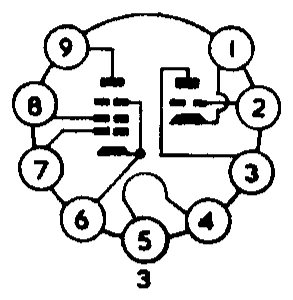 No image available
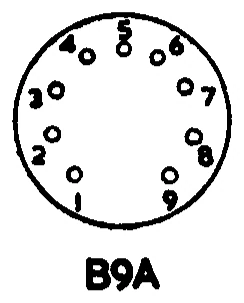 No image available
Documents
No documents available yet.
Prices
N/A
References
Universal references
- [U1]B. B. Babani – „A Comprehensive Radio Valve Guide”, Book 5, Bernards (Publishers) Ltd., London, 1963, section „Additional Triode Amplifiers Too Late for Classification”, p. 38
- [U2]B. B. Babani – „A Comprehensive Radio Valve Guide”, Book 5, Bernards (Publishers) Ltd., London, 1963, section „Additional Screened Tetrodes and Pentodes”, p. 38
- [U3]B. B. Babani – „A Comprehensive Radio Valve Guide”, Book 5, Bernards (Publishers) Ltd., London, 1963, section „Valve Base Key”, p. 5