UCH42
Unknown
- Manufacturer
- Unknown
- Country
- Unknown
- Year
- Unknown
- Category
- Components
- Type
- Tubes
- Equivalents
- N/A
- Documentation score
- 0/7
- Last edited
- 17 NOV 2026
Specifications
No manufacturer data yet – see the Universal Specifications below ↓
Universal Specifications (Common reference specs for all brands and equivalents)
- Type
- Triode–hexode or triode–heptode (frequency changer)From: [U1]
- Heater voltage (Vh)
- 14 VFrom: [U1]
- Heater current (Ih)
- 0.1 AFrom: [U1]
- Anode voltage (Va)
- 100 VFrom: [U1]
- Anode current (Ia)
- 1.2 mAFrom: [U1]
- Anode dissipation (Pa)
- 1.5 WFrom: [U1]
- Conversion transconductance (Sc)
- 0.53 mA/VFrom: [U1]
- Max. heater–cathode voltage (Vhk)
- 150 VFrom: [U1]
- Internal resistance (Ri)
- 1000 kΩFrom: [U1]
- Cathode bias resistor (Rk)
- 0.18 kΩFrom: [U1]
- Max. cathode current (Ik)
- 10 mAFrom: [U1]
- Grid capacitance (Cg)
- 4 pFFrom: [U1]
- Anode capacitance (Ca)
- 9.4 pFFrom: [U1]
- Application
- Hexode, frequency changerFrom: [U1]
Description
No description available yet.
Universal Description (Common reference data for all brands and equivalents)
From [U1] UCH42 – catalogue of electronic tubes (1956), chapter VIII – triode-hexodes
The general catalogue „Catalog de tuburi electronice” (Editura Tehnică, București, 1956) [U1] lists, in chapter „VIII. Triode-hexode”, UCH42 in section „Triode-hexode și triode-heptode” (triode-hexodes and triode-heptodes), p. 318 (application: hexode, frequency changer).
Show the table as printed (decimal comma; „—” = not given; the application is translated)
| Vf (V) | If (A) | Vhk (V) | Application | Va (V) | Ia (mA) | Ig2+4 (mA) | Ig3+gT (mA) | −Vg1 (V) | Sc (S) (µA/V) | Ri (MΩ) | Rk (Ω) | Rg3+gT (kΩ) | R′g2 (kΩ) | R″g2g4 (kΩ) | Pa (W) | Pg2+4 (W) | Ik (mA) | Cg1 (pF) | Ca (pF) | Cag1 (pF) | Rg1 max (MΩ) | Req (MΩ) |
|---|---|---|---|---|---|---|---|---|---|---|---|---|---|---|---|---|---|---|---|---|---|---|
| 14 | 0,1 | 150 | Hexode, frequency changer | 100 | 1,2 | 1,46 | 0,175 | 1 | 530 | 1 | 180 | 22 | 18 | 27 | 1,5 | 0,3 | 10 | 4 | 9,4 | 0,1 | 3 | 0,05 |
| — | — | — | — | 13,5 | 5,3 | 5 | — | — | — | — | — | — | — | — | — | — | — | — | ||||
| Triode, oscillator | 66 | 3,4 | — | 0,175 | — | — | — | — | 22 | — | — | 0,8 | — | — | 5,9 | 2,4 | 1,3 | — | — |
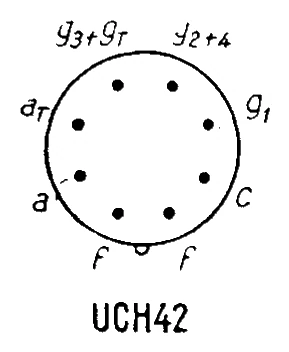
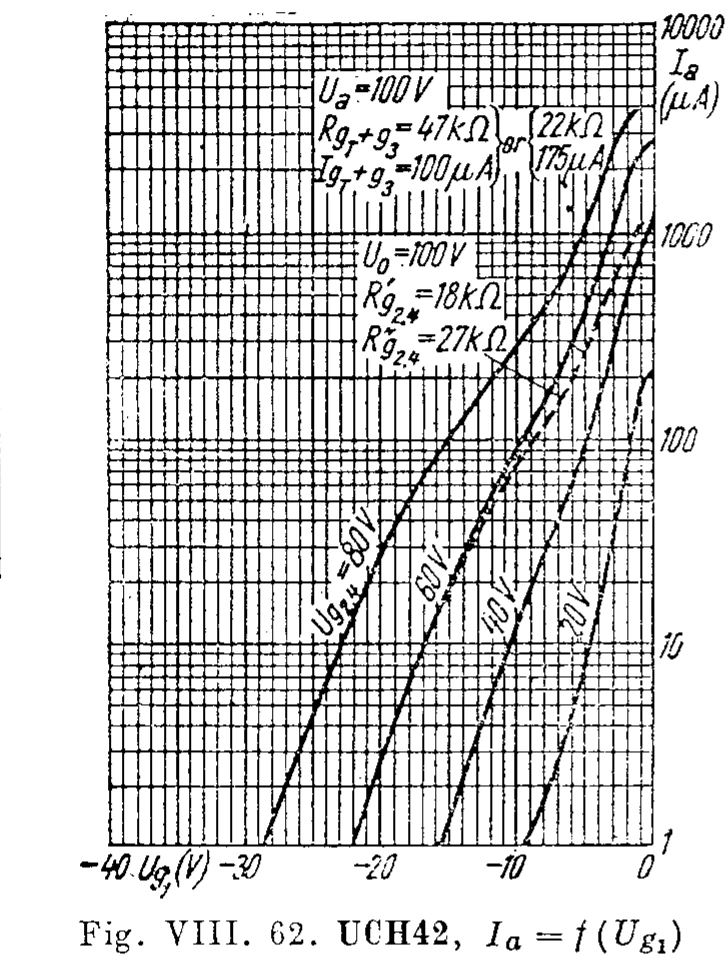
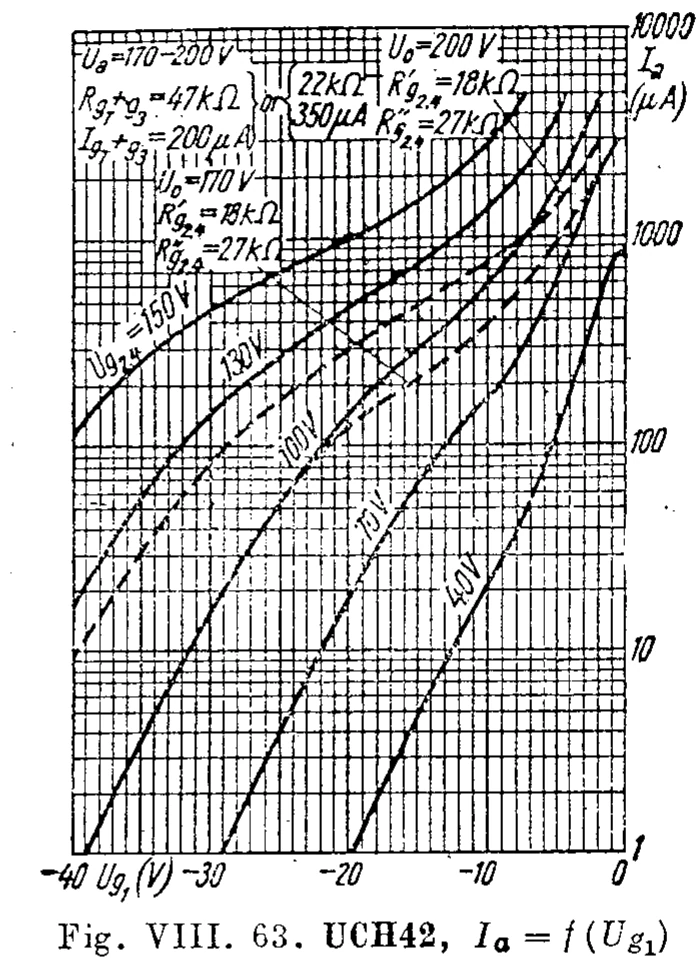
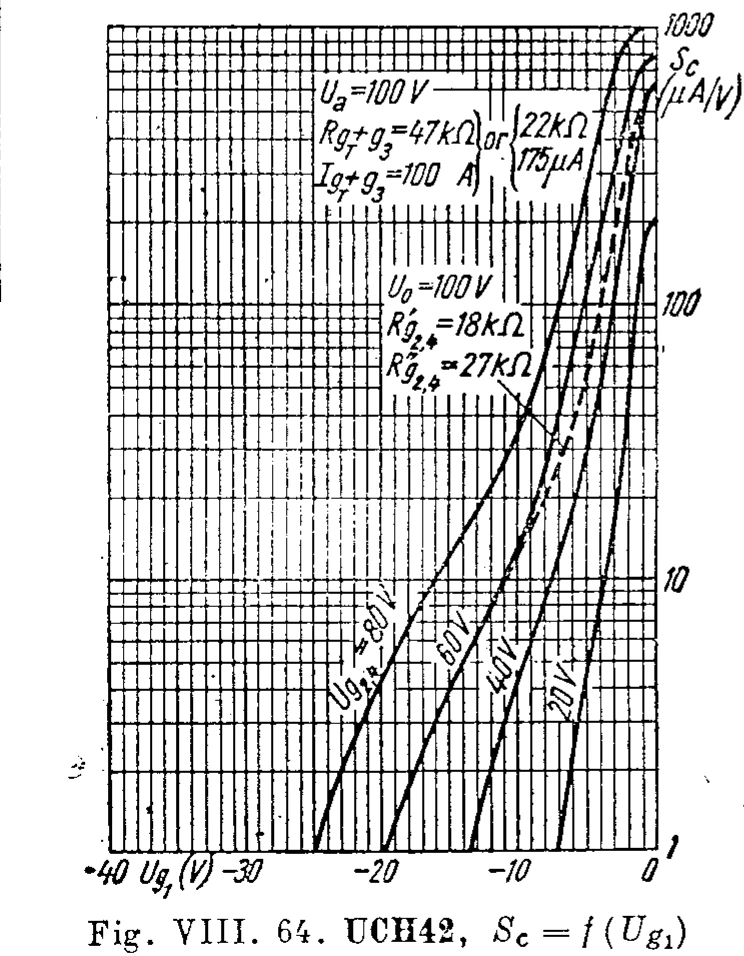
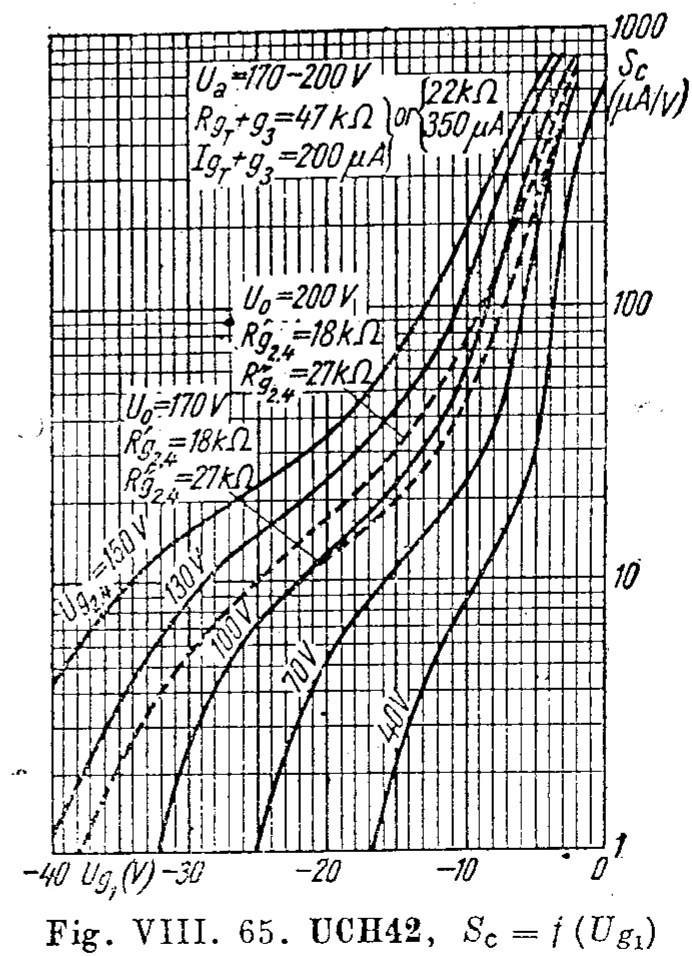
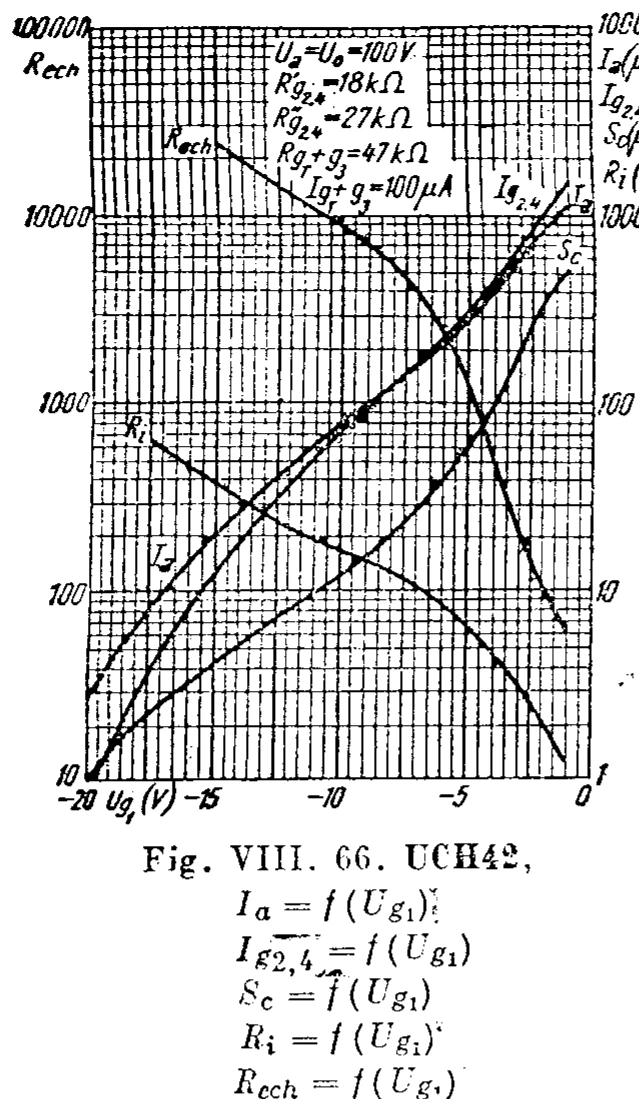
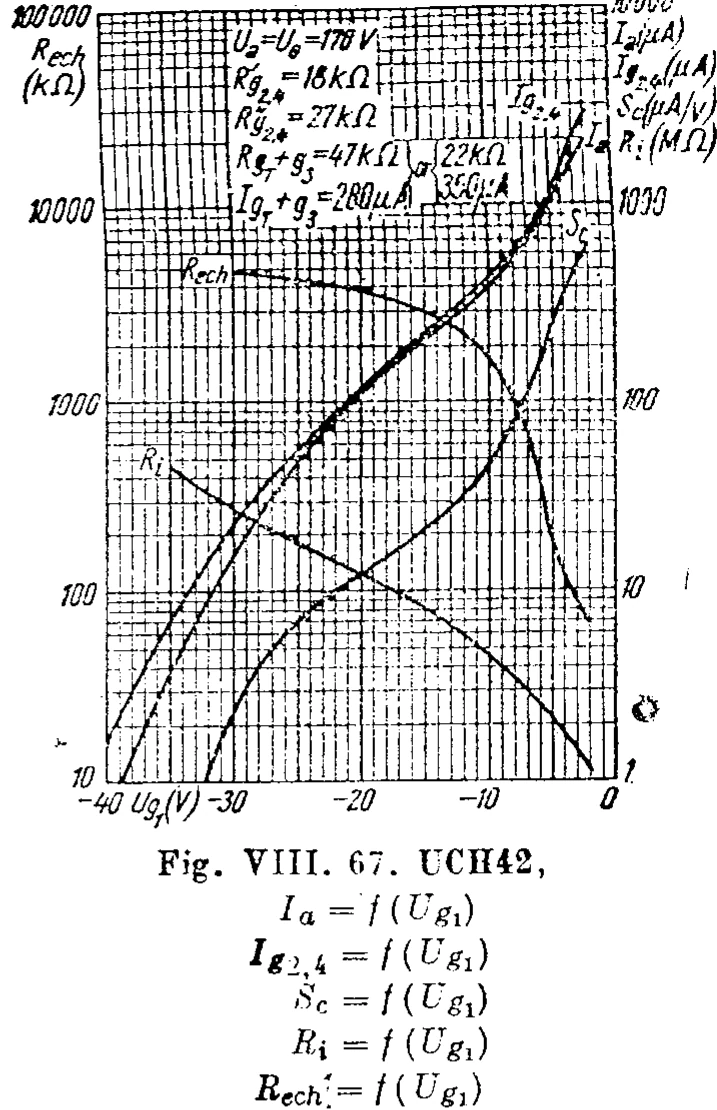
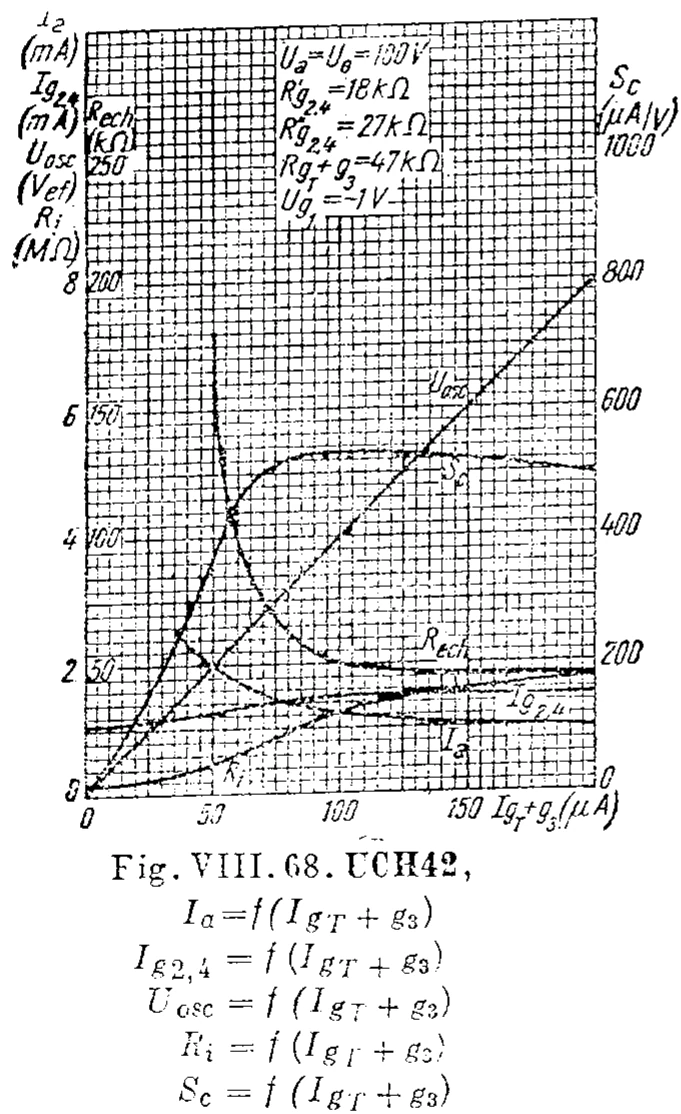
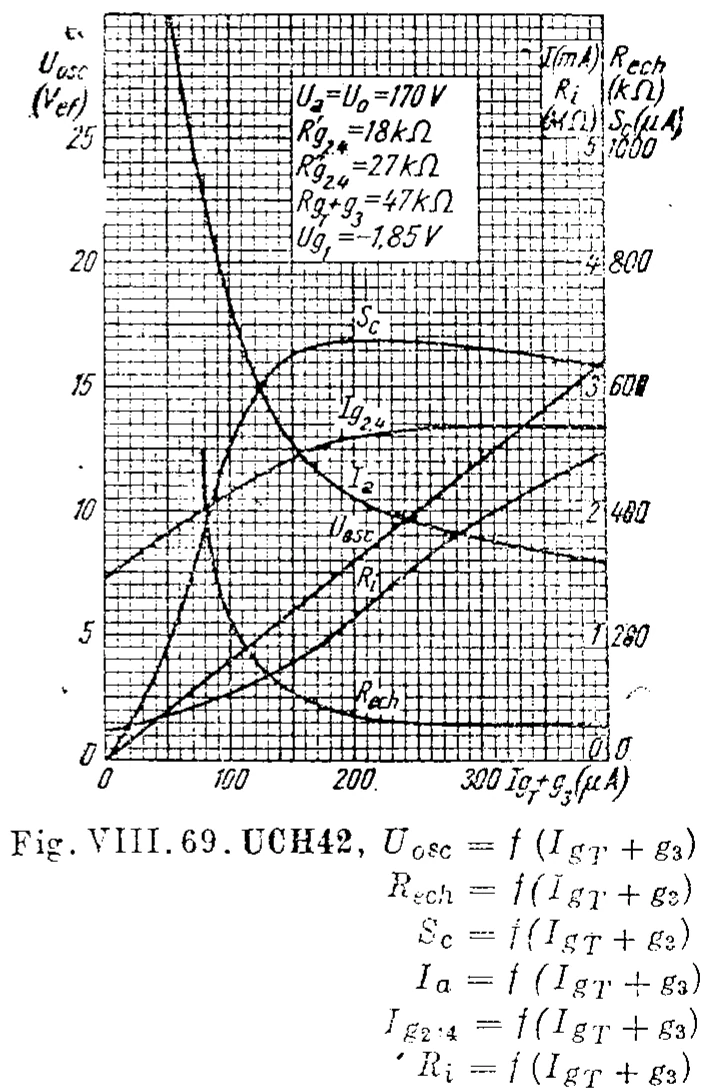
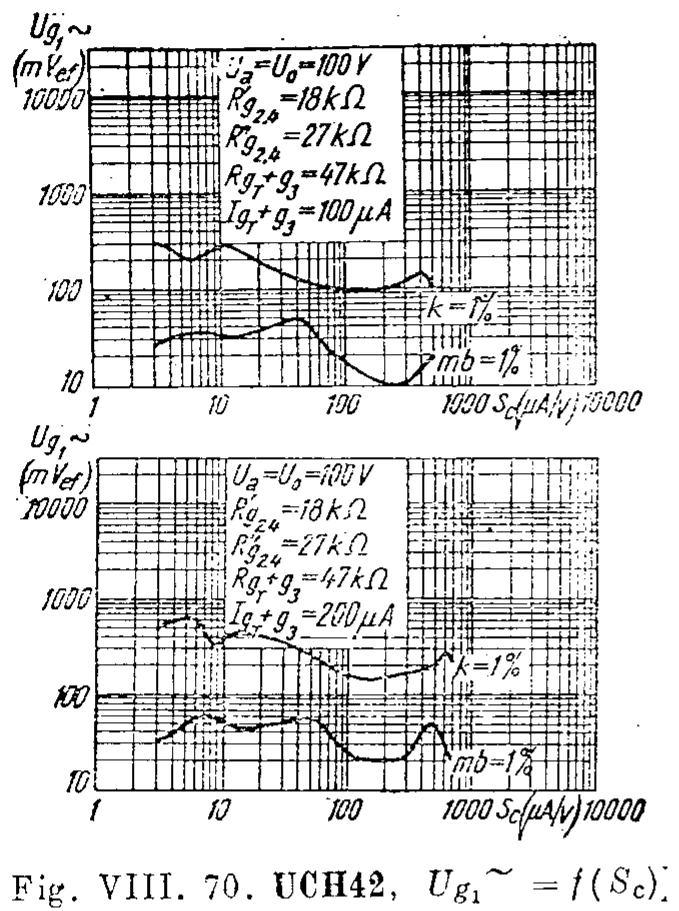
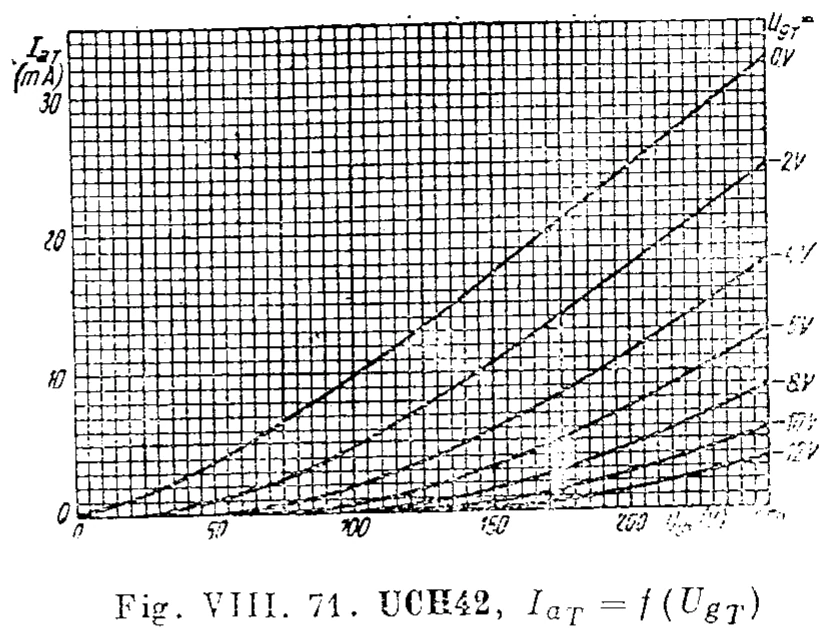
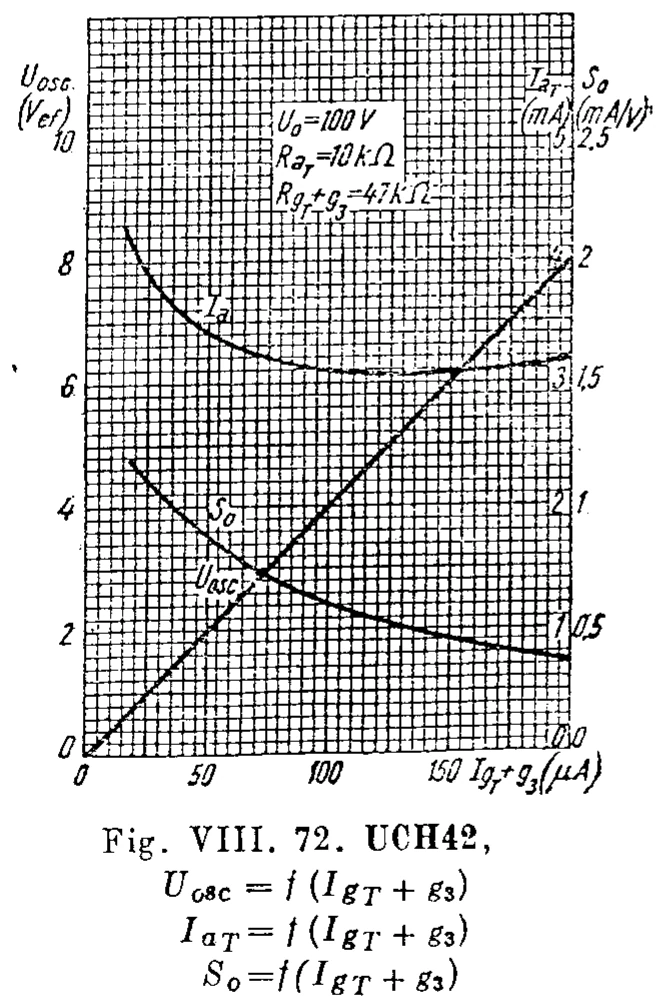
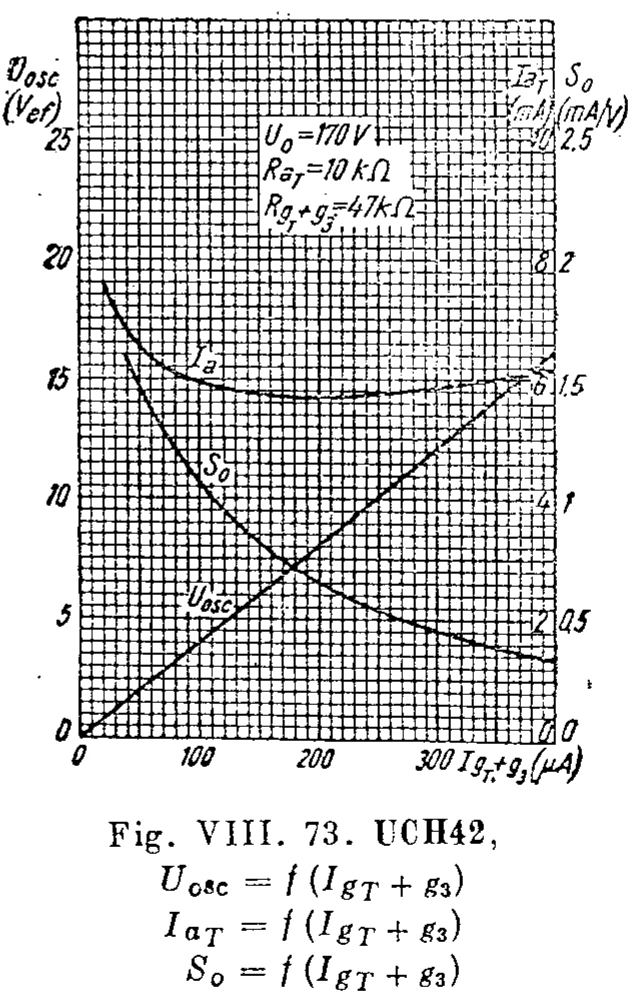
A line without heater data continues the line above it (another operating condition), as printed. Designation in the new European system (catalogue p. 14): U – heater 100 mA; C – triode, H – hexode or heptode; 42 – Rimlock series. Characteristic curves: Fig. VIII.62, UCH42 (anode current vs grid voltage, „Ia = f (Ug1)”); Fig. VIII.63, UCH42 (anode current vs grid voltage, „Ia = f (Ug1)”); Fig. VIII.64, UCH42 (conversion transconductance vs grid voltage, „Sc = f (Ug1)”); Fig. VIII.65, UCH42 (conversion transconductance vs grid voltage, „Sc = f (Ug1)”); Fig. VIII.66, UCH42 (anode current, Ig2,4, conversion transconductance, internal resistance and Rech vs grid voltage, „Ia = f (Ug1); Ig2,4 = f (Ug1); Sc = f (Ug1); Ri = f (Ug1); Rech = f (Ug1)”); Fig. VIII.67, UCH42 (anode current, Ig2,4, conversion transconductance, internal resistance and Rech vs grid voltage, „Ia = f (Ug1); Ig2,4 = f (Ug1); Sc = f (Ug1); Ri = f (Ug1); Rech = f (Ug1)”); Fig. VIII.68, UCH42 (anode current, Ig2,4, oscillator voltage, internal resistance and conversion transconductance vs IgT+g3, „Ia = f (IgT+g3); Ig2,4 = f (IgT+g3); Uosc = f (IgT+g3); Ri = f (IgT+g3); Sc = f (IgT+g3)”); Fig. VIII.69, UCH42 (oscillator voltage, Rech, conversion transconductance, anode current, Ig2,4 and internal resistance vs IgT+g3, „Uosc = f (IgT+g3); Rech = f (IgT+g3); Sc = f (IgT+g3); Ia = f (IgT+g3); Ig2,4 = f (IgT+g3); Ri = f (IgT+g3)”); Fig. VIII.70, UCH42 (AC grid voltage vs conversion transconductance, „Ug1~ = f (Sc)”); Fig. VIII.71, UCH42 (IaT vs UaT, „IaT = f (UaT)”); Fig. VIII.72, UCH42 (oscillator voltage, IaT and So vs IgT+g3, „Uosc = f (IgT+g3); IaT = f (IgT+g3); So = f (IgT+g3)”); Fig. VIII.73, UCH42 (oscillator voltage, IaT and So vs IgT+g3, „Uosc = f (IgT+g3); IaT = f (IgT+g3); So = f (IgT+g3)”). The base connections drawing is in Universal Drawings.
Drawing Gallery
No drawings available yet.
Photo Gallery
No other images available yet.
Universal Drawings (Technical drawings common to all brands and equivalents)
 No image available
 No image available
 No image available
 No image available
 No image available
 No image available
 No image available
 No image available
 No image available
 No image available
 No image available
 No image available
 No image available
Documents
No documents available yet.
Prices
N/A
References
Universal references
- [U1]A. Georgescu, I. Golea – „Catalog de tuburi electronice”, Editura Tehnică, București, 1956, cap. „VIII. Triode-hexode”, p. 318