βM387
IPRS Băneasa
- Manufacturer
- IPRS Băneasa

- Country
- Romania

- Year
- Unknown
- Category
- Components
- Type
- Integrated circuits
- Equivalents
- N/A
- Documentation score
- 2/7
- Last edited
- 16 NOV 2026
Specifications
- Function
- dual low-noise preamplifier
- Package
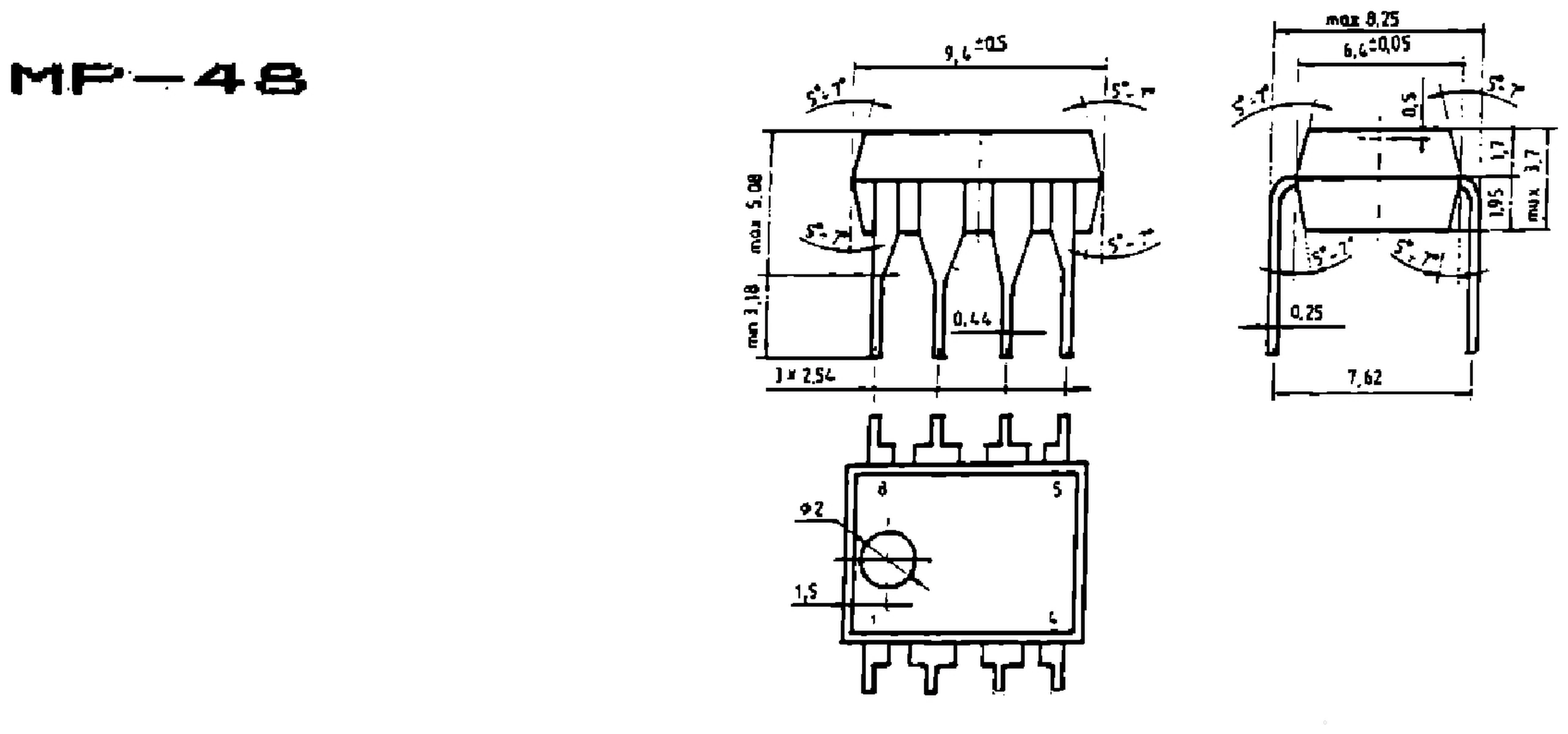
- plastic 8
- Operating temperature range
- −25…+70 °C
- Supply voltage (VS)
- +30 V, +40 V (see Variants)
- Max. internal power dissipation (Pdi)
- 300 mW
- Max. input voltage (VI)
- 0.3 V rms (linear)
- Common-mode rejection ratio (CMRR)
- 110 dB
- Output voltage range (VOR)
- (V+ − 2 V) p-p
- Voltage gain (Avd, G)
- 104 dB
- Bandwidth at −3 dB (B−3dB)
- 15000 kHz (unity gain), 75 kHz (power bandwidth)
- Equivalent input noise voltage (En)
- <1.2 µV rms, <0.9 µV rms (see Variants)
Variants (2)
| Compare | |||
|---|---|---|---|
| βM387N | +30 V | <1.2 µV rms | |
| βM387AN | +40 V | <0.9 µV rms |
Click a column heading to sort. „+” adds a variant to the comparison (βM387).
Description
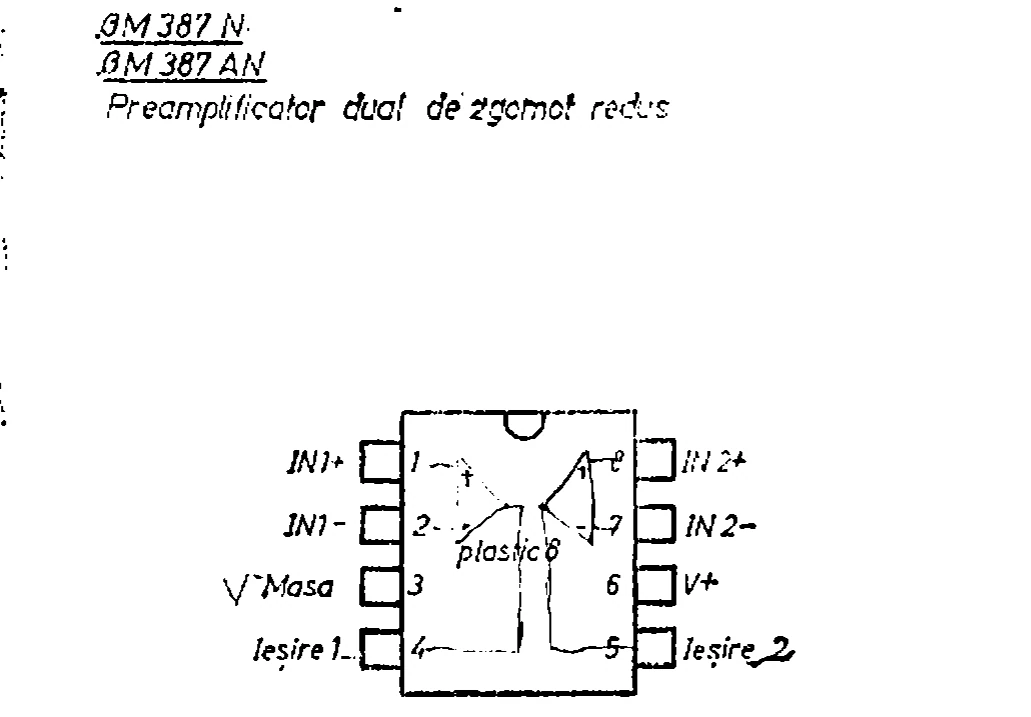
The βM387 is a series of dual low-noise preamplifiers, analog integrated circuits listed in the Agenda radioelectronistului (2nd edition, 1989) among the integrated circuits made in Romania by IPRS Băneasa, in a plastic 8 package [1]. Its codes (βM387N and βM387AN) are in the Variants table; the pinout is in the Gallery.
Coded as (internal IPRS Băneasa code) [2]:
| Part | Meaning |
|---|---|
| β | initial letter of the internal IPRS code for linear integrated circuits |
| M387 | serial number |
| N, AN | letter suffix: variants of the package used |
The Agenda radioelectronistului (2nd edition, 1989) gives the parameters of the βM387N and βM387AN in the table of audio-, low- and video-frequency (AF/JF/VF) amplifiers made in Romania by IPRS Băneasa and CCSIT-CE (section 35.3) [3]: absolute maximum ratings and electrical characteristics over the full temperature range; the values shared by the listed codes are in the specifications and the ones that differ are in the Variants table.
Notes on the table of section 35.3 [3]: The noise column gives the equivalent input noise voltage. The distortion cell is printed „0.5 V” (the column is in %) and is left out.
The I.P.R.S. Băneasa Full Line Condensed Catalog (1990) lists the βM387AN and βM387N as low noise dual preamplifiers: each amplifier is completely independent, with its own internal power supply decoupler-regulator, giving a supply rejection ratio of 110 dB and a channel separation of 60 dB; the amplifiers are internally compensated for voltage gains above 10 [4].
The catalog gives an operating temperature of −25…+70 °C (storage −25…+125 °C), a supply voltage of at most 40 V (βM387AN) and 30 V (βM387N), a typical open loop voltage gain of 160000, a typical supply current of 10 mA, a typical input current (negative input) of 0.5 µA, typical output source and sink currents of 8 mA and 2 mA, a typical unity gain bandwidth of 15 MHz, an input voltage (linear operation) of at most 300 mVrms, a typical channel separation (f = 1 kHz) of 40 dB, a typical supply rejection ratio (f = 1 kHz) of 110 dB and a total equivalent input noise of at most 0.9 µVrms (βM387AN) and 1.2 µVrms (βM387N) [4]. Pins (MP-48, top view): 1 input 1+, 2 input 1−, 3 GND, 4 output 1, 5 output 2, 6 V+, 7 input 2−, 8 input 2+ [4].
Drawing Gallery
 No image available
 No image available
Photo Gallery
No other images available yet.
Documents
No documents available yet.
Prices
N/A
References
- [1]N. Drăgulănescu – „Agenda radioelectronistului”, 2nd edition, Editura Tehnică, 1989, section 35.1 „Circuite integrate analogice – producător: IPRS-Băneasa”, p. 588
- [2]N. Drăgulănescu – „Agenda radioelectronistului”, 2nd edition, Editura Tehnică, 1989, section 34.5 „Coduri românești”, p. 583
- [3]N. Drăgulănescu – „Agenda radioelectronistului”, 2nd edition, Editura Tehnică, 1989, section 35.3 „Parametrii caracteristici ai unor circuite integrate analogice”, table C „Amplificatoare de AF/JF/VF produse în R.S.R.”, p. 622
- [4]I.P.R.S. Băneasa – „Full Line Condensed Catalog”, 1990, section 2 „Linear integrated circuits”, „Radio - TV”, „βM 387AN, βM 387N – Low noise dual preamplifiers”, p. 2-93