526УР1
USSR State Plants
- Also known as
- 526UR1
- Manufacturer
- USSR State Plants
- Country
- Soviet Union

- Year
- Unknown
- Category
- Components
- Type
- Integrated circuits
- Documentation score
- 0/7
- Last edited
- 18 NOV 2026
Specifications
No manufacturer data yet – see the Universal Specifications below ↓
Universal Specifications (Common reference specs for all brands and equivalents)
- Type
- linear integrated circuitFrom: IPRS Băneasa TBA120
- Function
- IF amplifier-demodulator for FM reception (10.7 MHz)From: IPRS Băneasa TBA120
- Package
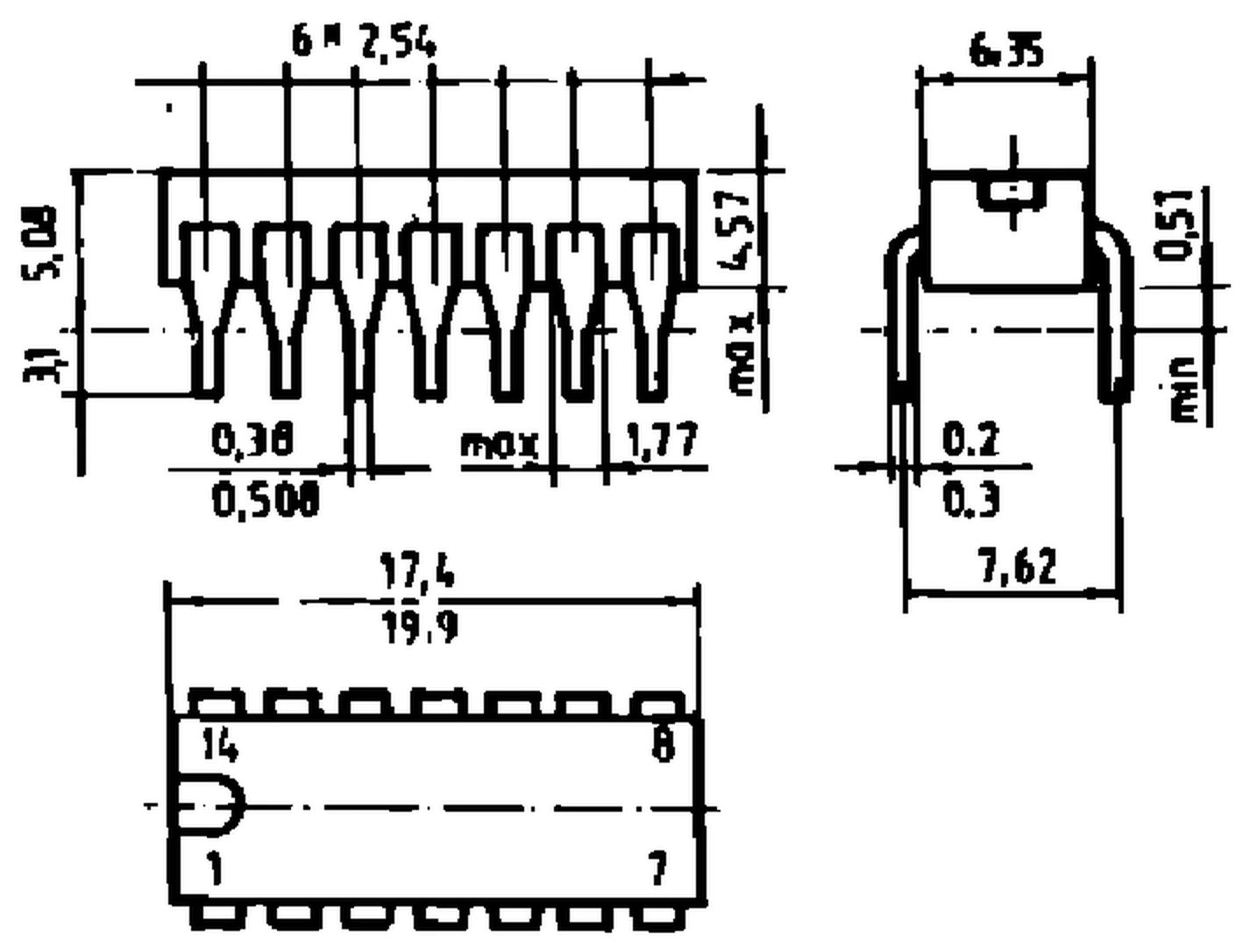
- plastic 14From: IPRS Băneasa TBA120
- Operating temperature range
- −25…+70 °CFrom: IPRS Băneasa TBA120
Description
No description available yet.
Universal Description (Common reference data for all brands and equivalents)
From [U1] TBA120 – Soviet microcircuits and their foreign analogues
The table „Отечественные микросхемы и их зарубежные аналоги” [U1] gives TBA120 as the foreign analogue of the Soviet microcircuits К174УР3,3М (p. 3) and 526УР1 (p. 5). „К174УР3,3М” stands for К174УР3, К174УР3М.
From IPRS Băneasa TBA120
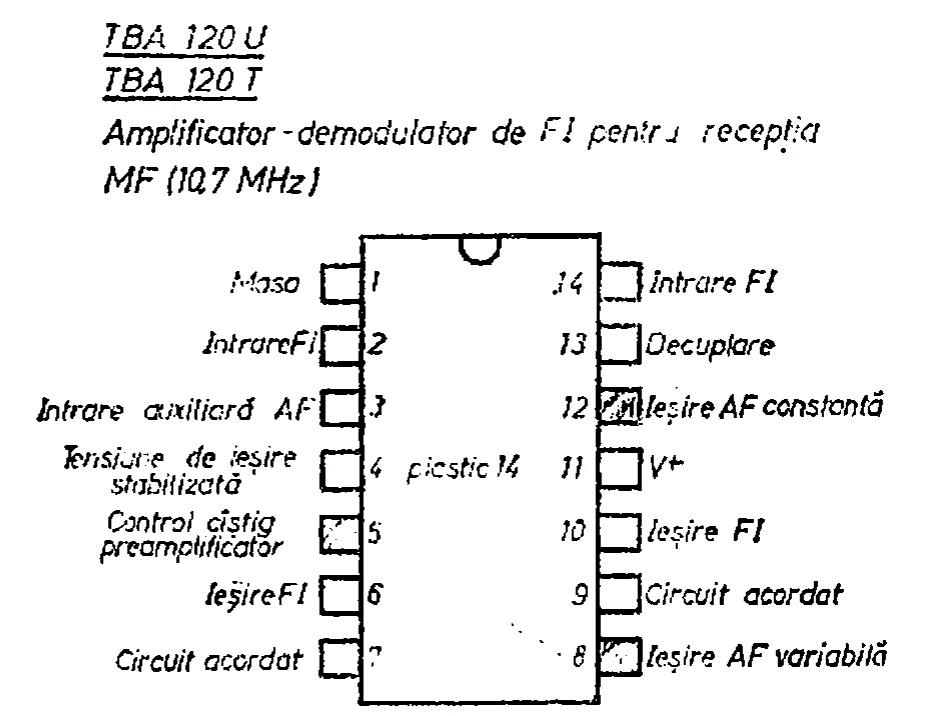
The TBA120 is a series of IF amplifier-demodulators for FM reception (10.7 MHz), analog integrated circuits listed in the Agenda radioelectronistului (2nd edition, 1989) among the integrated circuits made in Romania by IPRS Băneasa, in a plastic 14 package [1]. Its codes (TBA120U and TBA120T) are in the Variants table; the pinout is in the Gallery.
Coded as (Pro Electron system) [2]:
| Part | Meaning |
|---|---|
| T | analog circuit |
| B | serial letter (no meaning, except H = hybrid circuit) |
| A | temperature range not defined |
| 120 | serial number |
| U, T | letters added to the code: a single letter may also mark a constructional variant, without a precise meaning |
The I.P.R.S. Băneasa Full Line Condensed Catalog (1990) lists the TBA120T and TBA120U (printed „TAA 120U” in the heading) as integrated circuits for the sound stage of TV and FM radio receivers, with a limiting IF amplifier, a balanced coincidence FM detector, a voltage reference, an AF preamplifier, a DC operated volume control, a constant level audio output for video recording/playback and an auxiliary AF input for multistandard reception or video playback; the TBA120T uses ceramic filters, while the TBA120U is optimised for inductive tuning [3].
The catalog gives an operating temperature of −25…+70 °C (storage −25…+125 °C), a supply voltage of at most 18 V, a supply current of 9…18 mA, a voltage applied to pin 5 of at most 6 V, a pin 4 current of at most 5 mA, an operating frequency range of 0…12 MHz, a regulator voltage (i4 < 5 mA) of 4…6 V, a volume control range of at least 70 dB, a sensitivity (−3 dB) of at most 60 µV eff. and an AM rejection of at least 50 dB [3]. Pins (TO-116, top view): 1 GND, 2 bias decoupling, 3 recorder audio input, 4 volume control bias, 5 volume control, 6 IF amplifier output, 7 phase shift network, 8 volume controlled audio output, 9 phase shift network, 10 IF amplifier output, 11 V+, 12 constant level audio output, 13 IF input bias, 14 IF input [3].
Drawing Gallery
No drawings available yet.
Photo Gallery
No other images available yet.
Universal Drawings (Technical drawings common to all brands and equivalents)
From IPRS Băneasa TBA120
 No image available
 No image available
Documents
No documents available yet.
Prices
N/A
References
Universal references
- [U1]„Отечественные микросхемы и их зарубежные аналоги” (Soviet microcircuits and their foreign analogues; table after B. L. Perelman, V. V. Shevelev – „Отечественные микросхемы и зарубежные аналоги”, НТЦ Микротех, 1998), pp. 3, 5
From IPRS Băneasa TBA120
- [1]N. Drăgulănescu – „Agenda radioelectronistului”, 2nd edition, Editura Tehnică, 1989, section 35.1 „Circuite integrate analogice – producător: IPRS-Băneasa”, p. 592
- [2]N. Drăgulănescu – „Agenda radioelectronistului”, 2nd edition, Editura Tehnică, 1989, section 34.1 „Codul european PRO-ELECTRON”, p. 573
- [3]I.P.R.S. Băneasa – „Full Line Condensed Catalog”, 1990, section 2 „Linear integrated circuits”, „Radio - TV”, „TBA 120T, TAA 120U – IF amplifier and FM detector”, p. 2-71