A 65-13W/2
Fabrica de Cinescoape
- Also known as
- A 65-13 W 2
- Manufacturer
- Fabrica de Cinescoape
- Country
- Romania

- Year
- Unknown
- Category
- Components
- Type
- Picture tubes (CRT)
- Documentation score
- 1/5
- Last edited
- 08 OCT 2026
Specifications
- Type
- black-and-white, SELBOND 2 implosion protection
- Screen diagonal
- 650 mm
- Electron gun
- electrostatic focusing
- Heater
- 6.3 V ± 10% at 50 Hz, 0.3 A
- Operating voltages
- g2: 400 or 500 V; g3, g5 and a: 20 kV; g4: 0…400 V; cut-off: g1 −40…−77 V or −50…−93 V (grid drive), cathode 36…66 V or 45…79 V (cathode drive)
Description
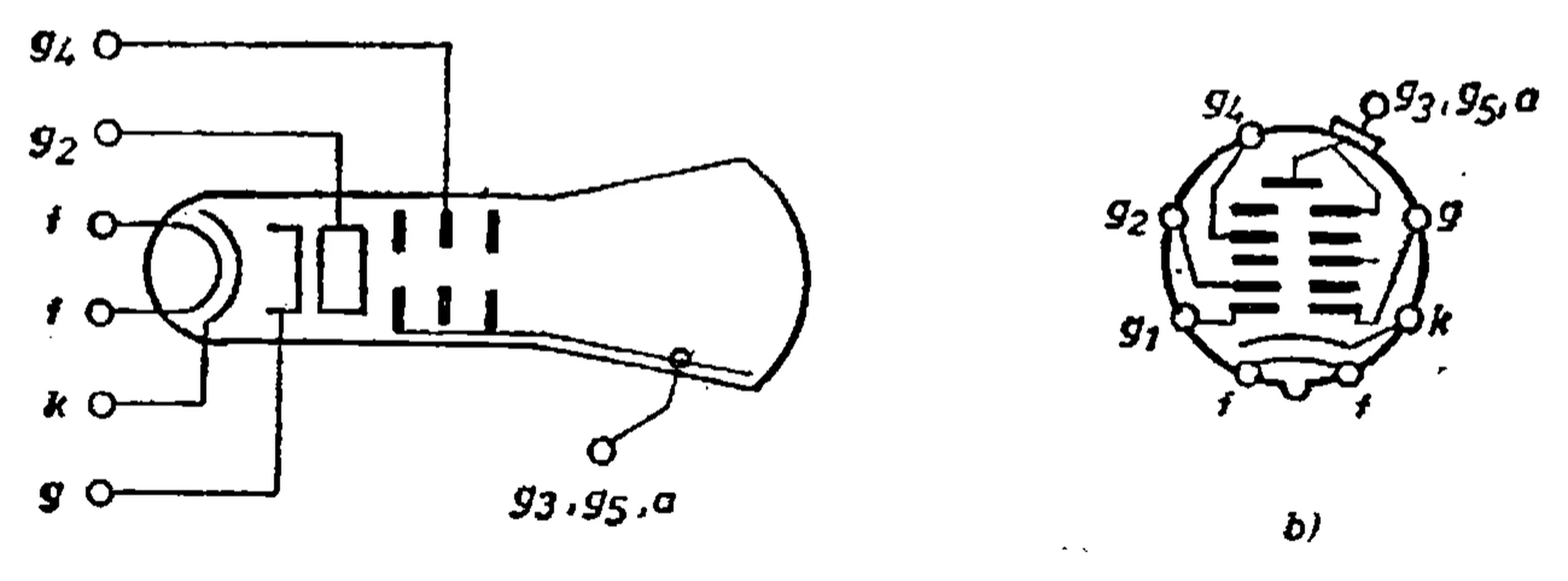
The A 65-13W/2 is a black-and-white television picture tube with a 65 cm screen diagonal, made in Romania by the Fabrica de Cinescoape in Bucharest: the Agenda radioelectronistului (2nd edition, 1989) uses it as the example when explaining the type code of the black-and-white picture tubes made by Întreprinderea de Cinescoape – București [1]. The electrode symbols and the base (fig. 39.1 of the book) are in the Gallery.
Chapter 39 of the book gives the code and the common characteristics of these tubes, without a list of types. Its code table lists screen diagonals of 65, 61, 59, 51, 47, 44 and 31 cm, electrostatic focusing (A), a white screen (W) and SELBOND 2 implosion protection (2), and leaves the column of the production type empty; the example is printed „A 65 – 13 W 2” [1] (in the 1st edition, 1983: „A 65 – 13 W/2” [3]).
Coded as (code of the picture tubes of Întreprinderea de Cinescoape) [1]:
| Part | Meaning |
|---|---|
| A | focusing type: electrostatic |
| 65 | screen diagonal (cm) |
| 13 | production type |
| W | screen fluorescence colour: white |
| 2 | implosion protection: SELBOND 2 |
In the European system for cathode-ray and picture tubes of section 38.5, the same code reads [2]:
| Part | Meaning |
|---|---|
| A | use / construction: picture tube for consumer television sets |
| 65 | screen size in cm: the diagonal (rectangular screen) or the diameter (circular screen) |
| 13 | serial number (1…999) |
| W | screen fluorescence colour: standard white (for picture tubes) |
| /2 | other screen characteristics (e.g. persistence), according to the manufacturer’s code |
The two tables of the book thus read the code differently: the first letter is electrostatic focusing in chapter 39 and a picture tube for consumer television sets in section 38.5, and the final 2 is SELBOND 2 implosion protection in chapter 39, while section 38.5 keeps that place for other screen characteristics (such as persistence), according to the manufacturer’s code [1][2].
The chapter gives these characteristics: heater voltage Uf = 6.3 V ± 10% at 50 Hz (If = 0.3 A); cathode zero current Iko ≥ 700 µA; heater warm-up time 10…20 s; leakage currents Ig2 ≤ ±5 µA and Ig4 ≤ ±25 µA; colour temperature about 12 000 K; power dissipated on the screen at most 10 mW/cm²; and the picture tube does not need an ion trap [1]. Its applications are television sets and TV monitors [1].
Nominal operating conditions, with grid drive (voltages measured relative to the cathode) or cathode drive (voltages measured relative to the control grid) [1]:
| Grid drive, Ug1b (cut-off) −40…−77 V | Grid drive, Ug1b (cut-off) −50…−93 V | Cathode drive, Ukb (cut-off) 36…66 V | Cathode drive, Ukb (cut-off) 45…79 V | |
|---|---|---|---|---|
| Ug2 | 400 V | 500 V | 400 V | 500 V |
| Ug3, g5, a | 20 kV | 20 kV | 20 kV | 20 kV |
| Ug4 | 0…400 V | 0…400 V | 0…400 V | 0…400 V |
The 2nd edition prints the labels of the last two rows as „U g3, g45, a” and „U g” (misprints); they are taken from the 1st edition of the Agenda (1983), which prints Ug3, g5, a and Ug4 [3].
Gallery
 No image available
Documents
No documents available yet.
Used in (3)
References
- [1]N. Drăgulănescu – „Agenda radioelectronistului”, 2nd edition, Editura Tehnică, 1989, chapter 39 „Tuburi cinescop [pentru televiziune alb-negru] produse în R.S.R. (producător: Întreprinderea de Cinescoape—București)”, pp. 676–677
- [2]N. Drăgulănescu – „Agenda radioelectronistului”, 2nd edition, Editura Tehnică, 1989, section 38.5 „Sistemul european pentru tuburi catodice și tuburi cinescop”, p. 675
- [3]N. Drăgulănescu – „Agenda radioelectronistului”, 1st edition, Editura Tehnică, 1983, section 3.11.2 „Tuburi cinescop pentru televiziune alb-negru (producător: Întreprinderea de Cinescoape – București)”, pp. 537–538