 No image available
History
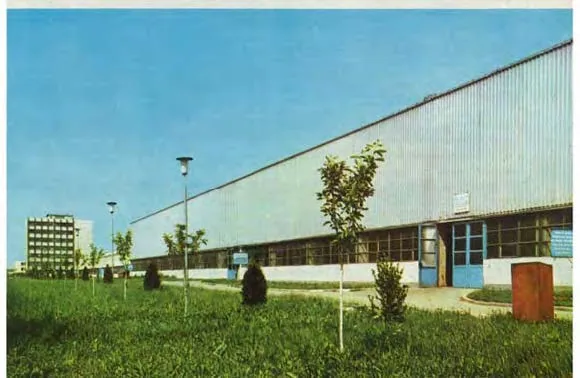
The Fabrica de Cinescoape (Picture Tube Factory) produced black-and-white and colour television picture tubes (cathode-ray tubes) for the Romanian television industry. It was established in 1970 and started production in 1971 on the basis of Western licences [1].
1969–1990
In 1969 Romania decided to build an integrated black-and-white picture tube factory, with its own glass works, electron gun line, tube assembly and utilities (CO2, oxygen and hydrogen plants) [3]. The enterprise was set up by decree on 1 April 1970 at 9–9A Dimitrie Pompei Boulevard, on the future Pipera industrial platform, by absorbing Electrofar, a Bucharest maker of fluorescent, mercury-vapour and sodium-vapour lamps, ballasts and starters [3]. It bought licences for the glass (Corning, USA), the electron gun and tube assembly (Standard Elektrik Lorenz, West Germany), the CO2 plant (Italy) and the oxygen plant (France) [3].
The first tubes were the 47, 59 and 65 cm types with a curved screen and a 28 mm neck (T 47-11A, T 59-11A, T 65-11A); 51 and 61 cm types followed, and then tubes with a thin 20 mm neck and a flat screen, with a shorter cone and lower power consumption [3]. The 31 cm tube for Electronica’s Sport portable TV was developed in-house, which took longer and cost more than the licence SEL had offered; a Turkish firm in Istanbul bought that licence in 1978–1979, and the Bucharest specialists commissioned its plant and trained its staff [3]. Capacity grew from 500,000 to 600,000 and then 750,000 tubes a year [3].
Firsts for Romania included electron gun assembly in a clean room and a continuously fired lead-glass furnace (28% lead, 200 tonnes a day from an 80 m² hearth), later run by the SDC 2050 distributed process control system; the furnace survived the 1977 earthquake with minor damage [3]. The tubes had “Selbond” implosion protection, and the factory also developed penetration CRTs for the army, long-persistence CRTs for electrocardioscopes, and a centre for magnetrons and plasma displays [3]. All Romanian black-and-white TV sets made after the factory opened used its tubes: about 7.9 million sets in 1974–1989, so total output to 1989 was about 10 million tubes [3]. Exports were 110,000 tubes in 1975, a peak of 266,100 in 1978, 234,800 in 1985 and 26,600 in 1989 [3].
Production stopped after 1990, when no hard currency was allotted for the small imports it needed, although China was asking for a million tubes a year for 20 years [3]. The enterprise became S.C. ROCIN SA, from which Electrofar split off (later Luxten) [3].
The site after 1989
Its buildings largely survived: around 2011 the administrative building and the production halls housed company offices and logistics centres [4].
In 1989
In 1989 the enterprise was listed as Întreprinderea de Cinescoape (ICIN), within the Industrial Central for Electronics and Computer Technology (CIETC) of the Ministry of the Electrotechnical Industry. Its entry shows two logos, the CR logo and a second one with a letter E (see the gallery below), and lists separate directors for the Pipera site and for Electrofar [2].
Gallery
 No image available
 No image available
Devices in the archive (3)
References
- [1]D. F. Lăzăroiu, N. Millea et al. – „Electronica românească. O istorie trăită”, vol. I, AGIR, chapter I „Industria electronică românească”
- [2]N. Drăgulănescu – „Agenda radioelectronistului”, 2nd edition, 1989, chapter 52 „Unități de cercetare, proiectare, producție și service – în industria electronică – din cadrul M.I.Et.”, pp. 742–749
- [3]D. F. Lăzăroiu, N. Millea et al. – „Electronica românească. O istorie trăită”, vol. I, AGIR, section III.3 „Întreprinderea de Cinescoape – București”, pp. 324–328
- [4]N. Millea (coord.) et al. – „Electronica românească. O istorie trăită”, vol. II „Electronica profesională”, AGIR, section VI.5 „Foto-raid pe platforma Pipera”, pp. 541–553