RBA 3000
IPEE Curtea de Argeș
- Also known as
- RBA 3000-L; RBA; RBA-L
- Manufacturer
- IPEE Curtea de Argeș

- Country
- Romania

- Year
- Unknown
- Category
- Components
- Type
- Resistors
- Documentation score
- 1/5
- Last edited
- 16 OCT 2026
Specifications
- Type
- wire-wound, ceramic body
- Standard
- STAS 9288-77
- Resistance (Rn)
- 0.1 Ω…68 kΩ
- Resistance, min
- 0.1 Ω
- Resistance, max
- 68000 Ω
- Tolerance
- ±5/10 %
- Value series
- E12, E24
- Rated power (Pn)
- 2–20 W (see Variants)
- Temperature coefficient
- ±200·10⁻⁶/°C (Rn ≥ 30 Ω), ±500·10⁻⁶/°C (Rn < 30 Ω)
- Insulation resistance (Riz)
- ≥ 100 MΩ
- Dielectric strength
- 1500 V DC / 60 s
- Climatic category
- 40/200/21
- Package
- square ceramic body, axial leads
- Max. length (Lmax)
- 21–82 mm (see Variants)
- Width (a)
- 6–9 mm (see Variants)
- Lead diameter (d)
- 0.8 mm
- Application
- general use, professional circuits (see Variants)
Variants (16)
| Note | Compare | ||||||||
|---|---|---|---|---|---|---|---|---|---|
| RBA 3002 | 0.1 Ω…8.2 kΩ | 0.1 | 8200 | 2 | 21 | 6 | general use | ||
| RBA 3002-L | 0.1 Ω…8.2 kΩ | 0.1 | 8200 | 2 | 21 | 6 | professional circuits | ||
| RBA 3004 | 0.1 Ω…12 kΩ | 0.1 | 12000 | 4 | 24 | 9 | general use | ||
| RBA 3004-L | 0.1 Ω…12 kΩ | 0.1 | 12000 | 4 | 24 | 9 | professional circuits | ||
| RBA 3006 | 0.1 Ω…20 kΩ | 0.1 | 20000 | 6 | 32 | 9 | general use | ||
| RBA 3006-L | 0.1 Ω…20 kΩ | 0.1 | 20000 | 6 | 32 | 9 | professional circuits | ||
| RBA 3008 | 0.1 Ω…27 kΩ | 0.1 | 27000 | 8 | 39 | 9 | general use | ||
| RBA 3008-L | 0.1 Ω…27 kΩ | 0.1 | 27000 | 8 | 39 | 9 | professional circuits | ||
| RBA 3010 | 1 Ω…39 kΩ | 1 | 39000 | 10 | 51 | 9 | general use | ||
| RBA 3010-L | 1 Ω…39 kΩ | 1 | 39000 | 10 | 51 | 9 | professional circuits | ||
| RBA 3012 | 1 Ω…39 kΩ | 1 | 39000 | 12 | 57 | 9 | general use | ||
| RBA 3012-L | 1 Ω…39 kΩ | 1 | 39000 | 12 | 57 | 9 | professional circuits | ||
| RBA 3016 | 1 Ω…68 kΩ | 1 | 68000 | 16 | 78 | 9 | general use | code damaged in the 2nd edition, read with the 1st | |
| RBA 3016-L | 1 Ω…68 kΩ | 1 | 68000 | 16 | 78 | 9 | professional circuits | code damaged in the 2nd edition, read with the 1st | |
| RBA 3020 | 1 Ω…68 kΩ | 1 | 68000 | 20 | 82 | 9 | general use | code damaged in the 2nd edition, read with the 1st | |
| RBA 3020-L | 1 Ω…68 kΩ | 1 | 68000 | 20 | 82 | 9 | professional circuits | code damaged in the 2nd edition, read with the 1st |
Click a column heading to sort. „+” adds a variant to the comparison (RBA 3000).
Description
The RBA 3000 and RBA 3000-L are wire-wound resistors in a square ceramic body with axial leads, made to STAS 9288-77, RBA 3000 for general use and RBA 3000-L for professional circuits [1]. The Agenda radioelectronistului (2nd edition, 1989) lists eight sizes, RBA 3002 to RBA 3020, each printed for both series („RBA 3002(-L)”), from 2 to 20 W and from 0.1 Ω to 68 kΩ [1].
The Agenda radioelectronistului names IPEE Electro-Argeș of Curtea de Argeș as the producer of all the resistors in its section on resistors made in Romania, in both editions [3][4]. Un secol de electronică în România says that the works, founded in 1972 as ICEP, took over the resistor lines that IPRS Băneasa made under a Thomson-CSF licence: the carbon resistors in 1973 and the wire-wound resistors in 1974 [5].
Coded as [3]:
| Part | Meaning |
|---|---|
| RBA | construction type: wire-wound resistor in a ceramic body („rezistor bobinat în corp ceramic”) |
| 3 | package type („tipul capsulei”, 1…6) |
| 002…020 | rated power: 2…20 W |
| -L | constructive variant: high reliability („cu fiabilitate ridicată”) |
Romanian resistors are generally marked in clear, with the series code, the nominal value (100 = 100 Ω, 1 K = 1 kΩ, 1 M = 1 MΩ), the tolerance and the rated power [3].
The 1st edition (1983) calls the series RBA and RBA-L and has the same table; the codes RBA 3016 and RBA 3020, damaged in the 2nd edition, are read from it [2][1].
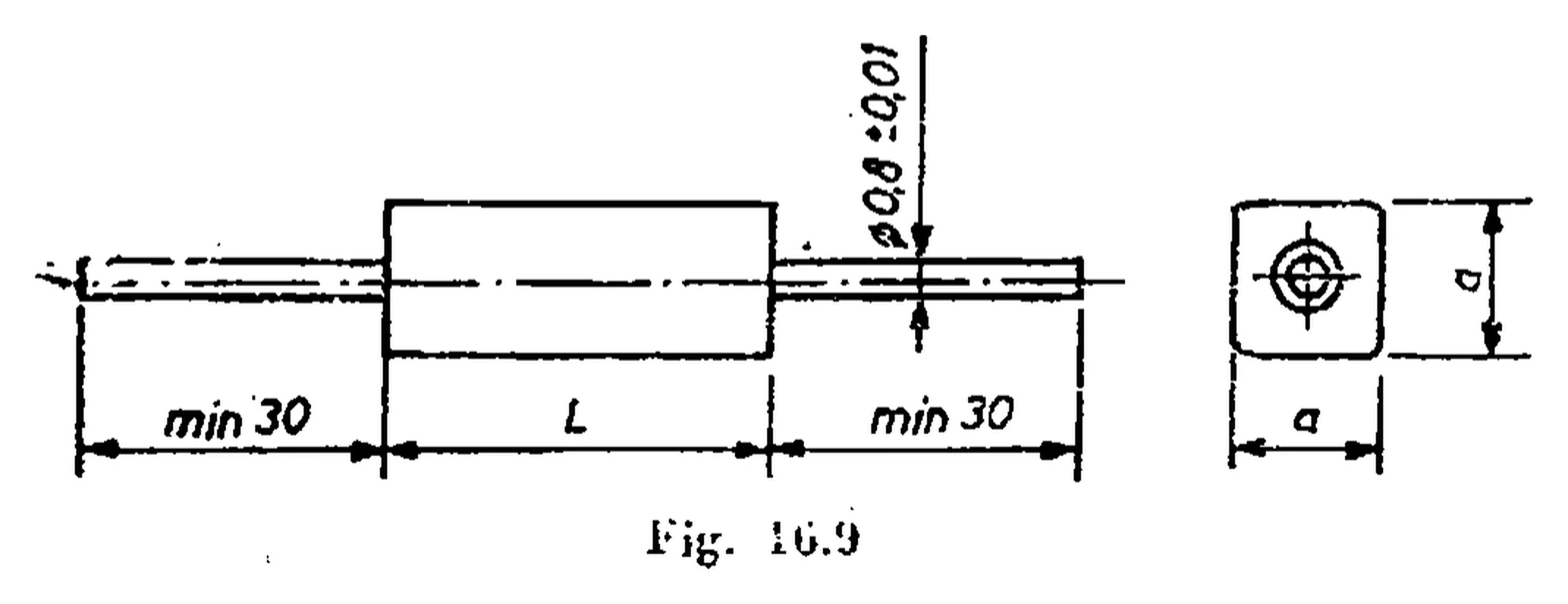
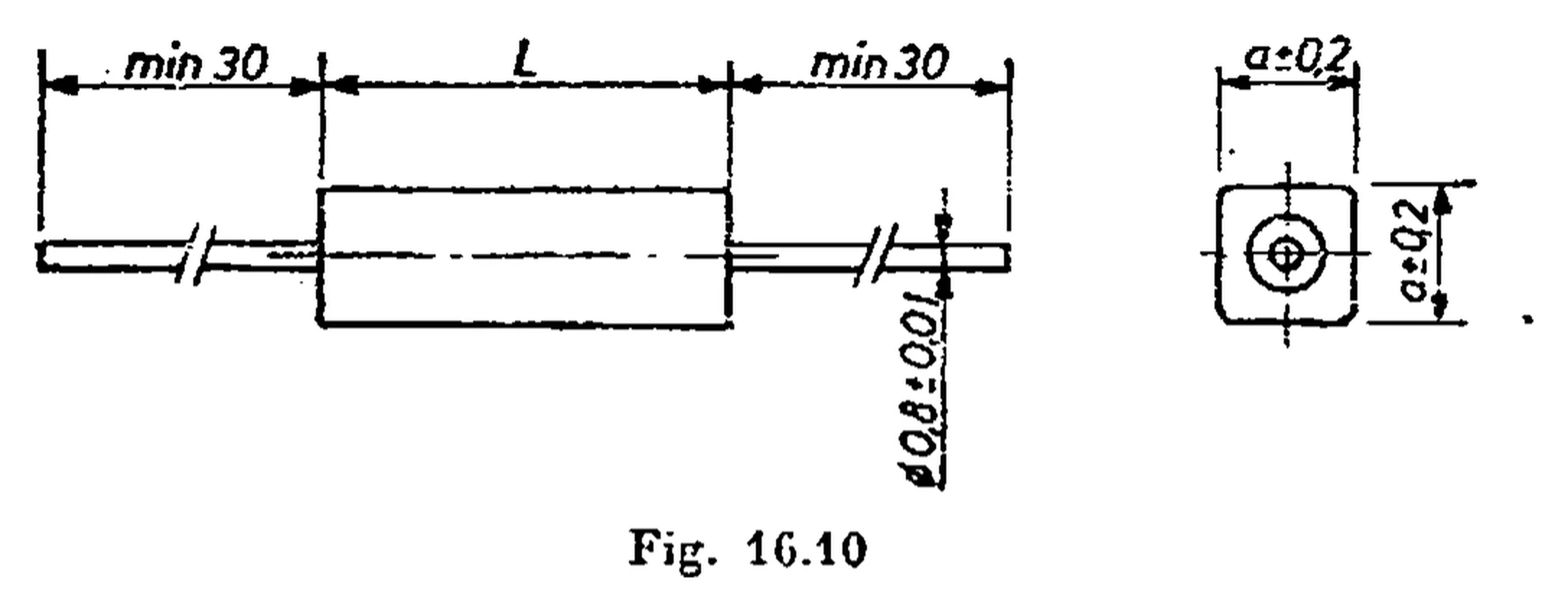
Dimensions in mm (fig. 16.9, 16.10): maximum length Lmax and side a (± 0.2) from the table; leads Ø 0.8 ± 0.01, at least 30 long [1].
Gallery
 No image available
 No image available
Documents
No documents available yet.
References
- [1]N. Drăgulănescu – „Agenda radioelectronistului”, 2nd edition, Editura Tehnică, 1989, section 16.3.9 „Rezistoare bobinate în corp ceramic, seriile RBA 3000 și RBA 3000-L”, pp. 188–189
- [2]N. Drăgulănescu – „Agenda radioelectronistului”, 1st edition, Editura Tehnică, 1983, section 3.1.3.9 „Rezistoare bobinate în corp ceramic, seriile RBA și RBA-L”, pp. 157–158
- [3]N. Drăgulănescu – „Agenda radioelectronistului”, 2nd edition, Editura Tehnică, 1989, section 16.3 „Rezistoare produse în R.S.R.”, 16.3.1 „Codificare – marcare”, p. 184
- [4]N. Drăgulănescu – „Agenda radioelectronistului”, 1st edition, Editura Tehnică, 1983, section 3.1.3 „Rezistoare produse în R.S.R.”, 3.1.3.1 „Codificare – marcare”, p. 153
- [5]N. Millea, I. Constantinescu (coord.) – „Un secol de electronică în România”, Editura Academiei Române, 2020, sections VIII.1.2.6 and VIII.2, pp. 410 and 434–435