RBC 1000
IPEE Curtea de Argeș
- Manufacturer
- IPEE Curtea de Argeș

- Country
- Romania

- Year
- Unknown
- Category
- Components
- Type
- Resistors
- Documentation score
- 1/5
- Last edited
- 16 OCT 2026
Specifications
- Type
- wire-wound, cemented
- Standard
- STAS 9288-77
- Resistance (Rn)
- 0.1 Ω…39 kΩ
- Resistance, min
- 0.1 Ω
- Resistance, max
- 39000 Ω
- Tolerance
- ±5/10 %
- Value series
- E12, E24
- Rated power (Pn)
- 0.5–9 W (see Variants)
- Temperature coefficient
- ±200·10⁻⁶/°C (Rn ≥ 30 Ω), ±500·10⁻⁶/°C (Rn < 30 Ω)
- Insulation resistance (Riz)
- ≥ 100 MΩ
- Dielectric strength
- 1500 V DC / 60 s
- Climatic category
- 40/125/21
- Package
- cylindrical, axial leads
- Max. diameter (Dmax)
- 5–7.5 mm (see Variants)
- Max. length (Lmax)
- 18–51 mm (see Variants)
- Min. lead length (lmin)
- 30–100 mm (see Variants)
- Lead diameter (d)
- 0.8 mm
- Application
- general use
Variants (8)
| Note | Compare | |||||||
|---|---|---|---|---|---|---|---|---|
| RBC 10005 | 0.1 Ω…4.7 kΩ | 4700 | 0.5 | 5 | — | 30 | 2nd edition only; Lmax printed unclear („1?”, 11 or 14) | |
| RBC 1001 | 0.1 Ω…8.2 kΩ | 8200 | 1 | 5 | 18 | 30 | ||
| RBC 1002 | 0.1 Ω…13 kΩ | 13000 | 2 | 5 | 25 | 30 | ||
| RBC 1003 | 0.1 Ω…13 kΩ | 13000 | 3 | 7.5 | 25.5 | 30 | ||
| RBC 1005 | 0.1 Ω…20 kΩ | 20000 | 5 | 7.5 | 32 | 30 | ||
| RBC 1007 | 0.1 Ω…27 kΩ | 27000 | 7 | 7.5 | 38 | 30 | ||
| RBC 1009 | 0.1 Ω…39 kΩ | 39000 | 9 | 7.5 | 51 | 30 | ||
| RBC 1009 (L) | 0.1 Ω…39 kΩ | 39000 | 9 | 7.5 | 51 | 100 |
Click a column heading to sort. „+” adds a variant to the comparison (RBC 1000).
Description
The RBC 1000 is a series of cemented wire-wound resistors with axial leads, made to STAS 9288-77 for general use [1]. The Agenda radioelectronistului (2nd edition, 1989) lists eight codes, RBC 10005 to RBC 1009 (L), from 0.5 to 9 W and from 0.1 Ω to 39 kΩ, in the E12 and E24 series [1].
The Agenda radioelectronistului names IPEE Electro-Argeș of Curtea de Argeș as the producer of all the resistors in its section on resistors made in Romania, in both editions [3][4]. Un secol de electronică în România says that the works, founded in 1972 as ICEP, took over the resistor lines that IPRS Băneasa made under a Thomson-CSF licence: the carbon resistors in 1973 and the wire-wound resistors in 1974 [5].
Coded as [3]:
| Part | Meaning |
|---|---|
| RBC | construction type: cemented wire-wound resistor („rezistor bobinat cimentat”) |
| 1 | package type („tipul capsulei”, 1…6) |
| 001…009 | rated power: 1…9 W (wire-wound power resistors: 001 = 1 W, 002 = 2 W…) |
| L | constructive variant: high reliability („cu fiabilitate ridicată”) |
The code RBC 10005 (0.5 W) has one digit more than the others, and RBC 1009 (L) differs from RBC 1009 in the table only by its leads, at least 100 mm long [1]. Romanian resistors are generally marked in clear, with the series code, the nominal value (100 = 100 Ω, 1 K = 1 kΩ, 1 M = 1 MΩ), the tolerance and, for wire-wound power resistors, the rated power [3].
The 1st edition (1983) has no RBC 10005 and does not name the series RBC 1000; the other rows are the same [2]. In the 2nd edition the maximum length of RBC 10005 is unclear („1?”) [1].
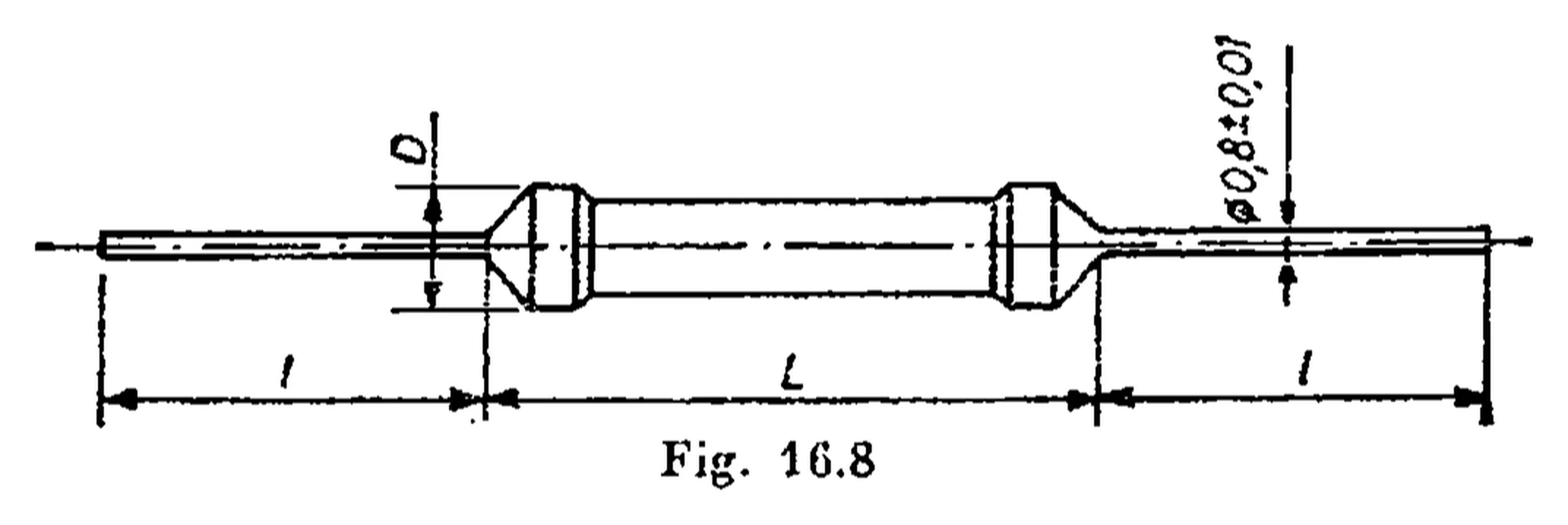
Dimensions in mm (fig. 16.8): maximum length Lmax, minimum lead length lmin and maximum diameter Dmax from the table; leads Ø 0.8 ± 0.01 [1].
Gallery
 No image available
Documents
No documents available yet.
References
- [1]N. Drăgulănescu – „Agenda radioelectronistului”, 2nd edition, Editura Tehnică, 1989, section 16.3.8 „Rezistoare bobinate cimentate, seria RBC 1000”, p. 188
- [2]N. Drăgulănescu – „Agenda radioelectronistului”, 1st edition, Editura Tehnică, 1983, section 3.1.3.8 „Rezistoare bobinate cimentate”, p. 157
- [3]N. Drăgulănescu – „Agenda radioelectronistului”, 2nd edition, Editura Tehnică, 1989, section 16.3 „Rezistoare produse în R.S.R.”, 16.3.1 „Codificare – marcare”, p. 184
- [4]N. Drăgulănescu – „Agenda radioelectronistului”, 1st edition, Editura Tehnică, 1983, section 3.1.3 „Rezistoare produse în R.S.R.”, 3.1.3.1 „Codificare – marcare”, p. 153
- [5]N. Millea, I. Constantinescu (coord.) – „Un secol de electronică în România”, Editura Academiei Române, 2020, sections VIII.1.2.6 and VIII.2, pp. 410 and 434–435