RR 3300
IPEE Curtea de Argeș
- Manufacturer
- IPEE Curtea de Argeș

- Country
- Romania

- Year
- Unknown
- Category
- Components
- Type
- Resistors
- Documentation score
- 1/5
- Last edited
- 16 OCT 2026
Specifications
- Type
- resistor network
- Tolerance
- ±5, ±1, ±0.5, ±0.25 %
- Rated power (Pn)
- 0.5 W
- Temperature coefficient
- ±50, ±100, ±250 ·10⁻⁶/°C
- Package
- flat, single-in-line pins (2.54 mm pitch)
- Lead diameter (d)
- 0.64 mm
- Lead spacing (d)
- 2.54 mm
- Application
- professional electronic circuits
Description
The RR 3300 is a series of resistor networks made to order in 20 configurations, with up to 20 precision, high-stability resistors in one flat package with pins at a 2.54 mm pitch, for professional electronic circuits [1]. The resistors have tolerances of ±0.25 to ±5 % and a maximum dissipated power of 0.125, 0.25 or 0.5 W [1].
The Agenda radioelectronistului names IPEE Electro-Argeș of Curtea de Argeș as the producer of all the resistors in its section on resistors made in Romania, in both editions [3][4]. Un secol de electronică în România says that the works, founded in 1972 as ICEP, took over the resistor lines that IPRS Băneasa made under a Thomson-CSF licence: the carbon resistors in 1973 and the wire-wound resistors in 1974 [5].
The letters RR are not in the book’s code list [3]. Romanian resistors are generally marked in clear, with the series code, the nominal value (100 = 100 Ω, 1 K = 1 kΩ, 1 M = 1 MΩ), the tolerance [3].
The 1st edition (1983) gives the same data, without the series name RR 3300 [2].
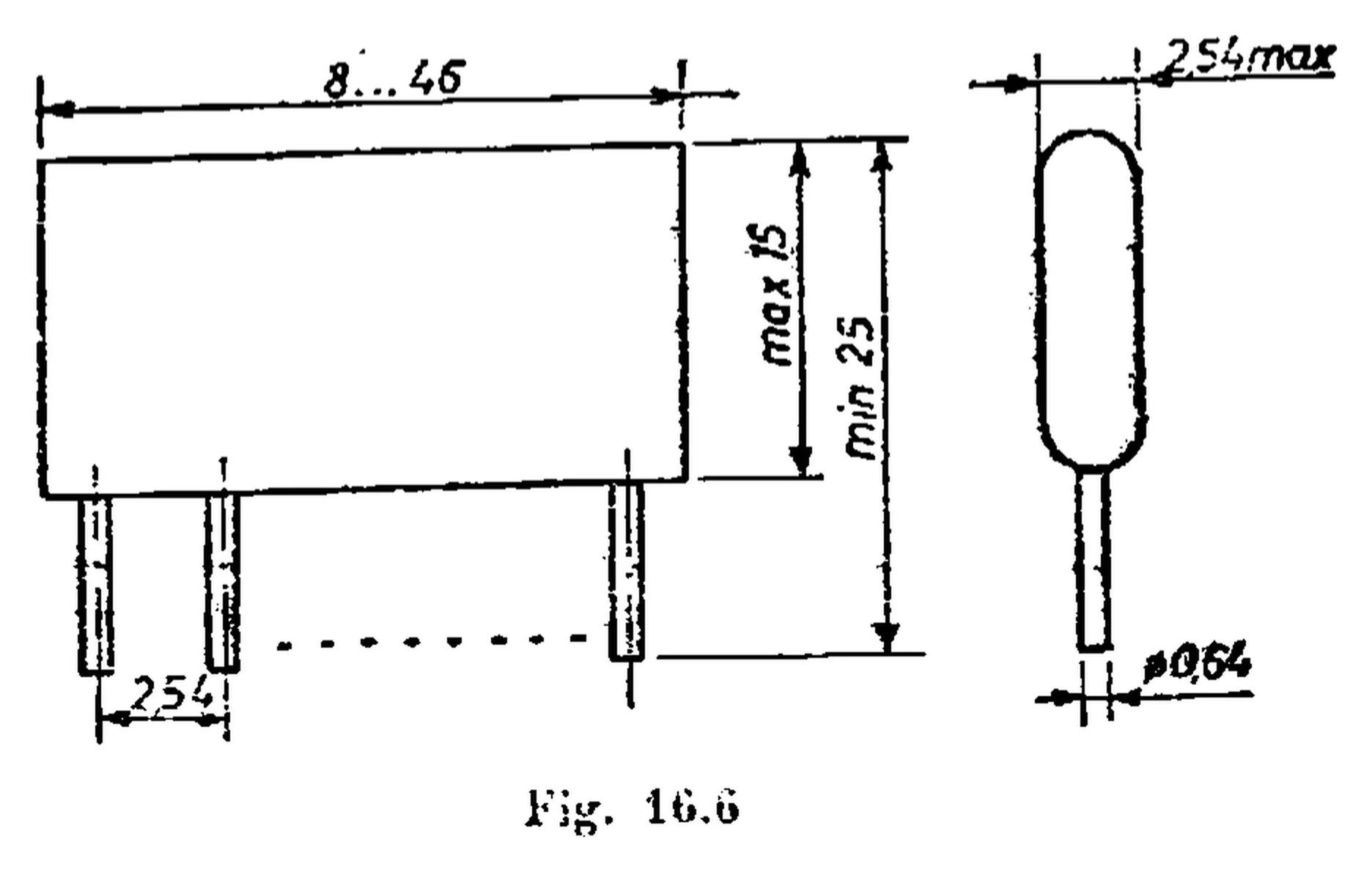
Rated power: maximum dissipated power 0.125, 0.25 or 0.5 W (the specifications give the largest). Dimensions in mm (fig. 16.6): length 8…46, body height at most 15, at least 25 from the top of the body to the pin tips, thickness at most 2.54, pins Ø 0.64 at a 2.54 pitch [1].
Gallery
 No image available
Documents
No documents available yet.
References
- [1]N. Drăgulănescu – „Agenda radioelectronistului”, 2nd edition, Editura Tehnică, 1989, section 16.3.6 „Rețele rezistive, seria RR 3300”, p. 187
- [2]N. Drăgulănescu – „Agenda radioelectronistului”, 1st edition, Editura Tehnică, 1983, section 3.1.3.6 „Rețele rezistive”, p. 156
- [3]N. Drăgulănescu – „Agenda radioelectronistului”, 2nd edition, Editura Tehnică, 1989, section 16.3 „Rezistoare produse în R.S.R.”, 16.3.1 „Codificare – marcare”, p. 184
- [4]N. Drăgulănescu – „Agenda radioelectronistului”, 1st edition, Editura Tehnică, 1983, section 3.1.3 „Rezistoare produse în R.S.R.”, 3.1.3.1 „Codificare – marcare”, p. 153
- [5]N. Millea, I. Constantinescu (coord.) – „Un secol de electronică în România”, Editura Academiei Române, 2020, sections VIII.1.2.6 and VIII.2, pp. 410 and 434–435