BD682
IPRS Băneasa
- Also known as
- BD682A
- Manufacturer
- IPRS Băneasa

- Country
- Romania

- Year
- Unknown
- Category
- Components
- Type
- Transistors
- Equivalents
- N/A
- Documentation score
- 2/7
- Last edited
- 25 OCT 2026
Specifications
- Material
- Si
- Polarity
- PNP
- Structure / technology
- power transistor, epitaxial-base
- Max. power dissipation (Pc, Ptot, Pd)
- 40 W
- Max. collector–base voltage |Vcb|
- 100 V
- Max. collector–emitter voltage |Vce|
- 100 V
- Max. emitter–base voltage |Veb|
- 5 V
- Max. collector current |Ic|
- 4 A
- Max. junction temperature (Tj)
- 150 °C
- DC current gain (hFE), min
- 750
- Small-signal current gain (hfe)
- ≥ 18 (f = 1 MHz)
- Collector–emitter saturation voltage (Vce sat)
- 2.5 V
- Thermal resistance, junction–case (Rth j-c)
- 3.12 °C/W
- Package
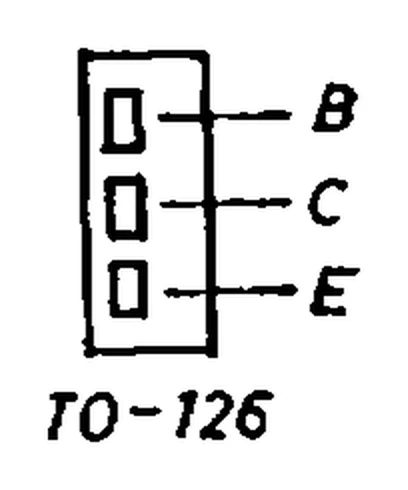
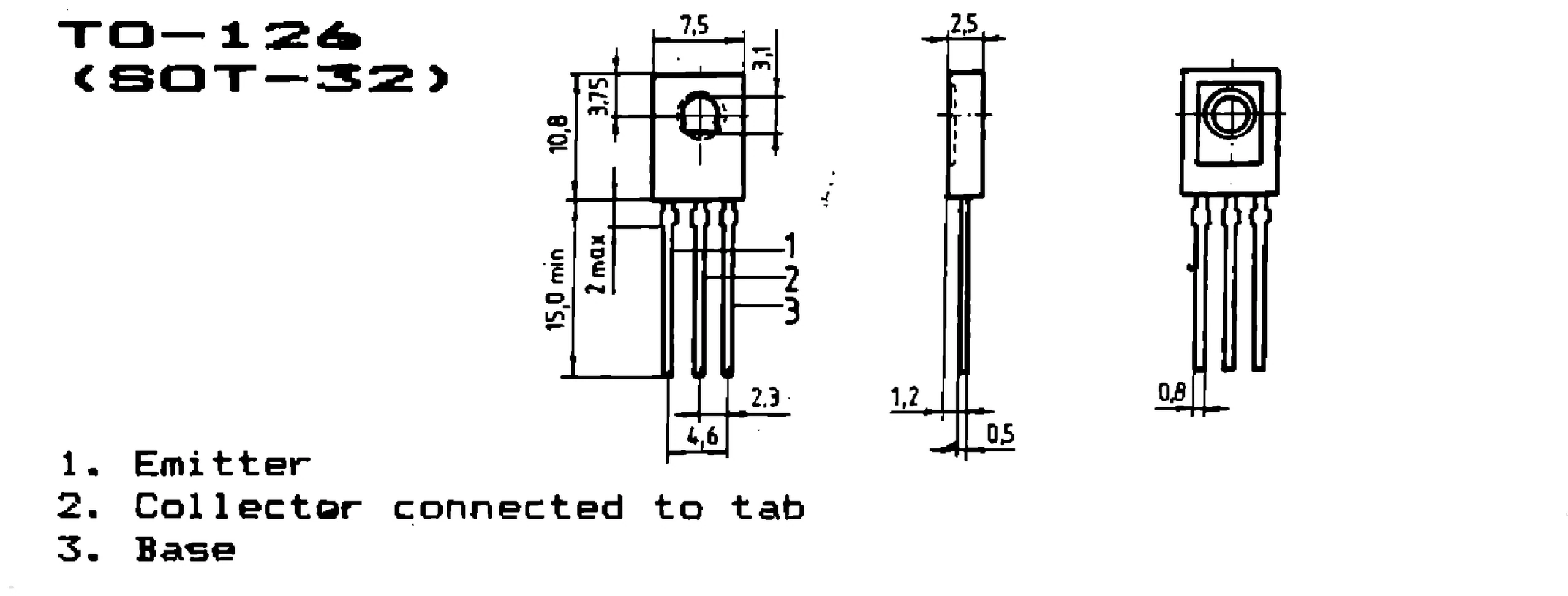
- TO-126
- Application
- Hi-Fi amplifiers, power supplies, low-voltage power and switching applications
Variants (2)
| Compare | |
|---|---|
| BD682 | |
| BD682A |
The sources give the same data for all these codes; they do not say how the versions differ.
Click a column heading to sort. „+” adds a variant to the comparison (BD682).
Description
The BD682 is a silicon power transistor made by IPRS Băneasa in its own epitaxial-base technology, one of the representative types of that technology, for Hi-Fi amplifiers, power supplies and low-voltage power and switching applications [1]. The book gives it within the range BD 675–682 [1]. Section 2500 (silicon diodes and transistors) of IPRS began in 1974 with a licence from ITT Intermetall – covering in full varicap and switching diodes and in part plastic transistors – but most of its range came from its own research; its 1989 silicon transistor catalogue held 366 data sheets [1].
The Agenda radioelectronistului (2nd edition, 1989) lists the BD682 among the bipolar transistors made by IPRS Băneasa, in the group of low-frequency silicon PNP power transistors, in a TO-126 package [2].
On p. 533 the heading of this table reads „Tranzistoare cu siliciu, PNP, de înaltă frecvență, mică putere”, but the table of contents gives 28.2.11 as „Tranzistoare cu Si, PNP, de JF, de putere” [2]. The column headers give the currents in mA, while the values (2–7) are those used in A for the NPN power transistors of 28.2.10; they are entered here in A. The BD682 and the BD682A are listed in one row, „BD 682(A)”, with hFE measured at IC = „2(1,5)”; the bracketed value belongs to the A version [2].
Coded as (Pro Electron system) [3]:
| Part | Meaning |
|---|---|
| B | base material with an activation energy of 1.0–1.3 eV, e.g. silicon (1.1 eV) |
| D | low-frequency power transistor |
| 682 | serial number: three digits (100–999), for components for general use |
| A | letter with no coded meaning, marking a constructional variant |
hFE (h21E) measured at IC = 2 A; Vce sat at IC = 1.5 A [2].
BD682A
The I.P.R.S. Băneasa Full Line Condensed Catalog (1990) lists the BD682 and BD682A among the „General purpose Darlingtons – plastic case” of its „High power” section [4]. The values of the codes new on this page are under Variants [4]. For the BD682 it gives Ptot 40 W (TC = 25 °C), TJM 150 °C, VCBO 100 V, VCEO 100 V, IC 4 A, VCEsat ≤ 2.5 V (IC = 1.5 A), hFE 750 (IC = 1.5 A, VCE = 3 V), hfe ≥ 18 at f = 1 MHz, TO-126 case [4]. For the BD682A it gives Ptot 40 W (TC = 25 °C), TJM 150 °C, VCBO 100 V, VCEO 100 V, IC 4 A, VCEsat ≤ 2.8 V (IC = 2 A), hFE 750 (IC = 2 A, VCE = 3 V), hfe ≥ 18 at f = 1 MHz, TO-126 case [4].
hFE (h21E) measured at IC = 1.5 A; Vce sat at IC = 1.5 A [2].
Drawing Gallery
 No image available
 No image available
Photo Gallery
No other images available yet.
Documents
No documents available yet.
Prices
N/A
References
- [1]N. Millea, I. Constantinescu (coord.) – „Un secol de electronică în România”, Editura Academiei Române, 2020, section VIII.1.2.5, pp. 404–408
- [2]N. Drăgulănescu – „Agenda radioelectronistului”, 2nd edition, Editura Tehnică, 1989, section 28.2.11 „Tranzistoare cu Si, PNP, de JF, de putere”, p. 533
- [3]N. Drăgulănescu – „Agenda radioelectronistului”, 2nd edition, Editura Tehnică, 1989, section 26.2 „Sistemul european PRO ELECTRON”, pp. 479–480
- [4]I.P.R.S. Băneasa – „Full Line Condensed Catalog”, 1990, section 3 „Silicon transistors”, „High power”, „General purpose Darlingtons – plastic case”, pp. 3-06…3-07