BF256
IPRS Băneasa
- Also known as
- BF256A, BF256B, BF256C
- Manufacturer
- IPRS Băneasa

- Country
- Romania

- Year
- Unknown
- Category
- Components
- Type
- Transistors
- Equivalents
- N/A
- Documentation score
- 2/7
- Last edited
- 25 OCT 2026
Specifications
- Material
- Si
- Polarity
- N-channel
- Structure / technology
- JFET
- Max. power dissipation (Pc, Ptot, Pd)
- 0.2 W
- Max. junction temperature (Tj)
- 125 °C
- Feedback capacitance (C12e, Cre)
- 1 pF
- Noise figure (NF)
- 7.5 dB
- Max. drain–source voltage |Vds|
- 30 V
- Max. gate–source voltage |Vgs|
- 30 V
- Gate–source cut-off / threshold voltage (Vgs off, Vgs th)
- −0.5…−7 V
- Zero-gate-voltage drain current (Idss)
- 3…18 mA, 3…7 mA, 6…13 mA, 11…18 mA (see Variants)
- Gate leakage current (Igss)
- −5 nA
- Forward transconductance (gm, gfs)
- ≥ 4.5 mA/V
- Package
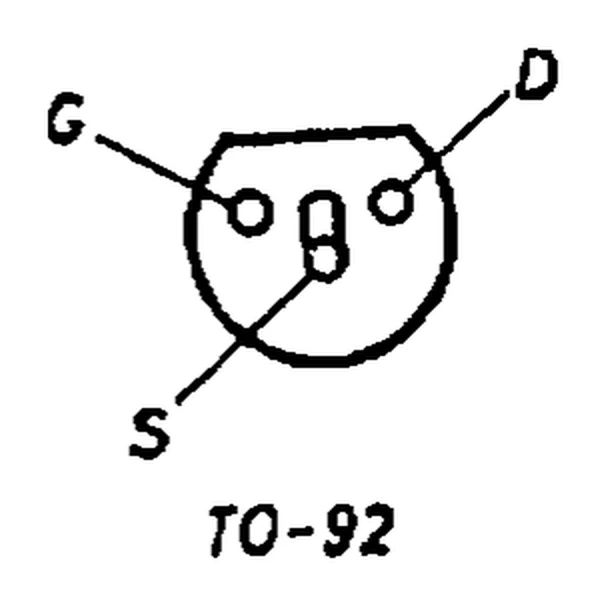
- TO-92
Variants (4)
| Compare | ||
|---|---|---|
| BF256 | 3…18 mA | |
| BF256A | 3…7 mA | |
| BF256B | 6…13 mA | |
| BF256C | 11…18 mA |
Click a column heading to sort. „+” adds a variant to the comparison (BF256).
Description
The BF256 is a silicon N-channel junction field-effect transistor (JFET) listed in the Agenda radioelectronistului (2nd edition, 1989) among the field-effect transistors made in Romania by IPRS Băneasa, in a TO-92 package [1].
Coded as (Pro Electron system) [2]:
| Part | Meaning |
|---|---|
| B | base material with an activation energy of 1.0–1.3 eV, e.g. silicon (1.1 eV) |
| F | high-frequency, low-power transistor |
| 256 | serial number: three digits (100–999), for components for general use |
| A, B, C | letter with no coded meaning, marking a constructional variant |
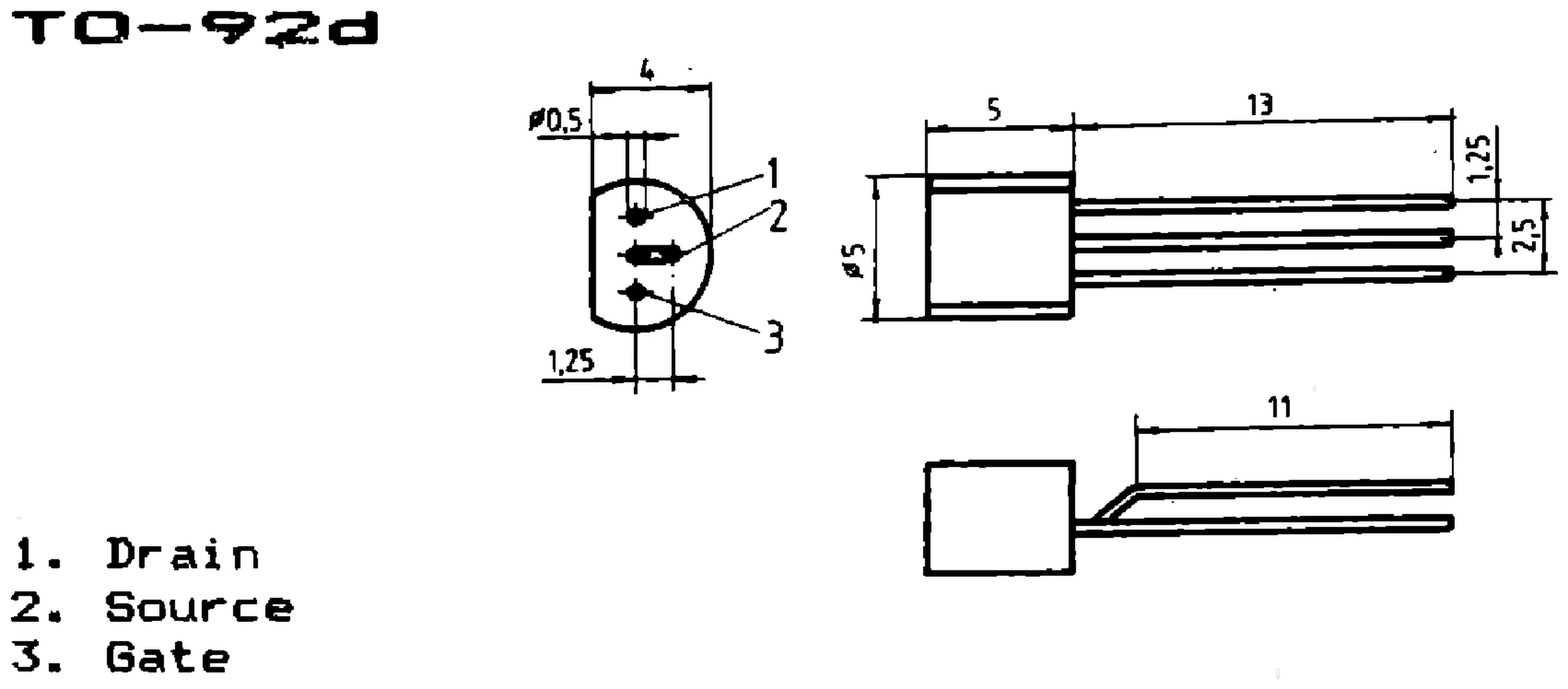
The I.P.R.S. Băneasa Full Line Condensed Catalog (1990) lists the BF256, BF256A, BF256B and BF256C among the „N-channel field-effect transistors” of its „Field-effect” section [3]. The values of the codes new on this page are under Variants [3]. For the BF256 it gives Ptot 200 mW, TJM 125 °C, ±VDS 30 V, −VGSS 30 V, −VGSoff 0.5–7.5 V, −IGSS ≤ 5 nA, IDSS 3–18 mA, Yfs 4.5 mS (VGS = 0 V, VDS = 15 V, f = 700 MHz), Cog 1.55 pF, Crs 1 pF, NF 7.5 dB (f = 800 MHz), TO-92d case [3]. For the BF256A it gives Ptot 200 mW, TJM 125 °C, ±VDS 30 V, −VGSS 30 V, −VGSoff 0.5–7.5 V, −IGSS ≤ 5 nA, IDSS 3–7 mA, Yfs 4.5 mS (VGS = 0 V, VDS = 15 V, f = 700 MHz), Cog 1.55 pF, Crs 1 pF, NF 7.5 dB (f = 800 MHz), TO-92d case [3]. For the BF256B it gives Ptot 200 mW, TJM 125 °C, ±VDS 30 V, −VGSS 30 V, −VGSoff 0.5–7.5 V, −IGSS ≤ 5 nA, IDSS 6–13 mA, Yfs 4.5 mS (VGS = 0 V, VDS = 15 V, f = 700 MHz), Cog 1.55 pF, Crs 1 pF, NF 7.5 dB (f = 800 MHz), TO-92d case [3]. For the BF256C it gives Ptot 200 mW, TJM 125 °C, ±VDS 30 V, −VGSS 30 V, −VGSoff 0.5–7.5 V, −IGSS ≤ 5 nA, IDSS 11–18 mA, Yfs 4.5 mS (VGS = 0 V, VDS = 15 V, f = 700 MHz), Cog 1.55 pF, Crs 1 pF, NF 7.5 dB (f = 800 MHz), TO-92d case [3].
The values given for the BF256 elsewhere on this page [1] differ: VGS off −0.5…−7 V; gfs ≥ 4.5 mA/V mA/V; package TO-92.
Drawing Gallery
 No image available
 No image available
Photo Gallery
No other images available yet.
Documents
No documents available yet.
Prices
N/A
References
- [1]N. Drăgulănescu – „Agenda radioelectronistului”, 2nd edition, Editura Tehnică, 1989, section 29.2 „Tranzistoare cu efect de cîmp produse în R.S.R.”, p. 548
- [2]N. Drăgulănescu – „Agenda radioelectronistului”, 2nd edition, Editura Tehnică, 1989, section 26.2 „Sistemul european PRO ELECTRON”, pp. 479–480
- [3]I.P.R.S. Băneasa – „Full Line Condensed Catalog”, 1990, section 3 „Silicon transistors”, „Field-effect”, „N-channel field-effect transistors”, pp. 3-64…3-65