1K24
Hitachi

Specifications
- Type
- High-vacuum rectifier
- Heater voltage (Vh)
- 5 V
- Heater current (Ih)
- 3 A
- Max. peak inverse voltage (Vinv)
- 20000 V
- Max. peak anode current (Iv)
- 300 mA
- Cathode type
- FT (thoriated-tungsten filament)
- Overall length
- 118 mm
- Diameter
- 38 mm
- Tube voltage drop
- 250 V
- Max. average anode current
- 0.06 A
Description
The 1K24 is a high-vacuum rectifier, made by Hitachi (Japan), listed in the „Hitachi Electron Tubes” catalogue (CT-358), section „Rectifiers – High-Vacuum Rectifiers” (pp. 10–11): „Half-wave type” [1].
The catalogue gives 3B24W as the American equivalent [1].
Maximum plate ratings and typical operating conditions, as printed [1]:
| Max. peak inverse (V) | Max. peak (A) | Max. average (A) |
|---|---|---|
| 20,000 | 0.3 | 0.06 |
Tube drop 250 V at a plate current of 0.160 A [1].
Universal Description (Common reference data for all brands and equivalents)
The „Hitachi Electron Tubes” catalogue (CT-358) gives 3B24W as the American equivalent of the Hitachi 1K24 [U1].
From Unknown 3B24W
The 3B24W is a tube of unknown maker named in the „Hitachi Electron Tubes” catalogue (CT-358) as the American equivalent of the Hitachi 1K24 [1]. The catalogue gives no data of its own for it.
Drawing Gallery
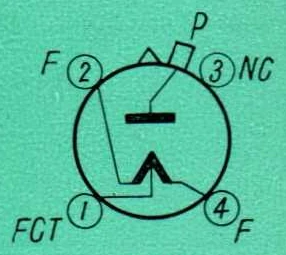 No image available
Photo Gallery
No other images available yet.
Documents
No documents available yet.
Prices
N/A
References
- [1]Hitachi, Ltd. – „Hitachi Electron Tubes” (catalogue CT-358), Tokyo (the year is not given), section „Rectifiers – High-Vacuum Rectifiers”, pp. 10–11
- [2]Hitachi, Ltd. – „Hitachi Electron Tubes” (catalogue CT-358), Tokyo (the year is not given), „Guide to the Use of This Catalogue”, p. 2
Universal references
- [U1]Hitachi, Ltd. – „Hitachi Electron Tubes” (catalogue CT-358), Tokyo (the year is not given), section „Rectifiers – High-Vacuum Rectifiers”, pp. 10–11
From Unknown 3B24W
- [1]Hitachi, Ltd. – „Hitachi Electron Tubes” (catalogue CT-358), Tokyo (the year is not given), section „Rectifiers – High-Vacuum Rectifiers”, pp. 10–11