
Specifications
- Type
- Power pentode
- Heater voltage (Vh)
- 12 V
- Heater current (Ih)
- 1.25 A
- Anode dissipation (Pa)
- 60 W
- Output power
- 105 W
- Grid 1 – screen amplification factor (µg2g1)
- 5
- Cathode type
- HO (oxide-coated unipotential cathode)
- Overall length
- 135 mm
- Diameter
- 50 mm
- Max. DC anode voltage
- 1200 V
- Max. DC anode input
- 160 W
- Max. frequency at full ratings
- 30 MHz
Description
The 3P50 is a power pentode, made by Hitachi (Japan), listed in the „Hitachi Electron Tubes” catalogue (CT-358), section „Power Tubes – Pentodes (Air-Cooled)” (pp. 10–11): „Sturdy type for use in amplifier and modulator” [1].
Maximum plate ratings and typical operating conditions, as printed [1]:
| Class | Max. frequency (Mc) | Max. DC plate (V) | Max. DC input (W) | Max. dissipation (W) | DC plate (V) | DC screen (V) | DC grid (V) | DC plate (A) | Driving power (W) | Power output (W) |
|---|---|---|---|---|---|---|---|---|---|---|
| B | — | 1,200 | 160 | 60 | 1,000 | 300 | -50 | 0.19 | 0 | 75 |
| CS | 30 | 1,200 | 85 | 60 | 1,000 | 260 | -120 | 0.08 | 1.1 | 28 |
| CT | 30 | 1,200 | 160 | 60 | 1,000 | 300 | -120 | 0.15 | 0.7 | 105 |
Classes of service: B = Class-B push-pull audio-frequency power amplifier or modulator; CT = Class-C telegraph and frequency-modulated telephone service [2]; Maximum ratings in the Absolute Maximum Rating System, for continuous service unless otherwise noted; in classes CM, CP and CT the values are for one tube (two units in twin-unit types), in classes AB1, AB2 and B the maximum plate ratings are for one tube and the typical operating conditions for two tubes (or two units) [2]; In Specifications the max. anode voltage, input, dissipation, frequency and the output power are the highest values of the table [1].
Drawing Gallery
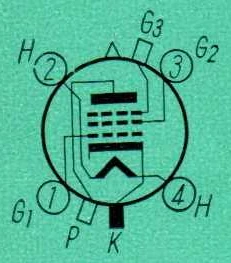 No image available
Photo Gallery
No other images available yet.
Documents
No documents available yet.
Prices
N/A
References
- [1]Hitachi, Ltd. – „Hitachi Electron Tubes” (catalogue CT-358), Tokyo (the year is not given), section „Power Tubes – Pentodes (Air-Cooled)”, pp. 10–11
- [2]Hitachi, Ltd. – „Hitachi Electron Tubes” (catalogue CT-358), Tokyo (the year is not given), „Guide to the Use of This Catalogue”, p. 2