VG-1000
IPEE Curtea de Argeș
- Also known as
- VG-1308
- Manufacturer
- IPEE Curtea de Argeș

- Country
- Romania

- Year
- Unknown
- Category
- Components
- Type
- Varistors
- Documentation score
- 1/5
- Last edited
- 17 OCT 2026
Specifications
- Type
- disc, general use
- Nominal voltage (Un)
- 27–82 V (see Variants)
- Tolerance of Un
- ±20 %
- Nominal current (In)
- 2–3 mA (see Variants)
- Rated dissipated power (Pdn)
- 0.6–0.8 W (see Variants)
- Current asymmetry, max (A)
- 10 %
- Nonlinearity coefficient, min
- 3
- Temperature coefficient, max (αT)
- 0.8 %/°C
- Temperature range
- −40…+100 °C
- Marking
- in clear: VG 27, in clear: VG 82 (see Variants)
- Diameter (D)
- 12 mm
- Thickness
- 2 mm
- Lead diameter
- 0.8 mm
- Min. lead length
- 50 mm
- Application
- general use
Variants (2)
| Note | Compare | |||||
|---|---|---|---|---|---|---|
| VG-1000 (27 V) | 27 | 3 | 0.8 | in clear: VG 27 | ||
| VG-1000 (82 V) | 82 | 2 | 0.6 | in clear: VG 82 | values in brackets in the 2nd edition; 2nd edition only |
Click a column heading to sort. „+” adds a variant to the comparison (VG-1000).
Description
The VG-1000 is a series of general-use disc varistors [1]. The Agenda radioelectronistului (2nd edition, 1989) gives no table for it, only a list of characteristics: a nominal voltage Un of 27 V (82 V), a nominal current In of 3 mA (2 mA), a rated power Pn of 0.8 W (0.6 W) at 25 °C, a voltage tolerance of ±20 %, a current asymmetry A of at most 10 %, a nonlinearity coefficient of at least 3, a temperature coefficient αT of at most 0.8 %/°C, a temperature range of −40…+100 °C and the marking in clear („VG 27; VG 82”) [1]. The two variants here follow the marking: the values in brackets go with the 82 V type [1].
The Agenda radioelectronistului names IPEE Electro-Argeș of Curtea de Argeș as the producer of the varistors in its section on varistors made in Romania, in both editions [3][4]. Un secol de electronică în România says that the works’ resistor catalogue (in English) covered 16 families of resistors, among them varistors and thermistors [5].
Coded as [3]:
| Part | Meaning |
|---|---|
| V | component type: varistor |
| G, P, T | main field of use: G = low voltage, general use; P = low voltage, for protecting contacts; T = high voltage |
| 1…9 | construction type: 1 = disc without leads; 2 = the same, impregnated; 3 = lacquered disc; 4 = the same, impregnated; 5 = cylinder; 6 = the same, lacquered; 7 = bead („perlă”); 8 = the same, lacquered; 9 = washer („șaibă”) |
| 0…6 | maximum admissible current (field P): 0 = 0.5 mA, 1 = 2 mA, 2 = 1.7 mA, 3 = 3.0 mA, 4 = 5.0 mA, 5 = 9.0 mA, 6 = 15 mA |
| 1…5 | nominal current (fields G, T): 1 = 1 mA, 2 = 2 mA, 3 = 3 mA, 4 = 10 mA, 5 = 100 mA |
| 01, 04, 08, 10, 20 | rated dissipated power (Pdn): 0.1, 0.4, 0.8, 1.0 and 2.0 W |
| (optional) | other characteristics: Un = nominal voltage, Uk = classification voltage |
The book’s example is „VP 1204 – 48 V”; „1 = 2 mA” is printed so in both editions, between 0.5 and 1.7 mA [3][4]. The book does not explain the codes in its tables digit by digit.
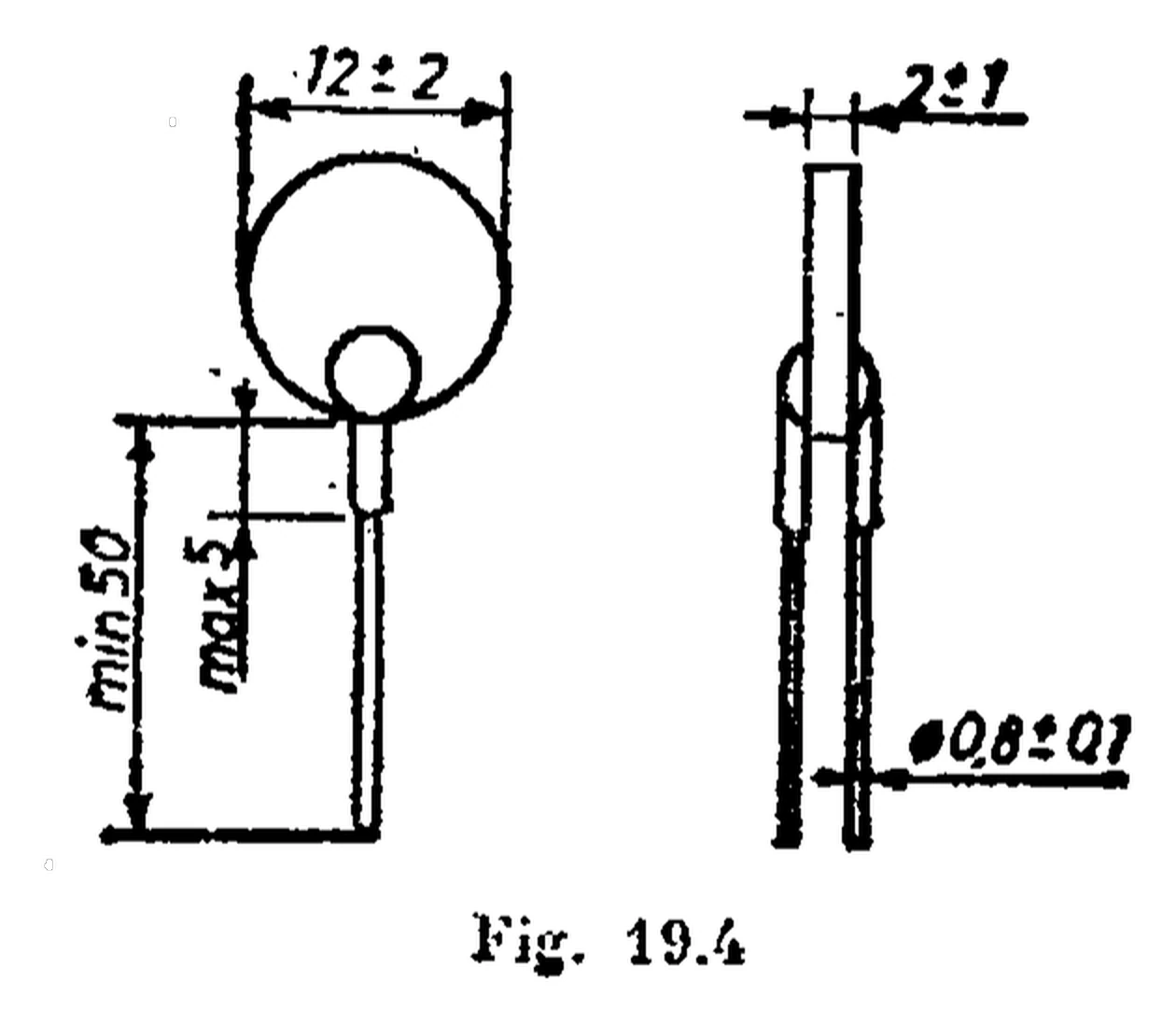
The drawing (fig. 19.4) gives a disc of 12 ± 2 mm, 2 ± 1 mm thick, with leads of Ø 0.8 ± 0.1 mm, at least 50 mm long [1]. The 1st edition (1983) calls the series VG-1308 and gives only the 27 V type (3 mA, 0.8 W), marked in clear with Un (fig. 3.4.4) [2].
Gallery
 No image available
Documents
No documents available yet.
References
- [1]N. Drăgulănescu – „Agenda radioelectronistului”, 2nd edition, Editura Tehnică, 1989, section 19.2.5 „Varistoare disc de uz general, seria VG-1000”, p. 233
- [2]N. Drăgulănescu – „Agenda radioelectronistului”, 1st edition, Editura Tehnică, 1983, section 3.4.2.5 „Varistoare disc de uz general, seria VG-1308”, p. 203
- [3]N. Drăgulănescu – „Agenda radioelectronistului”, 2nd edition, Editura Tehnică, 1989, section 19.2 „Varistoare produse în R.S.R.”, 19.2.1 „Codificare – marcare”, p. 231
- [4]N. Drăgulănescu – „Agenda radioelectronistului”, 1st edition, Editura Tehnică, 1983, section 3.4.2 „Varistoare produse în R.S.R.”, 3.4.2.1 „Codificare – marcare”, p. 201
- [5]N. Millea, I. Constantinescu (coord.) – „Un secol de electronică în România”, Editura Academiei Române, 2020, section VIII.2.2, p. 435