 No image available


Specifications
- Frequency range
- 29.7–47 MHz
- Modes
- phase modulation; simplex or semi-duplex; 2, 10 or 16 channels
- Max. number of channels
- 2/10/16
- Channel spacing
- 25 kHz
- Max. spread between extreme channels
- 400 kHz
- Output power
- 6/12/10 W (as printed)
- Max. frequency deviation
- ±5 kHz
- Transmitter audio response
- 300–3000 Hz
- Max. transmitter distortion
- 5 %
- Max. spurious emissions: harmonics
- 2.5 µW
- Max. spurious emissions: other
- 0.25 µW
- Sensitivity (SINAD)
- 0.4 µV
- Min. selectivity, 2 signals
- 75 dB
- Min. intermodulation ratio, 3 signals
- 70 dB
- Min. image rejection
- 80 dB
- Receiver audio response
- 300–3000 Hz
- Max. receiver distortion
- 5 %
- AF output power
- 2.5 W
- Max. current, receiving
- 0.15 A
- Max. current, transmitting
- 4 A
- Operating temperature
- −25…+50 °C
- Power supply
- 12 V DC (−15 %…+10 %)
Description
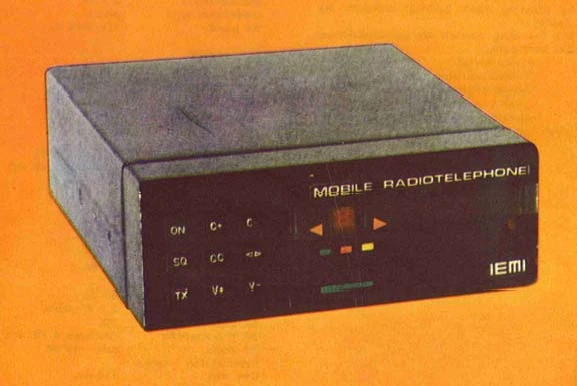
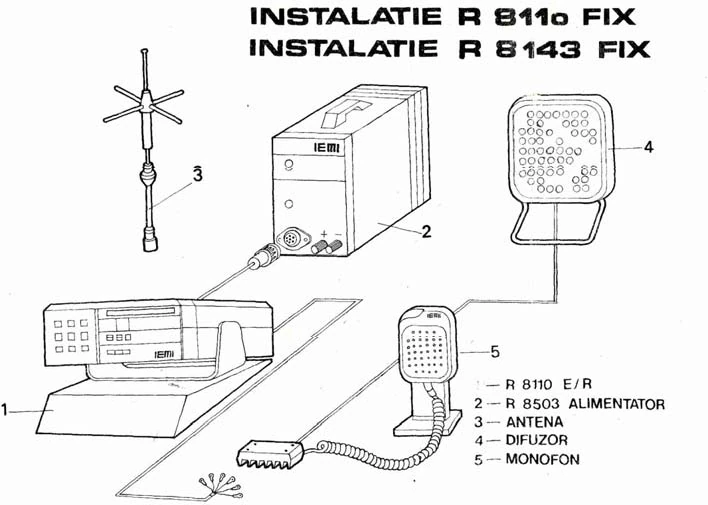
The R 8110 is a mobile radiotelephone with up to ten simplex or semi-duplex channels, made by IEMI in Bucharest [1]. It was made after 1985 [1]. IEMI made radiotelephones under a licence bought in 1968 from the Swedish firm SRA (Svenska Radio Aktiebolaget), later modernised by IEMI itself; they were used in industry, on the railways, in rescue services, agriculture, transport, construction, by the police and the fire brigade [1].
Annex III.2.15 lists it in IEMI’s 1988 production, for 29.7–47 MHz, with 20 W and a sensitivity of 0.4 µV. Its summary table gives versions with 2, 10 or 16 channels and 6, 12 or 20 W, with phase modulation, while the list gives at most 10 simplex or semi-duplex channels [2].
The Agenda radioelectronistului (2nd edition, 1989) lists the „R-8110” („Radiotelefon mobil”, mobile radiotelephone) among the mobile radiotelephones made by IEMI in Bucharest; its values are in the specifications [3]. A note gives the band as 29.7–47 MHz and says that the set has a Z80 microprocessor [3]. Its output power is printed „6/12/10” W, while the summary table of the annex quoted above gives 6, 12 or 20 W [3][2].
Photo Gallery
 No image available
Schematics
No schematics available yet.
Documents
No documents available yet.
Prices
N/A
References
- [1]N. Millea (coord.) et al. – „Electronica românească. O istorie trăită”, vol. II „Electronica profesională”, AGIR, sections III.2 „Producția IEMI” and III.3 „Comentarii tehnico-economice”, pp. 302–317, and annex III.2.3 „Producția IEMI – aparate electronice de măsură și industriale”, pp. 383–386
- [2]N. Millea (coord.) et al. – „Electronica românească. O istorie trăită”, vol. II „Electronica profesională”, AGIR, annex III.2.15 „Echipamente de radiocomunicații profesionale”, pp. 678–689
- [3]N. Drăgulănescu – „Agenda radioelectronistului”, 2nd edition, Editura Tehnică, 1989, chapter 48 „Principalele caracteristici ale radiotelefoanelor produse în R.S.R.” (producător: I.E.M.I. – București), pp. 698–700