 No image available


Specifications
- Frequency range
- 146–174 MHz
- Modes
- FM, up to 12 channels, 25 kHz spacing
- Max. number of channels
- 12 (band 4)
- Channel spacing
- 25 kHz
- Max. spread between extreme channels
- 1000 kHz
- Output power
- 12/20 W
- Frequency stability
- ≤ ±10⁻⁵
- Max. frequency deviation
- ±5 kHz
- Transmitter audio response
- 300–3400 Hz
- Max. transmitter distortion
- 5 %
- Max. spurious emissions: harmonics
- 2.5 µW
- Max. spurious emissions: other
- 0.2 µW
- Sensitivity (SINAD)
- 0.3 µV
- Min. selectivity, 2 signals
- 80 dB
- Min. intermodulation ratio, 3 signals
- 70 dB
- Min. image rejection
- 80 dB
- Receiver audio response
- 300–3000 Hz
- Max. receiver distortion
- 6 %
- AF output power
- 2.5 W
- Max. current, receiving
- 0.5 A
- Max. current, transmitting
- 4/6 A
- Operating temperature
- −25…+50 °C
- Power supply
- 12.6 V DC (−10 %…+15 %)
- Power consumption
- standby max 500 mA; transmitting max 6 A (version I) or 4 A (version II)
- Dimensions
- 210 × 240 × 70 mm
- Weight
- 3.5 kg
Description
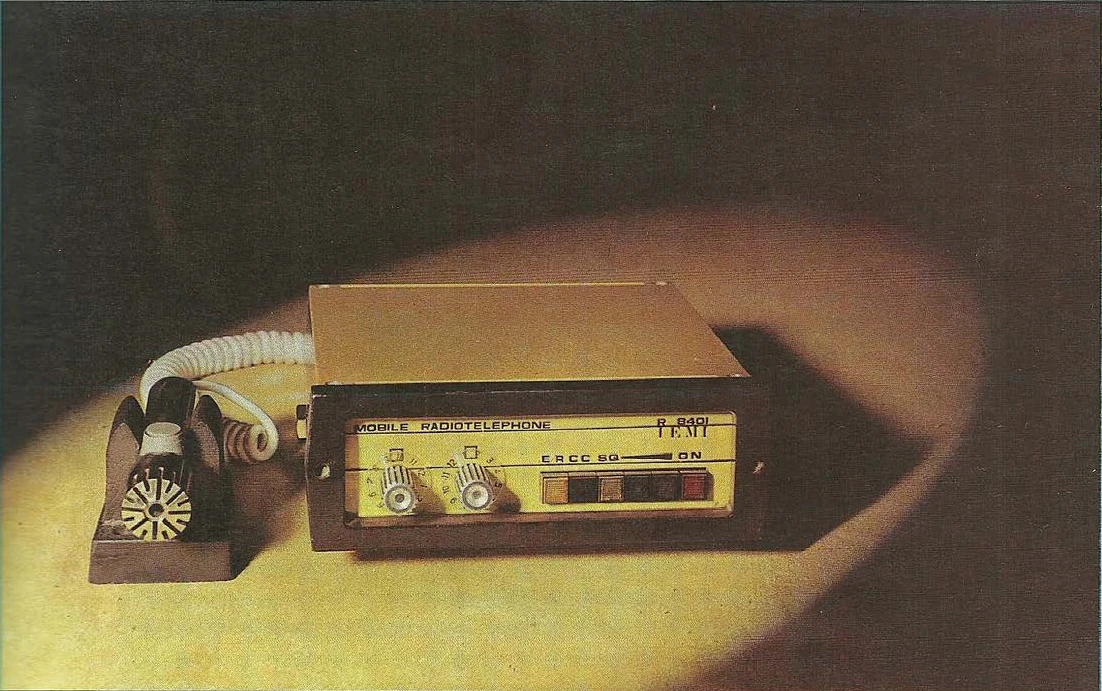
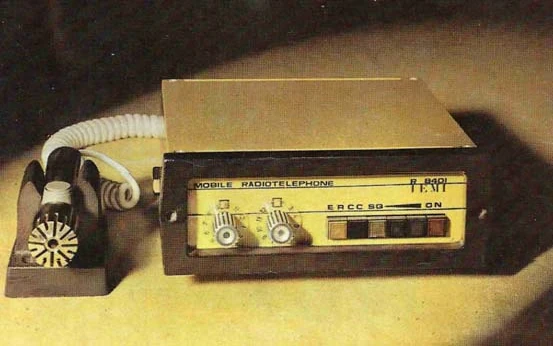
The R 8140 is a mobile radiotelephone, made by IEMI in Bucharest [1]. It was made after 1985 [1]. IEMI made radiotelephones under a licence bought in 1968 from the Swedish firm SRA (Svenska Radio Aktiebolaget), later modernised by IEMI itself; they were used in industry, on the railways, in rescue services, agriculture, transport, construction, by the police and the fire brigade [1].
IEMI’s production table lists 279 ‘15–20 W’ mobile radiotelephones coded R8140, made in 1980–1985, although the chapter text lists the R 8140 among the types made after 1985 [2]. The price list gives 30,000 lei for the R8140SD and 33,000 lei for the R8140SSD (prices set in 1982) [3].
Annex III.2.15 gives its prospectus: for all kinds of vehicles, in industry, on the railways, in agriculture, the fire brigade or repair teams, working with the R 8601 selective calling unit and optionally with an automatic scanner monitoring two channels, with an optical indication of the channel carrying a message; a keyboard of six self-lit keys switched the supply, the volume (four steps), the squelch and the scanner and keyed the transmitter. It covered 146–174 MHz in up to 12 channels 25 kHz apart, with at least 20 W (version I) or 12 W (version II) and a sensitivity of 0.3 µV. The annex adds that the R 8240 was derived from it [4].
The Agenda radioelectronistului (2nd edition, 1989) lists the „R-8140” („Radiotelefon mobil”, mobile radiotelephone) among the mobile radiotelephones made by IEMI in Bucharest; its values are in the specifications [5]. Its output power is printed „12/20” W and its transmitting current „4/6” A [5].
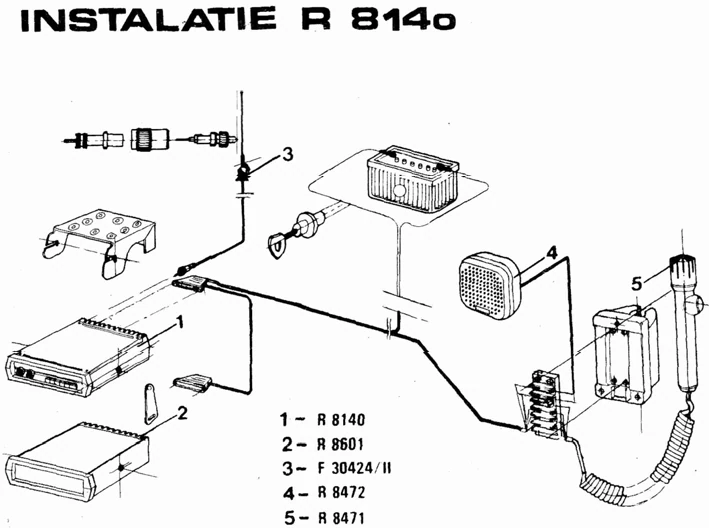
The accessories listed for it are a microphone (R-8471 or R-8474), a loudspeaker (R-8472), an installation set (R-8473/I), an antenna (F 30 424/I), a selective-call unit (R-8601) and a 6/24 V power supply (R-8502) [5].
A note says that the mobile installation can be built in two versions: with the control unit included in the transceiver unit (type R-8140) or with a control unit (type R-8606) separate from the transceiver unit (type R-8142) [5].
The IEMI catalogue 1980 presents it as the „Mobile radiotelephone S (SD) type R 8140”, for all types of motor vehicles, for two-way communication between two mobile subscribers or between a mobile and a stationary one, in industry, on the railways, in agriculture, ambulance services, fire stations and repair groups; it has a rugged construction, resistant to bumps and vibrations [6]. It works simplex, semi-duplex or both, with the R 8671 selective signal unit (as printed; the prospectus quoted above names the R 8601), and can have an automatic tone calling allowing the watch of any two channels, with an optical indication of the channel receiving a call [6]. A self-lit six-key keyboard connects it to the accumulators, sets the volume in four levels, switches the squelch and switches the set to transmission, which can also be done from the microphone and from the selective calling unit; it cannot transmit unless channel calling is disconnected, which works only with the squelch connected [6]. The annexes listed are the aerial, the loudspeaker, the microphone, an outfit set, the optional selective calling and a handbook [6].
Its table gives 146–174 MHz, a minimum spacing of 25 kHz, max. 12 channels, −25 to +50 °C, a frequency stability of ±10 ppm, 12.6 V (+15 % / −10 %), max. 500 mA receiving and max. 5 A (variant I) or 3.5 A (variant II) transmitting, 210 × 240 × 70 mm and max. 3.5 kg; a receiver sensitivity of 0.3 µV for S/N = 12 dB (1/2 EMF), a selectivity of min. 80 dB, an intermodulation of min. 70 dB, a distortion of max. 5 % (printed „at 1 000 MHz”), 2.5 W of audio power and min. 80 dB attenuation of disturbance; a transmitter output of min. 20 W (variant I) or 12 W (variant II), an audio characteristic of 300–3,400 Hz, harmonics of 2.5 µW and other radiations of max. 0.2 µW [6]. Its transmitting current of 5 A / 3.5 A and its receiver distortion of 5 % differ from the 6 A / 4 A and the 6 % in the specifications [6].
Photo Gallery
 No image available
 No image available
Schematics
No schematics available yet.
Documents
No documents available yet.
Prices
N/A
References
- [1]N. Millea (coord.) et al. – „Electronica românească. O istorie trăită”, vol. II „Electronica profesională”, AGIR, sections III.2 „Producția IEMI” and III.3 „Comentarii tehnico-economice”, pp. 302–317, and annex III.2.3 „Producția IEMI – aparate electronice de măsură și industriale”, pp. 383–386
- [2]N. Millea (coord.) et al. – „Electronica românească. O istorie trăită”, vol. II „Electronica profesională”, AGIR, annex III.2.4 „Producția IEMI – radiotelefoane”, pp. 387–392
- [3]N. Millea (coord.) et al. – „Electronica românească. O istorie trăită”, vol. II „Electronica profesională”, AGIR, annex III.2.5 „Lista cu prețurile produselor – IEMI”, pp. 393–396
- [4]N. Millea (coord.) et al. – „Electronica românească. O istorie trăită”, vol. II „Electronica profesională”, AGIR, annex III.2.15 „Echipamente de radiocomunicații profesionale”, pp. 678–689
- [5]N. Drăgulănescu – „Agenda radioelectronistului”, 2nd edition, Editura Tehnică, 1989, chapter 48 „Principalele caracteristici ale radiotelefoanelor produse în R.S.R.” (producător: I.E.M.I. – București), pp. 698–700
- [6]Measuring Electronic Instruments Enterprise (I.E.M.I.), Bucharest – „catalogue 1980” (in English), section I „Professional radio-communications equipment”, „Mobile radiotelephone S (SD) type R 8140” (unnumbered pages)