

Specifications
- Frequency range
- 146–174 MHz
- Modes
- frequency synthesis; simplex or semi-duplex
- Max. number of channels
- 2/10/16 (band 4)
- Channel spacing
- 25 kHz
- Max. spread between extreme channels
- 1000 kHz
- Output power
- 6/10/20 W
- Max. frequency deviation
- ±5 kHz
- Max. transmitter distortion
- 7 %
- Max. spurious emissions: harmonics
- 2.5 µW
- Max. spurious emissions: other
- 0.2 µW
- Sensitivity (SINAD)
- 0.4 µV
- Min. selectivity, 2 signals
- 75 dB
- Min. intermodulation ratio, 3 signals
- 65 dB
- Max. receiver distortion
- 7 %
- AF output power
- 2.5 W
- Operating temperature
- −25…+55 °C
- Power supply
- 13.6 V DC (10.5…16 V)
Description
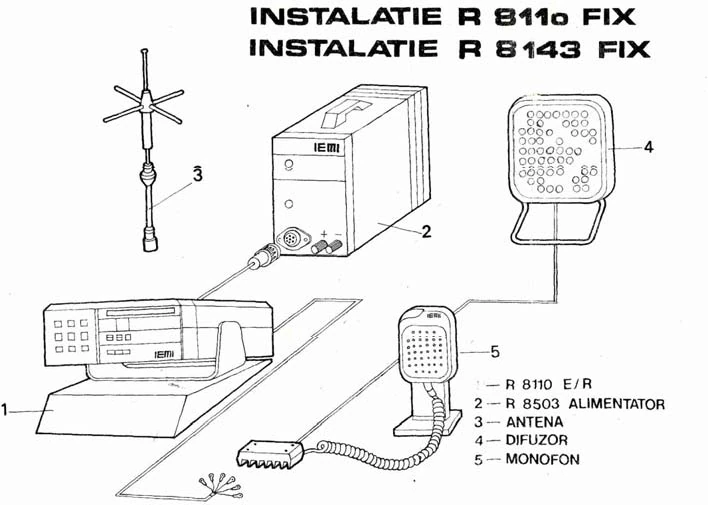
The R 8143 is a mobile radiotelephone with frequency synthesis, made by IEMI in Bucharest [1]. It was made after 1985, and the book counts it among the modern, high-technology products of IEMI’s 1988 programme [1]. IEMI made radiotelephones under a licence bought in 1968 from the Swedish firm SRA (Svenska Radio Aktiebolaget), later modernised by IEMI itself; they were used in industry, on the railways, in rescue services, agriculture, transport, construction, by the police and the fire brigade [1].
Annex III.2.15 gives 146–174 MHz, 20 W and a sensitivity of 0.45 µV; its list gives 16 simplex or semi-duplex channels, its summary table at most 6 [2].
The Agenda radioelectronistului (2nd edition, 1989) lists the „R-8143” („Radiotelefon mobil”, mobile radiotelephone) among the mobile radiotelephones made by IEMI in Bucharest; its values are in the specifications [3]. It gives 2, 10 or 16 channels („2/10/16”) and 6, 10 or 20 W („6/10/20”), and no current, frequency stability, audio response or image rejection [3]. The annex quoted above gives 20 W and, in its list, 16 channels [2].
Photo Gallery
 No image available
Schematics
No schematics available yet.
Documents
No documents available yet.
Prices
N/A
References
- [1]N. Millea (coord.) et al. – „Electronica românească. O istorie trăită”, vol. II „Electronica profesională”, AGIR, sections III.2 „Producția IEMI” and III.3 „Comentarii tehnico-economice”, pp. 302–317, and annex III.2.3 „Producția IEMI – aparate electronice de măsură și industriale”, pp. 383–386
- [2]N. Millea (coord.) et al. – „Electronica românească. O istorie trăită”, vol. II „Electronica profesională”, AGIR, annex III.2.15 „Echipamente de radiocomunicații profesionale”, pp. 678–689
- [3]N. Drăgulănescu – „Agenda radioelectronistului”, 2nd edition, Editura Tehnică, 1989, chapter 48 „Principalele caracteristici ale radiotelefoanelor produse în R.S.R.” (producător: I.E.M.I. – București), pp. 698–700