 No image available


Specifications
- Frequency range
- 146–174 MHz
- Modes
- simplex or semi-duplex, 4 channels
- Max. number of channels
- 4 (band 4)
- Channel spacing
- 25 kHz
- Max. spread between extreme channels
- 1000 kHz
- Output power
- 0.5/1.5 W
- Max. frequency deviation
- ±5 kHz
- Transmitter audio response
- 300–3000 Hz
- Max. transmitter distortion
- 7 %
- Max. spurious emissions: harmonics
- 2.5 µW
- Max. spurious emissions: other
- 0.25 µW
- Sensitivity (SINAD)
- 0.4 µV
- Min. selectivity, 2 signals
- 70 dB
- Min. intermodulation ratio, 3 signals
- 70 dB
- Min. image rejection
- 70 dB
- Receiver audio response
- 300–3000 Hz
- Max. receiver distortion
- 7 %
- AF output power
- 0.2 W
- Max. current, receiving
- 0.015 A
- Max. current, transmitting
- 0.33 A
- Operating temperature
- −25…+50 °C
- Power supply
- 12 V DC (11…14 V)
Description
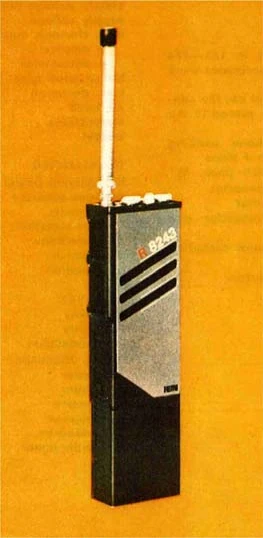
The R 8243 is a portable radiotelephone with hybrid circuits, made by IEMI in Bucharest [1]. It was made after 1985 [1]. IEMI made radiotelephones under a licence bought in 1968 from the Swedish firm SRA (Svenska Radio Aktiebolaget), later modernised by IEMI itself; they were used in industry, on the railways, in rescue services, agriculture, transport, construction, by the police and the fire brigade [1].
IEMI’s 20th-anniversary symposium in 1988 included a paper on this portable radiotelephone with hybrid circuits, listed there as R 8423 [2].
Annex III.2.15 gives 146–174 MHz, 1.5 W (0.5–1.5 W in its summary table), a sensitivity of 0.4 µV and four simplex or semi-duplex channels [3].
The Agenda radioelectronistului (2nd edition, 1989) lists the „R-8243” („Radiotelefon portabil”, portable radiotelephone) among the portable radiotelephones made by IEMI in Bucharest; its values are in the specifications [4]. Its output power is printed „0,5/1,5” W, as in the summary table of the annex quoted above; the table gives no frequency stability and no accessories for it [4][3].
Photo Gallery
No other images available yet.
Schematics
No schematics available yet.
Documents
No documents available yet.
Prices
N/A
References
- [1]N. Millea (coord.) et al. – „Electronica românească. O istorie trăită”, vol. II „Electronica profesională”, AGIR, sections III.2 „Producția IEMI” and III.3 „Comentarii tehnico-economice”, pp. 302–317, and annex III.2.3 „Producția IEMI – aparate electronice de măsură și industriale”, pp. 383–386
- [2]N. Millea (coord.) et al. – „Electronica românească. O istorie trăită”, vol. II „Electronica profesională”, AGIR, section III.4 „Viața în IEMI la început de drum” (N. Drăgulănescu), pp. 317–332, and annex III.4.2 „IEMI – 20 de ani – Realizări și perspective”, pp. 403–405
- [3]N. Millea (coord.) et al. – „Electronica românească. O istorie trăită”, vol. II „Electronica profesională”, AGIR, annex III.2.15 „Echipamente de radiocomunicații profesionale”, pp. 678–689
- [4]N. Drăgulănescu – „Agenda radioelectronistului”, 2nd edition, Editura Tehnică, 1989, chapter 48 „Principalele caracteristici ale radiotelefoanelor produse în R.S.R.” (producător: I.E.M.I. – București), pp. 698–700