 No image available


Specifications
- Frequency range
- 146–174 MHz
- Modes
- FM; simplex, semi-duplex or duplex; up to 12 channels; repeater
- Max. number of channels
- 12 (band 4)
- Channel spacing
- 25 kHz
- Max. spread between extreme channels
- 1000 kHz
- Output power
- 50 W
- Frequency stability
- ≤ ±10⁻⁵
- Max. frequency deviation
- ±5 kHz
- Transmitter audio response
- 300–3000 Hz
- Max. transmitter distortion
- 5 %
- Max. spurious emissions: harmonics
- 2.5 µW
- Max. spurious emissions: other
- 0.2 µW
- Sensitivity (SINAD)
- 0.3 µV
- Min. selectivity, 2 signals
- 80 dB
- Min. intermodulation ratio, 3 signals
- 70 dB
- Min. image rejection
- 80 dB
- Receiver audio response
- 300–3000 Hz
- Max. receiver distortion
- 5 %
- AF output power
- 2.5 W
- Operating temperature
- −25…+50 °C
- Power supply
- 220 V AC +10% / −20%, 50 Hz, or 12.6 V DC
- Power consumption
- 50 VA receiving; 250 VA (version I) or 150 VA (version II) transmitting
- Dimensions
- 125 × 390 × 550 mm
- Weight
- 25 kg
Description
The RTF 8040 is a fixed radiotelephone of at least 50 W, made by IEMI in Bucharest [1]. IEMI made radiotelephones under a licence bought in 1968 from the Swedish firm SRA (Svenska Radio Aktiebolaget), later modernised by IEMI itself; they were used in industry, on the railways, in rescue services, agriculture, transport, construction, by the police and the fire brigade [1].
IEMI’s production table lists 610 made in 1980–1985, with R8501 (541) and R8503 (907) power supplies, R8600 control units (571), R8603 distribution units (46) and R8700 telephone units (442) [2]. Its transceiver unit cost 60,300 lei (price set in 1982) [3].
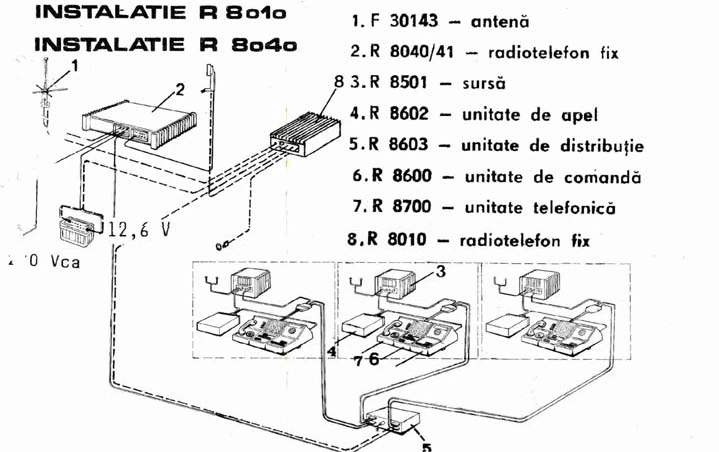
Annex III.2.15 calls it the R 8040 and gives its prospectus: 146–174 MHz, simplex, semi-duplex or duplex, up to 12 channels, also usable as a repeater, with at least 50 W (version I) or 20 W (version II) and a sensitivity of 0.3 µV. It could have a built-in R 8674 control unit for the main local commands, or remote units for more complex functions – the R 8670 control unit, R 8672 selective call, R 8770 telephone unit and, for several control posts, the R 8673 distributor; in duplex it worked with the R 8340–R 8343 duplex filters (R 8340). The production table above names the corresponding units R8600, R8603 and R8700 [4].
The Agenda radioelectronistului (2nd edition, 1989) lists the „R-8040/41” („Radiotelefon fix”, fixed radiotelephone) among the fixed radiotelephones made by IEMI in Bucharest, in one column with the RTF 8041; its values are in the specifications [5]. Its supply is printed „220–50 Hz” and „12,6 cc” (−20 %…+10 %), and its consumption 50 VA when receiving and 250 VA when transmitting, as in the prospectus quoted above, which applies the tolerance to the 220 V supply [5].
The accessories listed for it are a microreceiver (114-1-0148), an antenna (F 30143 J, K, I, M), a control unit (R-8600), a telephone unit (R-8700), a selective-call unit (R-8602), a distribution unit (R-8603), a 13 V power supply (R-8501), a remote control unit (R-8607), an installation set (cables, supports) and duplex filters (R-8340, R-8342, R-8343) [5]. The R-8040 works in duplex, the R-8041 in semi-duplex [5].
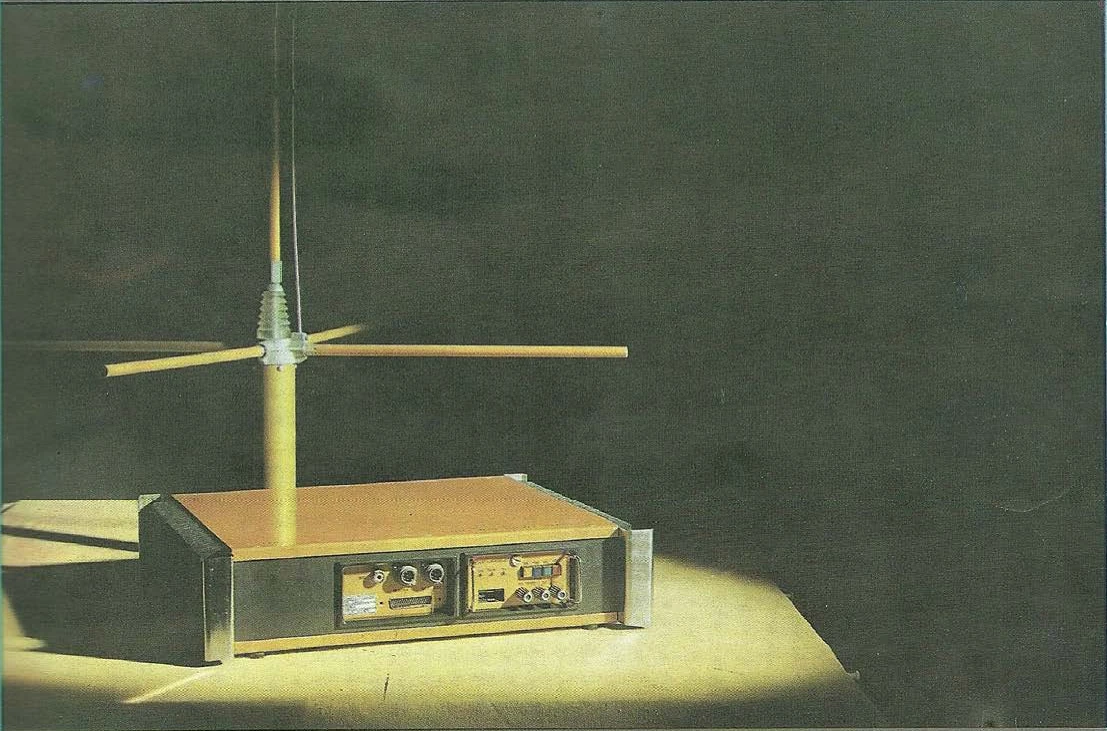
The IEMI catalogue 1980 presents it as the „Stationary radiotelephone type R 8040” (its photo page: „RTF-50W R 8040”), for stationary radiotelephone stations in complex networks linking stationary, portable and mobile subscribers, in industry, on the railways, in agriculture, ambulance services, fire stations or special fields; it has a unitary, rugged structure and a built-in power supply [6]. It works in 146–174 MHz, simplex, semi-duplex, simplex and semi-duplex or duplex, on max. 12 channels, and also as a repeater („retranslation regime”) [6]. It can have a built-in R 8614 control unit, for the main controls on the spot, and/or the blocks for remote functions: the R 8600 control unit, the R 8602 selective signal, the R 8700 telephone unit and the R 8603 distributor when several control units are coupled [6]. The optional local control unit switches the set on, selects the channel, connects the squelch, switches to transmission and adjusts the volume of the earphones [6]. It can also be fed from a 12.6 V accumulator, switched in automatically when the 220 V mains fails and recharged by the set while on mains [6]. For duplex operation, depending on the spacing between the transmission and reception frequencies, it uses the R 8430, R 8341, R 8342 or R 8343 duplex filters, the data changing with the filter [6].
Its table gives 146–174 MHz, a minimum spacing of 25 kHz, max. 12 channels, −25 to +50 °C, ±10 ppm, a supply of 220 V AC (±10 % / −20 %), 50 Hz, or 12–6 V batteries (as printed), 50 VA receiving and 250 VA (variant I) or 150 VA (variant II) transmitting, 125 × 390 × 550 mm and 25 kg; a receiver sensitivity of 0.3 µV for S/Z = 12 dB (1/2 EMF), a selectivity of min. 80 dB, an intermodulation of min. 70 dB, a distortion of max. 5 % at 1,000 Hz, an audio power of 1 mW in the earphone of the local control unit or 2.5 W with the R 8670 control unit, an attenuation of disturbance of min. 80 dB; a transmitter output of min. 50 W (variant I) or 20 W (variant II), an audio characteristic of 300–3,400 Hz, max. 5 % distortion, harmonics of max. 2.5 µW and other radiations of max. 0.2 µW [6]. Its 20 W for variant II and its 300–3,400 Hz transmitter response are not in the specifications, which give 50 W and 300–3,000 Hz [6].
Photo Gallery
 No image available
 No image available
Schematics
No schematics available yet.
Documents
No documents available yet.
Prices
N/A
References
- [1]N. Millea (coord.) et al. – „Electronica românească. O istorie trăită”, vol. II „Electronica profesională”, AGIR, sections III.2 „Producția IEMI” and III.3 „Comentarii tehnico-economice”, pp. 302–317, and annex III.2.3 „Producția IEMI – aparate electronice de măsură și industriale”, pp. 383–386
- [2]N. Millea (coord.) et al. – „Electronica românească. O istorie trăită”, vol. II „Electronica profesională”, AGIR, annex III.2.4 „Producția IEMI – radiotelefoane”, pp. 387–392
- [3]N. Millea (coord.) et al. – „Electronica românească. O istorie trăită”, vol. II „Electronica profesională”, AGIR, annex III.2.5 „Lista cu prețurile produselor – IEMI”, pp. 393–396
- [4]N. Millea (coord.) et al. – „Electronica românească. O istorie trăită”, vol. II „Electronica profesională”, AGIR, annex III.2.15 „Echipamente de radiocomunicații profesionale”, pp. 678–689
- [5]N. Drăgulănescu – „Agenda radioelectronistului”, 2nd edition, Editura Tehnică, 1989, chapter 48 „Principalele caracteristici ale radiotelefoanelor produse în R.S.R.” (producător: I.E.M.I. – București), pp. 698–700
- [6]Measuring Electronic Instruments Enterprise (I.E.M.I.), Bucharest – „catalogue 1980” (in English), section I „Professional radio-communications equipment”, „Stationary radiotelephone type R 8040” (unnumbered pages)