 No image available

Specifications
- Frequency range
- 1.5–30 MHz, 10 Hz steps
- Modes
- voice, telegraphy, teleprinter, data
- Power supply
- 220 V AC (max 0.85 A) or 24 V DC (max 5.5 A)
- Weight
- 65 kg
- Environment
- −10…+50 °C
Description
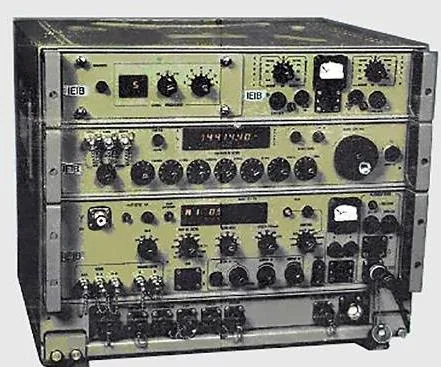
The R2500 is a first-class military short-wave receiver made by IEI in Bucharest [2]. The picture above shows it as a rack-mounted set of units with digital displays.
It was designed at the short-wave radio communications laboratory of ICE, which also built the tools and test equipment for its production line in its microproduction workshop [1].
Work began in 1975: it covers 1.5–30 MHz in 10 Hz steps, in all voice, telegraph, teleprinter and data modes, for receiving centres or radio vehicles, stationary or on the move, simplex or duplex, and on navy ships [2]. It signals failures and identifies the faulty module, which the user can replace without readjustment; components that were hard to import, such as a fast-warm-up crystal oven oscillator and the rotation decoder of the tuning knob, were made in ICE’s microproduction workshop [2]. Two prototypes were approved in 1980, and IEI made it in series until 1988, with 42 test machines built for its production line [2]. It belongs to the working set of the R1180 radio station, and was followed by the R2502 [2].
It was also used for radio reconnaissance [3].
Its prospectus gives 1,400–29,999 kHz in 10 or 100 Hz steps (up to 2,859,900 channels), the modes A1A, A3E, R3E, H3E, F1B and F7B among others, 1–7 µV sensitivity, a synthesiser driven by switches, a programmer or a tachogenerator for continuous tuning, a pilot oscillator stable to 1.5 × 10⁻⁷ and an optoelectronic display [4].
Gallery
No other images available yet.
Schematics
No schematics available yet.
Documents
No documents available yet.
References
- [1]N. Millea (coord.) et al. – „Electronica românească. O istorie trăită”, vol. II „Electronica profesională”, AGIR, section II.4.4 „Laborator echipamente radiocomunicații profesionale în gama de unde scurte”, pp. 127–130
- [2]N. Millea (coord.) et al. – „Electronica românească. O istorie trăită”, vol. II „Electronica profesională”, AGIR, section II.8.2 „Laboratorul 4 ICE” (R. Enescu), pp. 188–196
- [3]N. Millea (coord.) et al. – „Electronica românească. O istorie trăită”, vol. II „Electronica profesională”, AGIR, section V.1.4.4 „Întreprinderea Electronica Industrială / IEI”, pp. 441–444
- [4]N. Millea (coord.) et al. – „Electronica românească. O istorie trăită”, vol. II „Electronica profesională”, AGIR, annex V.2.3 „Produse speciale fabricate la IEI”, pp. 723–732