 No image available
ICE
Manufacturer
- Also known as
- Institutul de Cercetări Electronice; Institutul de Cercetări și Proiectări Electronice
- Country
- Romania

- Address
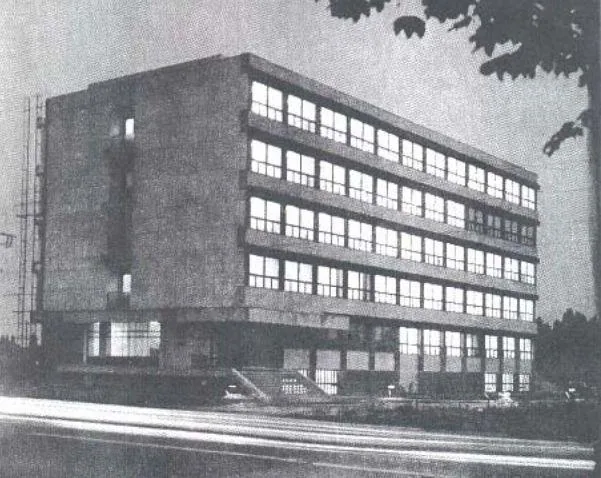
- Calea Floreasca nr. 169, sector 2, București (from 1970)
- Founded
- 1966
- In the archive
- 87 devices
- Last edited
- 03 OCT 2026
History
ICE (Institutul de Cercetări și Proiectări Electronice, the Institute for Electronics Research and Design) in Bucharest was the main Romanian research institute for professional electronics. It should not be confused with ICE Felix, the computer manufacturer.
The institute was founded in 1966 by bringing together the research teams that worked on professional electronics within the Ministry of the Machine-Building Industry (MICM) [1]. By 1989 it had 11 laboratories and 1,461 employees, 235 of them researchers [1].
1966–1989
The institute was set up by Council of Ministers Decision 1408 of 5 July 1966, for research and production in ferrites, instruments for electrical and non-electrical quantities, medical and biological electronics, professional radio communications and electronic technologies, with a prototype workshop [2]. It started by taking over existing teams: professional radio communications and ferrites from Electronica, and measuring instruments from ICPE [2]. In 1970 it registered the ICE trademark and moved into its new building at 169 Calea Floreasca [2]. A production line for quartz crystals, bought under a US licence for the civil and military radiotelephones, was installed in 1977 in a new wing that also enlarged the microproduction of ferrites and instruments [2]. When Romania bought the BAC licence for passenger aircraft, ICE was to develop their radio communication and navigation equipment, to be made at Tehnoton; these were the institute’s last imports of equipment, as all imports stopped after 1984 [2].
The institute’s designs went into production at IEMI (from 1968), the Urziceni ferrite factory (from 1971), Tehnoton (marine equipment, from 1972), IEI (professional radio communications, from 1981) and IEIA Cluj-Napoca (medical equipment and stabilised power supplies) [2]. In 1989 its approved prototypes accounted for 100% of the production capacity at Urziceni, 70% at IEMI, 40% at IEI and 25% at IEIA Cluj-Napoca [2]. That year, its busiest, it had eleven laboratories, three research teams, three microproduction sections and four branches, in Cluj-Napoca, Iași, Timișoara and Brașov [2]. It exported instruments to East Germany and North Korea [2].
When ICE was founded in 1966, under two army engineers, it took over from the electrotechnical research institute ICPE its sections for electronic measuring instruments and for the measurement of non-electrical quantities; engineer Vartires came from Electronica [4].
Microproduction
From 1971 the institute’s prototype and microproduction section built the more complex instruments and those needed only in small numbers; after the 1977 extension it tripled its area and added presswork, tooling, electroplating, printed circuit and plastics workshops [2]. With 471 workers, 10 foremen and 12 engineers, its output rose from US$0.5 million in 1977 to US$3 million in 1982 [2]. The quartz resonator section delivered its first resonators in 1981, at first entirely from imported materials; from 1984 the quartz itself was made in Romania, and the main customer was IEMI, for police and army radiotelephones [2]. In 1989 the ferrites made at Urziceni and in ICE’s pilot plant covered 90% of Romania’s needs [2].
The design team created the METROSET enclosure system for electronic instruments, which replaced sheet-steel cases and was adopted by the whole Romanian industry; its aluminium profiles were made at the Slatina aluminium works [2]. The metrology laboratory also serviced AKAI and JVC video recorders and Tektronix and Rohde & Schwarz professional equipment for the whole country [2].
The book’s annex on ICE’s microproduction gathers the prospectuses of instruments made in small series in its workshops: the N2704 concrete tester, the N2709 M cover meter, the N2103 and N2104 vibration meters, the N 23-100 and N 23-1000 strain gauge instruments and the N 2365 installation for weighing railway wagons in motion; the E504 function generator, the E0710 RLC comparator and the I4109 power supply; the microwave components CS-030, CDX-09, ACX-09, IDX-09, SPX-09, SX-09 and M 09; the PDUS METEOSAT weather-satellite ground station, the Hermes 2700 paging system and the R 6101 SSB radiotelephone; the MINER 100 and MINER 200 mine radios; and medical equipment such as the Elstar 1A electrocardiograph, the M 5220, MC-01, M 5102, M 5101, ECM, Neurocon, NP-01, M 5181, Bioprot M 5501 and Gravipic 01 [5].
Designs for IEMI
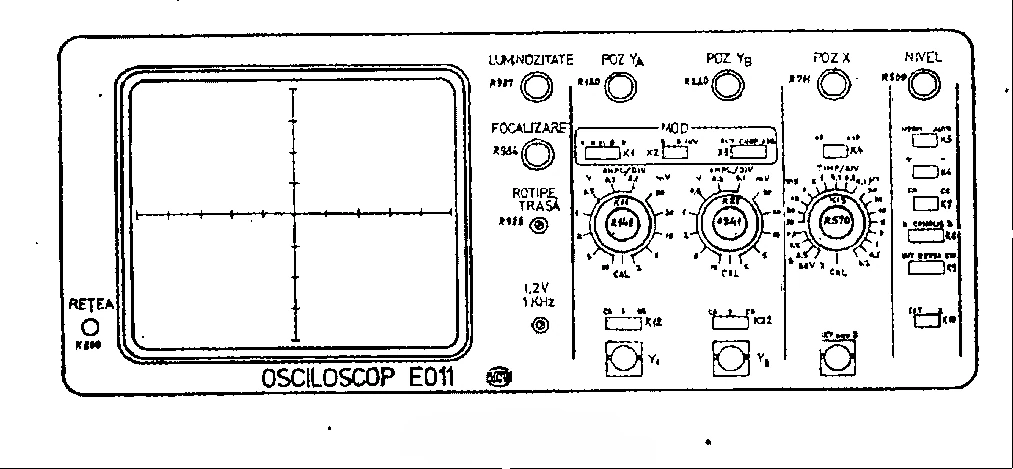
Many of the instruments made by IEMI were designed at ICE under research contracts [1]. Its electrical measurements laboratory designed the IEMI oscilloscopes, from the E0101 service oscilloscope of 1971 to the storage and digital-memory models of the second half of the 1980s [1].
After 1989
The institute did not fare well after 1989, and its building was demolished in 2006 [1]. In 1991 it became the joint-stock company SC ICE SA; its ferrite laboratory and microproduction became SC AFERO SA, and its quartz resonator section SC ROMCUARȚ SA [2]. In 1999 more than 90% of its shares were sold by direct negotiation to ROMSYS Bucharest, which also bought AFERO and ROMCUARȚ; in 2005 ROMSYS sold the three companies to an Italian investor, who had the buildings demolished in 2006 to make way for offices [2].
Gallery
 No image available
Devices in the archive (87)
 No image available
References
- [1]N. Millea, I. Constantinescu – „Un secol de electronică în România (II). Electronica profesională”, NOEMA XVIII, 2019
- [2]N. Millea (coord.) et al. – „Electronica românească. O istorie trăită”, vol. II „Electronica profesională”, AGIR, chapter II „Institutul de Cercetări Electronice”, sections II.1–II.2, pp. 96–102, II.4, pp. 109–143, and II.7, pp. 155–167
- [3]„Un secol de electronică în România”, Editura Academiei Române, 2020 (source of the building photograph)
- [4]N. Millea (coord.) et al. – „Electronica românească. O istorie trăită”, vol. II „Electronica profesională”, AGIR, section VI.3 „Roirea de cadre în sectorul electrotehnic”, pp. 529–532
- [5]N. Millea (coord.) et al. – „Electronica românească. O istorie trăită”, vol. II „Electronica profesională”, AGIR, annex II.4.4 „ICE – aparate realizate în microproducție”, pp. 569–607