 No image available
IEI
Manufacturer
- Also known as
- Întreprinderea de Electronică Industrială
- Country
- Romania

- Address
- Str. Baicului nr. 82, sector 2, București (1989)
- Founded
- 1981
- Closed
- 1992
- In the archive
- 32 devices
- Last edited
- 03 OCT 2026
History
IEI (Întreprinderea de Electronică Industrială, the Industrial Electronics Enterprise) in Bucharest was set up in 1981 on the original site of Uzinele Electronica, at 82 Baicului Road, taking over the production of special radio communications and professional electronics [1]. Its products were developed by ICSIT-E, the research institute for electronics [1].
According to Radiomuseum it was established on 1 October 1981 and was active until 1992, making industrial automation equipment, professional audio amplifiers and radio receivers; well-known products are the A-350 stereo amplifier (2×35 W) and the RX 2001 AM/FM receiver for ships [2].
From Electronica to IEI
Under Decree 254/1981 the Electronica works were split into two enterprises, both losing the rank of “works”: IEI kept the old site at 82 Baicului Road, with professional and industrial electronics, electro-acoustic products, subassemblies, spare parts and service, while IIS Electronica on the Pipera platform kept the TV sets, radios, music centres, speaker enclosures and radio-cassette recorders [4]. Of Electronica’s 42,079 m² of buildings (73,578 m² of floor space) at the end of 1980, IEI kept 15,879 m² (46,298 m²); each unit kept its own equipment, the Pipera factory having been equipped almost entirely in 1971 [4]. Of the 9,864 employees of 1980, IEI had 4,456 in 1981, 84% of them workers [4].
Products
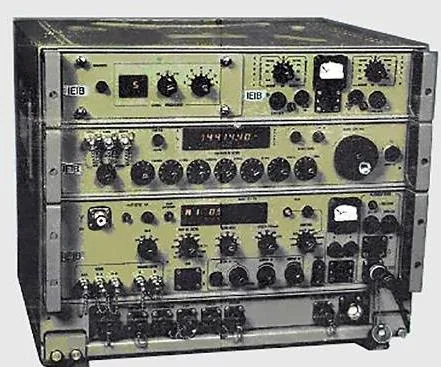
Most of IEI’s output by value was military: the R2500 and R2502 first-class short-wave receivers, the R1180 short-wave radio station, the R1070 and R1071 VHF radio stations, the R-4010 D UHF radio relay station, radio relay equipment for telephone and data links, the INSTM 18 moving target selection unit and the IPIBAR M1, IPIBAR M2 and IPIBAR M3 video protection units for ground radars and radio altimeters [4]; its prospectuses also list the R 550 E and R 550 N radio reception systems for helicopters and ships [7]. In 1980 production of the AHV 6 radio altimeter moved from Tehnoton in Iași to Electronica; nine specialists spent 100 days training at TRT in France, the licensor, whose licence also covered airborne search, Doppler navigation and weather radars, a multi-function radar and a border radar [4].
On the civilian side, TV set components (110° deflection yokes, deflection yokes for camera tubes, line output transformers, programme selectors), the whole loudspeaker production (with its anechoic chamber) and the music centres (which the decree had assigned to IIS Electronica) stayed at IEI, together with collective and individual antenna amplifiers, a wideband UHF antenna and a TV channel combiner [4]. Its catalogue also included the AA 12.24 bus amplifier, the CLUB 2000 and AHF-C81 amplifiers, the PD-D 350 record player, CD-350 cassette deck, T 350 tuner and EQ-350 equaliser, a 200 W modular public-address station, a car alarm with an electronic code lock, the PCI-20 B and PCI-02 H interphone systems, an explosion-proof interphone station for offshore platforms and ships, a ship interphone for up to ten stations, a 2 × 100 W ship broadcasting station, trimmer and variable capacitors and glass fuses [4][5]. Its industrial products included the N2705 concrete tester and the N 23-50 and N 23-100 automatic strain gauge installations [4]. The medical range comprised the M 5220 bedside monitor, taken over from ICE, the MBN-01, Calmostin NTS-02 M, THERASTIM LP-NST-03, Diadin 2, STEREOFREM-2000, MIOSTIM SM-02 and EA-1, a three-channel electrocardiograph and cardiac monitoring and pacing units [4][6]. IEI also listed a satellite navigation receiver, the Hermes 2700 paging system first made at ICE, the SN 600 echo sounder and the AM 2 Morse code trainer [4].
In 1989
In 1989 IEI belonged to the Industrial Central for Electronics and Computer Technology (CIETC) of the Ministry of the Electrotechnical Industry [3].
Devices in the archive (32)
 No image available
References
- [1]D. F. Lăzăroiu, N. Millea et al. – „Electronica românească. O istorie trăită”, vol. I, AGIR, chapter I „Industria electronică românească”
- [2]Radiomuseum – „IEI, Intreprinderea Electronica Industriala”
- [3]N. Drăgulănescu – „Agenda radioelectronistului”, 2nd edition, 1989, chapter 52 „Unități de cercetare, proiectare, producție și service – în industria electronică – din cadrul M.I.Et.”, pp. 742–749
- [4]N. Millea (coord.) et al. – „Electronica românească. O istorie trăită”, vol. II „Electronica profesională”, AGIR, chapter IV „Uzinele Electronica / Întreprinderea de Electronică Industrială – IEI”, pp. 411–422
- [5]N. Millea (coord.) et al. – „Electronica românească. O istorie trăită”, vol. II „Electronica profesională”, AGIR, annex IV.2.1 „IEI – produse de uz civil: aparatură audio”, pp. 690–693
- [6]N. Millea (coord.) et al. – „Electronica românească. O istorie trăită”, vol. II „Electronica profesională”, AGIR, annex IV.2.2 „IEI – produse de uz civil: aparatură medicală”, pp. 694–701
- [7]N. Millea (coord.) et al. – „Electronica românească. O istorie trăită”, vol. II „Electronica profesională”, AGIR, annex V.2.3 „Produse speciale fabricate la IEI”, pp. 723–732