CT 10.07
IPRS Băneasa
- Manufacturer
- IPRS Băneasa

- Country
- Romania

- Year
- Unknown
- Category
- Components
- Type
- Capacitors
- Documentation score
- 1/5
- Last edited
- 16 OCT 2026
Specifications
- Type
- ceramic trimmer
- Standard
- STAS 9507-74
- Capacitance (Cn)
- 3…30 pF
- Capacitance, min
- 3 pF
- Capacitance, max
- 30 pF
- Minimum capacitance, at most
- 3.3–7.7 pF (see Variants)
- Maximum capacitance, at least
- 9–27 pF (see Variants)
- Rated voltage (Un)
- 160 V
- Dissipation factor (tan δ)
- ≤ 20·10⁻⁴ (1 MHz)
- Dielectric strength
- 480 V DC
- Temperature coefficient (αC)
- (+100…−200)·10⁻⁶/°C, (−200…−900)·10⁻⁶/°C, (−500…−1200)·10⁻⁶/°C, (−800…−1800)·10⁻⁶/°C (see Variants)
- Climatic category
- 25/085/04
- Marking
- orange, violet, violet + S (as printed), blue (see Variants)
- Package
- disc trimmer, three pins
- Rotation torque
- 80…400 gf·cm
- Application
- radio-frequency circuits
Variants (8)
| Note | Compare | ||||||||
|---|---|---|---|---|---|---|---|---|---|
| CT 10.07 (3…10 pF, +100…−200) | 3…10 pF | 3 | 10 | 3.3 | 9 | (+100…−200)·10⁻⁶/°C | orange | ||
| CT 10.07 (3…10 pF, −200…−900) | 3…10 pF | 3 | 10 | 3.3 | 9 | (−200…−900)·10⁻⁶/°C | violet | ||
| CT 10.07 (3…12 pF, −200…−900) | 3…12 pF | 3 | 12 | 3.3 | 10.8 | (−200…−900)·10⁻⁶/°C | violet | ||
| CT 10.07 (5…15 pF, −200…−900) | 5…15 pF | 5 | 15 | 5.5 | 13.5 | (−200…−900)·10⁻⁶/°C | violet | ||
| CT 10.07 (5…20 pF, −200…−900) | 5…20 pF | 5 | 20 | 5.5 | 18 | (−200…−900)·10⁻⁶/°C | violet | ||
| CT 10.07 (6…25 pF, −200…−900) | 6…25 pF | 6 | 25 | 6.6 | 22.5 | (−200…−900)·10⁻⁶/°C | violet | ||
| CT 10.07 (7…30 pF, −500…−1200) | 7…30 pF | 7 | 30 | 7.7 | 27 | (−500…−1200)·10⁻⁶/°C | violet + S (as printed) | marking printed „violet+S”; S is not explained | |
| CT 10.07 (7…30 pF, −800…−1800) | 7…30 pF | 7 | 30 | 7.7 | 27 | (−800…−1800)·10⁻⁶/°C | blue |
Click a column heading to sort. „+” adds a variant to the comparison (CT 10.07).
Description
The CT 10.07 is a series of ceramic disc trimmer capacitors with three pins for printed circuits, rated 160 V DC, made to STAS 9507-74 for radio-frequency circuits [1]. The Agenda radioelectronistului (2nd edition, 1989) lists eight versions, from 3…10 pF to 7…30 pF, each with the largest value of its minimum capacitance, the smallest value of its maximum capacitance, its temperature coefficient and its colour marking [1].
The Agenda does not say which works made the series: for the whole section on capacitors made in Romania it lists IPEE Electroargeș of Curtea de Argeș, Tehnoton of Iași, IIS Electronica of Bucharest and IPRS Băneasa as producers, and the 1st edition (1983) names only the first three [3][4]. It is listed here as made by IPRS Băneasa; Un secol de electronică în România says that the ceramic capacitor line of IPRS passed to IPEE Curtea de Argeș in 1973 [5].
Coded as [3]:
| Part | Meaning |
|---|---|
| CT | construction type: adjustable ceramic capacitor, disc type („trimere”) |
| 10 (in the book’s example CT 10.11) | technological family („familia tehnologică”) |
| 11 (in the book’s example CT 10.11) | package code („codul capsulei”) |
A dot of paint on the body gives the range of the temperature coefficient: orange +100…−200, violet −200…−900, blue −800…−1800 (×10⁻⁶/°C) [3]. The 7…30 pF version with −500…−1200 is marked „violet+S”; the book does not explain the S [1].
The 1st edition (1983) has no marking column and six versions: 3…10 pF (two), 3.5…13 pF, 4.5…20 pF and 6…30 pF (two); the 3…12, 5…15, 5…20, 6…25 and 7…30 pF versions are new in the 2nd edition [2][1].
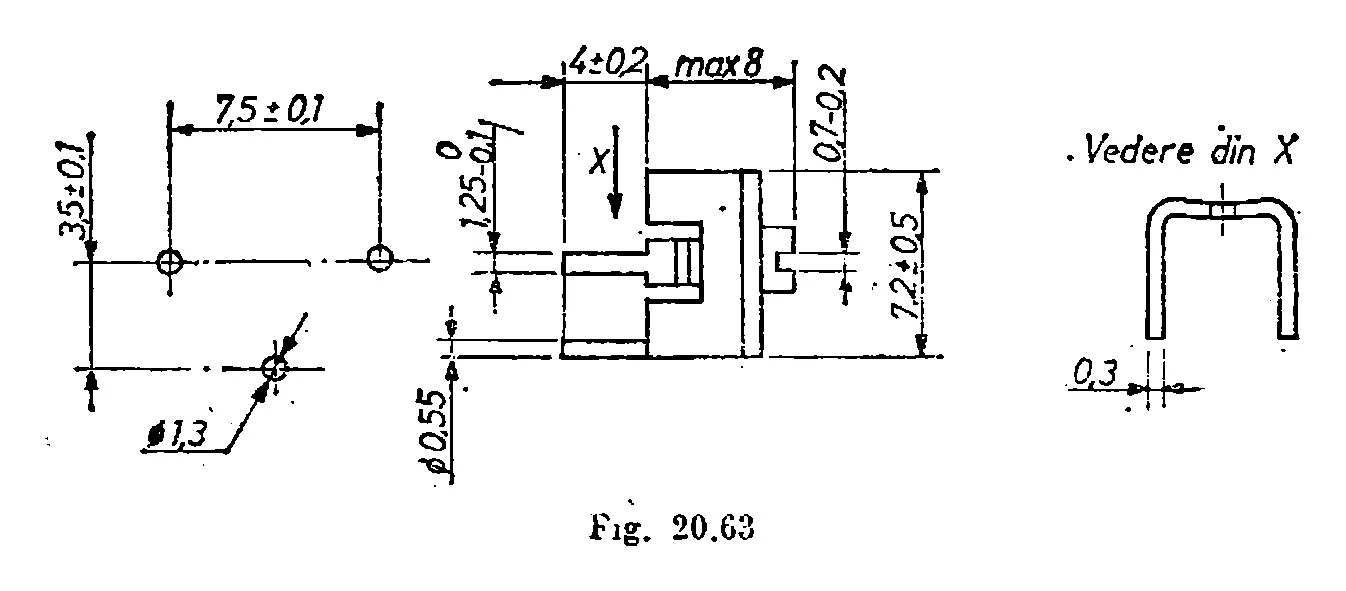
Rated voltages are DC („Vcc”). Dimensions in mm (fig. 20.63): pin spacing 7.5 ± 0.1 and 3.5 ± 0.1, holes Ø 1.3; the other dimensions are in the drawing [1].
Gallery
 No image available
Documents
No documents available yet.
References
- [1]N. Drăgulănescu – „Agenda radioelectronistului”, 2nd edition, Editura Tehnică, 1989, section 20.4.5.2 „Condensatoare ceramice ajustabile, disc, seria CT 10.07”, p. 302
- [2]N. Drăgulănescu – „Agenda radioelectronistului”, 1st edition, Editura Tehnică, 1983, section 3.5.4.5.2 „Condensatoare ceramice ajustabile-disc, seria CT 10.07”, p. 271
- [3]N. Drăgulănescu – „Agenda radioelectronistului”, 2nd edition, Editura Tehnică, 1989, sections 20.4 „Condensatoare produse în R.S.R.” (p. 248) and 20.4.5.1 „Codificare – marcare (în clar)” (p. 301)
- [4]N. Drăgulănescu – „Agenda radioelectronistului”, 1st edition, Editura Tehnică, 1983, sections 3.5.4 „Condensatoare produse în R.S.R.” (p. 218) and 3.5.4.5.1 „Codificare – marcare (în clar)” (p. 270)
- [5]N. Millea, I. Constantinescu (coord.) – „Un secol de electronică în România”, Editura Academiei Române, 2020, section VIII.1.2.6, pp. 408–411