 No image available
Electronica
Manufacturer
- Also known as
- Uzinele Electronica; Philips S.A.R. (1937–1948); Radio Popular (1948–1960); Întreprinderea „Electronica”
- Country
- Romania

- Address
- Bd. Dimitrie Pompei nr. 5-7, sector 2, București (1989)
- Founded
- 1937
- In the archive
- 345 devices
- Last edited
- 03 OCT 2026
History
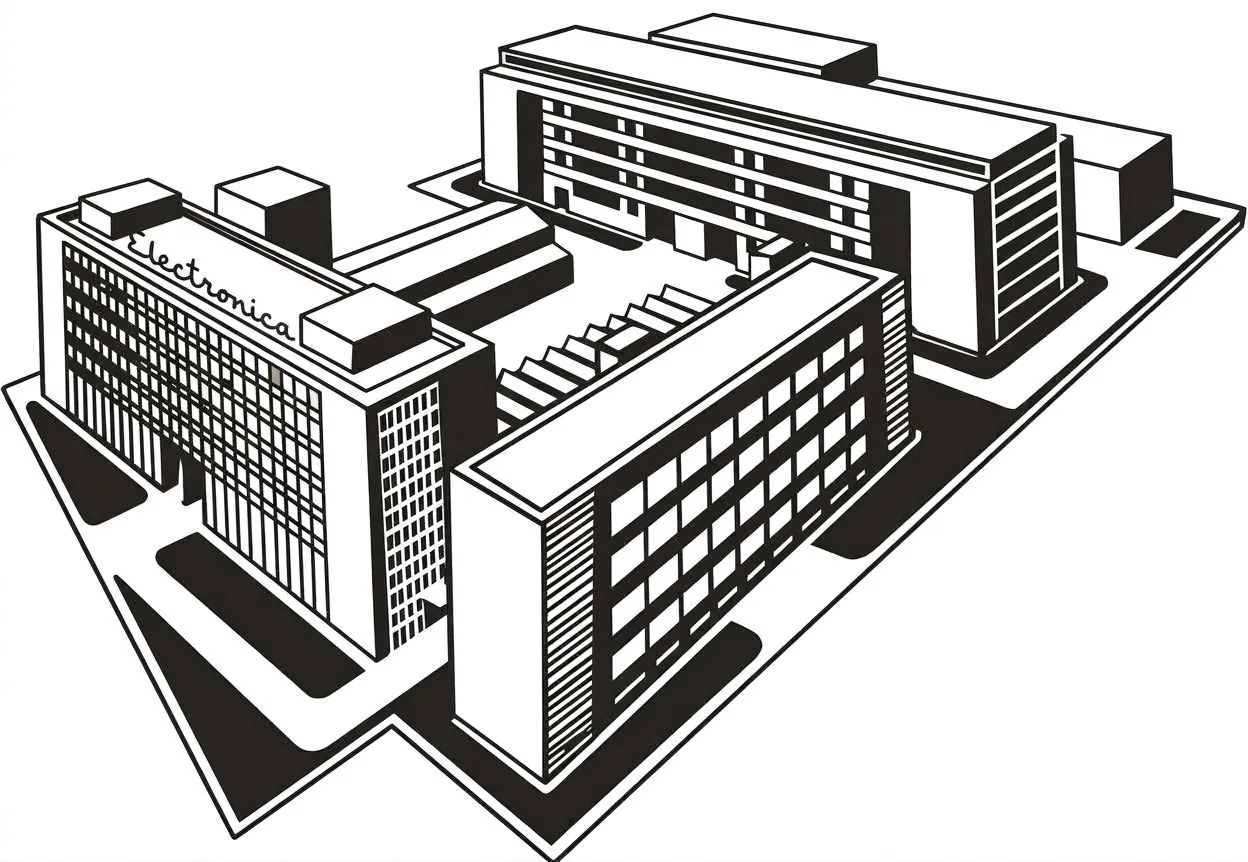
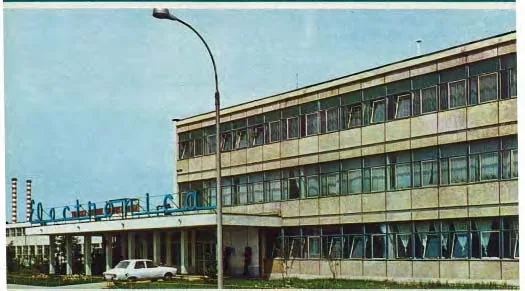
Uzinele Electronica (the Electronica Works) in Bucharest was the cradle of the Romanian electronics industry. Most of the later Romanian consumer and professional electronics enterprises were derived from it [1]. The gallery at the bottom of the page shows the logos used by Radio Popular and Electronica over the years, and the company’s buildings.
Philips in Romania (1927–1948)
Romanian electronics began in 1937 with the factory of Philips – Societate Anonimă Română, built at 82 Baicului Road (Șoseaua Baicului) in Bucharest [1]. The company had been registered in Bucharest in September 1927 to sell Philips products; from the end of 1928 it also sold Dutch-made Philips radios, loudspeakers and radio tubes [3]. In 1933 it opened an assembly workshop in Oradea (about 70 people), which put together Philips radios from parts brought from the Netherlands; in 1934 the workshop moved to Bucharest [3].
In March 1937 the government approved a factory for radios and radio parts with a capacity of 10,000–15,000 sets a year; it started in September 1937 in rented premises and from the autumn of 1938 worked in its own halls on Baicului Road, with 133 employees [3]. During the war its output varied widely, between about 2,000 and 13,700 receivers a year, in 9 to 17 types a year; Philips models made in Bucharest included the 115A, 215A, 471A, 616A, 753A, 845A/U and 905X, and the Mediator and Siera series [3]. In 1941–1943 the factory also made industrial and professional equipment: welding sets, measuring instruments (17 types of the Philips GM series, among them the GM 3152, GM 3155 and GM 3156), microphones, audio amplifiers, loudspeakers, sound film projectors and rectifiers [3]. During the war it also built or repaired magnetic mine detectors, transmitter-receivers and Morse equipment [3]. In total, 60,994 radio receivers were made there between 1938 and June 1948 [3].
Radio Popular (1948–1960)
At the nationalisation of 1948 the factory became Radio Popular, with 158 employees, 125 of them workers [1]; two smaller firms, Radiomet and Starck (medical and professional electronics), were merged into it [3]. Its main products were radio receivers and radio-relay (“radioficare”) equipment for villages [4]. For ten years it assembled radio receivers from kits imported from socialist countries; the first, the Record S 49 U of 1949, built with Soviet kits, was clearly inferior to the sets made earlier with Dutch kits [1][4]. Kits later came from Hungary, Czechoslovakia and East Germany, and 36 types of popular-class table radios left the factory, together with simple crystal sets with headphones, village radio-relay stations and their loudspeakers [4].
Step by step the factory replaced imported parts with its own: loudspeakers with Al-Ni magnets (1954, tested from 1958 in an anechoic room built with Romanian Radio), pressed barium-ferrite ceramic magnets developed in-house (1956, when few factories in the world made them), potentiometers (1957), the CV 581 and CV 591 variable capacitors (1958), transformers, RF blocks and piano-key waveband switches [4]. From 1950 its Dura unit also had a section making electron tubes, moved to Baicului Road in 1956 [4]. In 1958 it launched the first radio receiver of Romanian design, the Opereta S 572 A, using locally made components such as loudspeakers, magnets and transformers; a few engineers trained at Philips kept the quality requirements close to Western standards [1][4]. It was followed in 1959 by the Concert S 591 A and the București 500 [4].
Until 1956 Radio Popular also made electromedical equipment (electric scalpels, dental diathermy, X-ray and ultrasound equipment), later taken over by Electrotehnica, as well as amplifier stations, radio-relay installations and radio transmitters for the armed forces; in 1958 it built the electronic part of the MECAN-2 analogue computer of the Academy’s Institute of Energetics [4]. Between 1948 and 1960 it made about 890,000 radio receivers in 85 types, rising from 1,706 sets in 1948 to almost 167,000 a year in 1959–1960 [4].
Uzinele Electronica (from 1960)
On 18 January 1960 Radio Popular became Uzinele Electronica, a date regarded as the birth of the modern Romanian electronics industry [1]. The works expanded with transistor portable radios built under a French licence, FM table radios of its own design, black-and-white television sets (also under a French licence), and professional electronics for agriculture and medicine [1]. In 1965 it had 5,396 employees [1].
The first year under the new name brought two firsts: the Enescu S 602 A, the first Romanian-designed FM receiver, and the Solistor S 595 T, the first transistor radio and the first set with printed-circuit wiring, built under a French licence [5]. In 1958 the works had bought the licence of the French firm COSEM for germanium transistors and diodes, and in 1960 it began making the first Romanian transistors, the EFT series (EFT106, EFT107, EFT108 and others) [5]. Transistor sets of its own design followed, such as the Miorița T2 S 618 T (about 240,000 made in 1961–1964) and the Turist S 615 T (about 600,000 in 1961–1966), and from 1965 the Mamaia S 651 T, the first Romanian portable with FM, built under a Japanese licence [5]. Printed circuits replaced point-to-point wiring from 1961 [5].
Television production began in 1961 with the VS 43-611, made under a licence from the French firm CSF, followed by sets built from Japanese (National, Sanyo), Hungarian and Czechoslovak kits, and from 1964 by the first Romanian-designed sets, the E 43 and E 47 [5]. In 1961–1965 the works made 50 types of radio receivers and 25 types of television sets [5]. Yearly radio output rose from 166,872 sets in 1960 to 323,099 in 1965 (1,474,398 in all, 609,711 of them transistor sets), and television output from 14,827 sets in 1961 to 100,000 in 1965 [5]. The 1,000,000th radio was made on 1 December 1962 and the 2,000,000th, a Darclee, in June 1965 [5].
The works also made industrial electronics: a grain moisture meter for the Ministry of Agriculture (1962, first series of 2,000), a 5 kVA capacitive high-frequency generator for the wood industry (1963), an inductive high-frequency generator and the Magnetodiaflux for treating seeds and plants in an electromagnetic field (1964), a capacitive level meter and communal radio and TV antenna equipment (1965), and audio amplifiers of 10 and 20 W (from 1960) and 250 and 300 W (1965) [5]. From 1961 to 1964 ceramic magnets, soft ferrites and industrial electronics were made in a second unit on Clăbucet Street, moved in 1965–1966 to Venerei Street, until these lines passed to IEMI (1970) and the Urziceni ferrite factory (1971) [5]. According to the postface of the book’s second volume, the first professional electronic equipment was made from 1960 in a new section of the works set up for this purpose: moisture meters for agriculture, military communications equipment and metal detectors, the last made to Soviet documentation; the activity then grew [9].
1966–1981
In 1966–1981 the works grew from 5,396 to 9,864 employees (1980) [6]. Radio production moved entirely to transistors – in 1968 170,000 of the 400,000 radios made still had tubes, in 1970 all 566,000 were transistorised – and the last tube set, the Traviata, was made in 1969 [6]. Notable radios were the Albatros portable (900,000 in 1967–1973), the first car radio, Sinaia S 693 T (1969), the Neptun (1970) with IPRS silicon transistors, the Cora miniature pocket set (1971), the stereo Maestro S 702 TS (1971) and the multifunctional Gloria (1974) [6]. Radio exports began in 1967 with 6,100 sets and reached 250,000 a year from 1973; in 1975–1981 the works also made clock radios for export (five Soundesign models for the USA, Junior for Yugoslavia, Comix for France) [6]. From 1974 radio production for the home market passed step by step to Tehnoton in Iași, for which Electronica trained 15–20 engineers [6]. Altogether Electronica made 5,476,462 radios in 1966–1981 (4,302,529 of them transistor sets) and exported more than 1.9 million [6].
Television production rose from 105,000 sets in 1966 to 574,397 in 1979 (6,042,026 in 1966–1981), passing through three generations of black-and-white sets: tube sets such as the Dacia (1966) and the Miraj–Venus series (1968; more than 1.2 million on the Miraj chassis), hybrid sets from the Saturn of 1971 (about 2.4 million hybrid sets in 1971–1976), and from 1976 modular sets with integrated circuits (Snagov, Sirius, Diamant, Lux) [6]. The first Romanian portable television set, the Sport E 31-731, followed in 1973 [6]. In 1970 television production moved to a new assembly plant at Pipera, and TV exports, begun in 1969 with 650 sets, reached 140,546 in 1980; from 1975 the works also exported production lines, and it was the general supplier of a black-and-white television factory in Pyongyang (North Korea) [6]. The works also made professional electronics (“profile II”): moisture meters and process instruments for agriculture and the food industry, medical equipment such as the Diadin 2, ship and aircraft radio equipment designed by ICE, communal antenna systems, loudspeakers, speaker enclosures and amplifiers of up to 2 × 50 W [6]. Its first military equipment was the R-34 T short-wave receiver, designed by its chief designer service IV; it later made the R1070, R1071 and R1260 VHF radio stations and the R-4010 radio relay station [8].
On 1 October 1981, under State Council Decree 254/1981, the works were split: the Baicului Road unit became the Industrial Electronics Enterprise of Bucharest (IEI), while Întreprinderea Electronica moved its headquarters to 5–7 Dimitrie Pompei Boulevard on the Pipera platform and kept the production of black-and-white and colour TV sets, radios, music centres, speaker enclosures and radio-cassette recorders [6].
1981–1989
In 1982–1986 Întreprinderea Electronica put into production more than 130 new and modernised black-and-white TV types (75 for export) and 25 audio-radio products (12 for export) [7]. New audio products included the Stereoson 1 music centre (1983), the RIC miniature radios with micro-earphones (from 1983), the RCS 001 and RCS 002 stereo radio-cassette recorders and mini-rack stereo systems (from 1985), and its own cassette and record-player mechanisms [7]. Its black-and-white sets moved to a low-consumption chassis with three integrated circuits (Sirius 237, 1983) and were exported under many foreign brands [7]. Colour television production began with East German kits (Telecolor 3006, Cromatic) and Soviet kits (Elcrom), and in 1988 the first Romanian-designed colour set, the Telecolor 5601, was launched [7]. From 1984 the works also made colour and monochrome monitors [7].
Electronica also acted as an incubator, hosting new factories until they had their own premises: IPRS Băneasa (1962), IEMI (1968–1970, on Venerei Street) and Conect (1972–1974) [1]. In 1970 its television assembly moved to the Pipera platform as Electronica TV, and in 1974 the complete documentation for all its radio receivers was handed over to the new Tehnoton factory in Iași [1]. In 1981 the original site on Baicului Road became the home of IEI [1].
Together, the Romanian radio factories (Electronica, Tehnoton and Electromureș) made more than 15 million radio receivers, exported among others to the Netherlands, France, Germany, Switzerland, the USA and Czechoslovakia [1]. Later products included the RCS radio-cassette recorders (RCS 001 from 1984, RCS 002 in 1986), 2×20 W and 2×50 W amplifiers and “mini-tower” music centres [1].
In 1989
In 1989 the enterprise was listed as Întreprinderea „Electronica”, within the Industrial Central for Electronics and Computer Technology (CIETC) of the Ministry of the Electrotechnical Industry, at its Pipera headquarters [2].
Gallery
 No image available
 No image available
 No image available
 No image available
 No image available
Devices in the archive (345)
References
- [1]D. F. Lăzăroiu, N. Millea et al. – „Electronica românească. O istorie trăită”, vol. I, AGIR, chapter I „Industria electronică românească”
- [2]N. Drăgulănescu – „Agenda radioelectronistului”, 2nd edition, 1989, chapter 52 „Unități de cercetare, proiectare, producție și service – în industria electronică – din cadrul M.I.Et.”, pp. 742–749
- [3]D. F. Lăzăroiu, N. Millea et al. – „Electronica românească. O istorie trăită”, vol. I, AGIR, section II.1 „Societatea Anonimă Română – Philips, 1937–1948”, pp. 68–72
- [4]D. F. Lăzăroiu, N. Millea et al. – „Electronica românească. O istorie trăită”, vol. I, AGIR, section II.2 „Fabrica Radio Popular, 1948–1959”, pp. 103–117
- [5]D. F. Lăzăroiu, N. Millea et al. – „Electronica românească. O istorie trăită”, vol. I, AGIR, section II.3 „Uzinele Electronica, 1960–1965”, pp. 124–144
- [6]D. F. Lăzăroiu, N. Millea et al. – „Electronica românească. O istorie trăită”, vol. I, AGIR, section II.4 „Uzinele Electronica, 1966–1981”, pp. 155–181
- [7]D. F. Lăzăroiu, N. Millea et al. – „Electronica românească. O istorie trăită”, vol. I, AGIR, section II.5 „I.I.S. Electronica, 1981–1989”, pp. 202–213
- [8]N. Millea (coord.) et al. – „Electronica românească. O istorie trăită”, vol. II „Electronica profesională”, AGIR, section V.1.4.4 „Întreprinderea Electronica Industrială / IEI”, pp. 441–444
- [9]N. Millea (coord.) et al. – „Electronica românească. O istorie trăită”, vol. II „Electronica profesională”, AGIR, „Postfață la volumul 2” (D.-F. Lăzăroiu), pp. 733–737