EG 24.00
IPRS Băneasa
- Manufacturer
- IPRS Băneasa

- Country
- Romania

- Year
- Unknown
- Category
- Components
- Type
- Capacitors
- Documentation score
- 1/5
- Last edited
- 16 OCT 2026
Specifications
- Type
- aluminium electrolytic, multiple, for printed circuits
- Standard
- STAS 7675-73
- Capacitance (Cn)
- 10…200 µF
- Capacitance, min
- 10 µF
- Capacitance, max
- 200 µF
- Tolerance
- −20…+50 %; −10…+50 %
- Rated voltage (Un)
- 350 V
- Surge voltage (Us)
- 385 V
- Dissipation factor (tan δ)
- ≤ 0.15
- Leakage current (If)
- ≤ 0.05·CnUn [µF·V] + 0.5 µA, at 20 °C
- Ripple current (I~)
- 400–850 mA (see Variants)
- Climatic category
- 25/070/21
- Package
- tube with a cathode fixing ring and pins for printed circuits
- Sections
- 1–3 (see Variants)
- Diameter (D)
- 30–35 mm (see Variants)
- Length (L)
- 60–80 mm (see Variants)
- Application
- filtering in high-voltage rectifiers, on printed circuits
Variants (6)
| Note | Compare | ||||||||
|---|---|---|---|---|---|---|---|---|---|
| EG 24.71 (200 µF) | 200 µF | 200 | 200 | 850 | 1 | 35 | 80 | anode 3; I0 850 mA | |
| EG 24.71 (100 + 100 µF) | 100 + 100 µF | 100 | 100 | — | 2 | 35 | 80 | anodes 2, 3; I0 400 + 400 mA | |
| EG 24.71 (10 + 100 + 100 µF) | 10 + 100 + 100 µF | 10 | 100 | — | 3 | 35 | 80 | anodes 1, 2, 3; I0 70 + 400 + 400 mA | |
| EG 24.71 (100 + 47 + 47 µF) | 100 + 47 + 47 µF | 47 | 100 | — | 3 | 35 | 80 | anodes 1, 2, 3; I0 400 + 200 + 200 mA | |
| EG 24.66 (100 µF) | 100 µF | 100 | 100 | 400 | 1 | 30 | 60 | anode 3; I0 400 mA | |
| EG 24.66 (47 + 47 µF) | 47 + 47 µF | 47 | 47 | — | 2 | 30 | 60 | anodes 2, 3; I0 200 + 200 mA |
Click a column heading to sort. „+” adds a variant to the comparison (EG 24.00).
Description
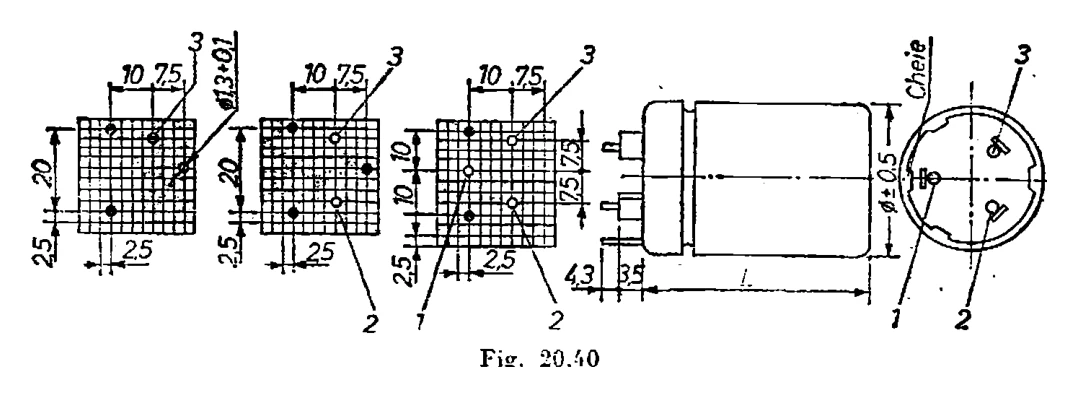
The EG 24.00 is a series of multiple aluminium electrolytic capacitors – one, two or three in one tube – for mounting on printed circuits, rated 350 V DC, made to STAS 7675-73 for filtering in high-voltage rectifiers [1]. The common cathode is a fixing ring with small feet and the anodes are numbered 1, 2 and 3 in the drawing [1]. The Agenda radioelectronistului (2nd edition, 1989) lists two package codes, EG 24.66 and EG 24.71, each in several combinations of sections, with the maximum ripple current I0 of each section; the peak voltage is 1.1 Un [1].
The Agenda does not say which works made the series: for the whole section on capacitors made in Romania it lists IPEE Electroargeș of Curtea de Argeș, Tehnoton of Iași, IIS Electronica of Bucharest and IPRS Băneasa as producers, and the 1st edition (1983) names only the first three [3][4]. It is listed here as made by IPRS Băneasa; Un secol de electronică în România says that IPRS made seven types of electrolytic capacitors, from 1 µF to 10,000 µF and from 3 V to 450 V [5].
Coded as [3]:
| Part | Meaning |
|---|---|
| EG | construction type: electrolytic capacitor (of high capacitance) |
| 24 | technological family („familia tehnologică”) |
| 66, 71 | package code („codul capsulei”) |
The capacitors are marked in clear; the book’s example „EG 52.43—22/16” gives the code, the nominal capacitance (22 µF) and the rated voltage (16 V) [3].
The 1st edition (1983) has the same table, but its leakage-current formula ends in „+ 0,5 Un” (2nd edition: „+ 0,5 µA”) [2][1]. The book gives the dissipation factor without the frequency or temperature [1].
Rated voltages are DC („Vcc”). Dimensions in mm (fig. 20.40): Ø ± 0.5 and length L from the table; the drawing shows the hole patterns (2.5 mm grid, holes Ø 1.3) and a key on the end [1].
Gallery
 No image available
Documents
No documents available yet.
References
- [1]N. Drăgulănescu – „Agenda radioelectronistului”, 2nd edition, Editura Tehnică, 1989, section 20.4.3.8 „Condensatoare electrolitice pentru cablaje imprimate seria EG 24.00”, p. 280
- [2]N. Drăgulănescu – „Agenda radioelectronistului”, 1st edition, Editura Tehnică, 1983, section 3.5.4.3.8 „Condensatoare electrolitice pentru cablaje imprimate seria EG 24.00”, p. 250
- [3]N. Drăgulănescu – „Agenda radioelectronistului”, 2nd edition, Editura Tehnică, 1989, sections 20.4 „Condensatoare produse în R.S.R.” (p. 248) and 20.4.3.1 „Codificare – marcare (în clar)” (p. 273)
- [4]N. Drăgulănescu – „Agenda radioelectronistului”, 1st edition, Editura Tehnică, 1983, sections 3.5.4 „Condensatoare produse în R.S.R.” (p. 218) and 3.5.4.3.1 „Codificare – marcare (în clar)” (p. 243)
- [5]N. Millea, I. Constantinescu (coord.) – „Un secol de electronică în România”, Editura Academiei Române, 2020, section VIII.1.2.6, pp. 408–411