P solid-dielectric variable capacitors
Electronica
- Also known as
- condensatoare variabile cu dielectric solid
- Manufacturer
- Electronica

- Country
- Romania

- Year
- Unknown
- Category
- Components
- Type
- Capacitors
- Documentation score
- 1/5
- Last edited
- 16 OCT 2026
Specifications
- Type
- variable, solid dielectric
- Standard
- STAS 7938-76
- Capacitance (Cn)
- ΔC up to 270 or 296 pF (AM sections), up to 10.5 pF (FM sections)
- Rated voltage (Un)
- 50 V
- Dissipation factor (tan δ)
- AM sections: ≤ 7·10⁻³ (C = 50 pF); FM sections: ≤ 6·10⁻³ (C = 10 pF)
- Construction
- 5 different values (see Variants)
- Rotation torque
- 5·10⁻³…40·10⁻³ N·m
- Rotation angle
- 174 °
- Drive ratio
- 1–5.66 : 1 (see Variants)
- Capacitance swing (ΔC), AM
- 270–296 pF (see Variants)
- Capacitance swing (ΔC), FM
- 10.5 pF (see Variants)
- Initial capacitance (C0), AM
- 35 pF
- Initial capacitance (C0), FM
- 20 pF
- Residual capacitance (CR), AM
- 7 pF
- Residual capacitance (CR), FM
- 5 pF
- Alignment tolerance
- AM: ±(2 % + 2 pF), FM: ±(1.5 % + 1.5 pF), to the capacitance curve and between sections
- ΔC curve, AM
- 20.70 e, 20.70 f (see Variants)
- ΔC curve, FM
- 20.70 g (see Variants)
- Length (L)
- 58–61 mm (see Variants)
- Application
- tuning circuits of miniature transistor AM or AM/FM radio receivers
Variants (5)
| Note | Compare | |||||||||
|---|---|---|---|---|---|---|---|---|---|---|
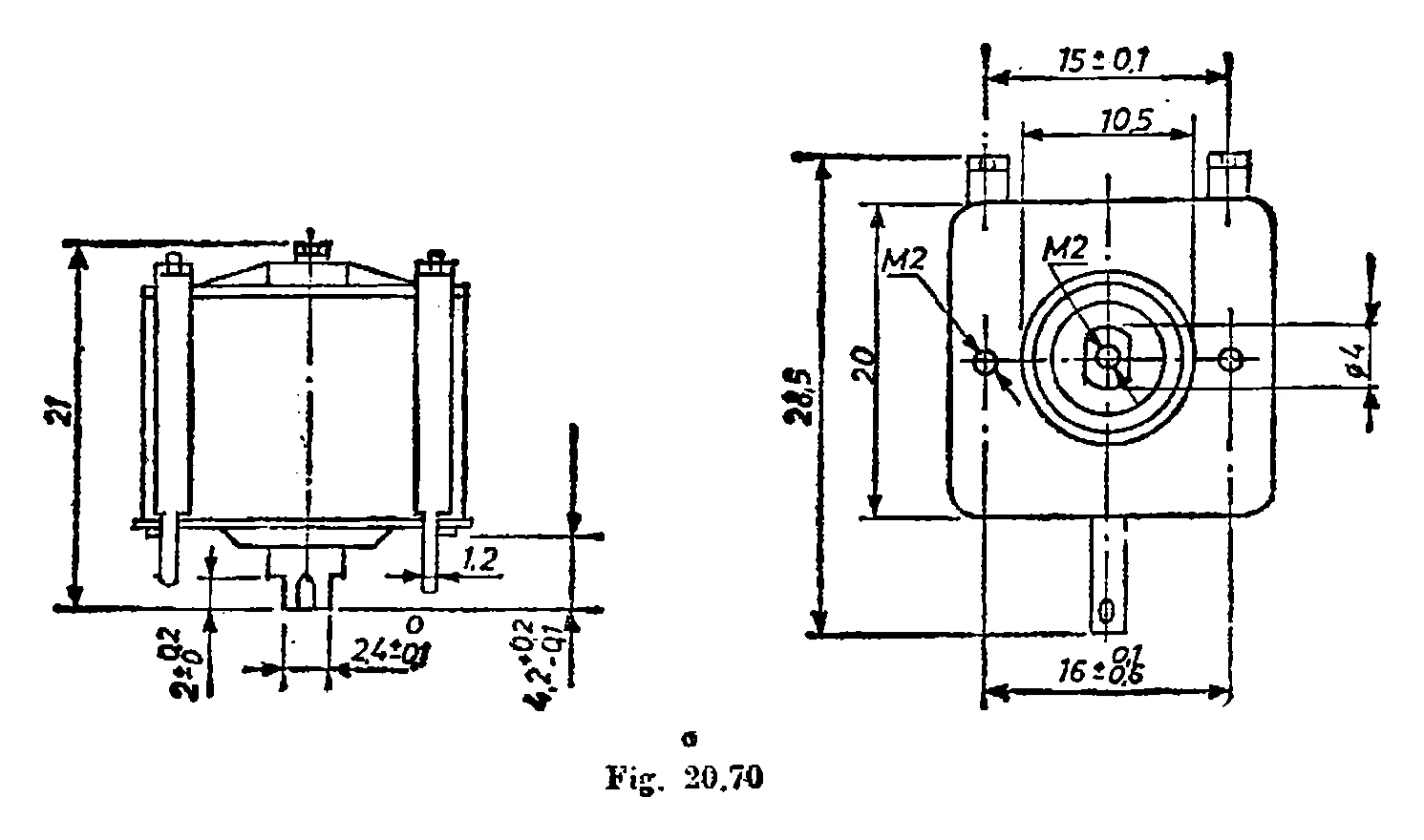
| P 10.589 | fig. 20.70 a, counter-clockwise | 1 | 270 | — | 20.70 e | — | — | AM | ||
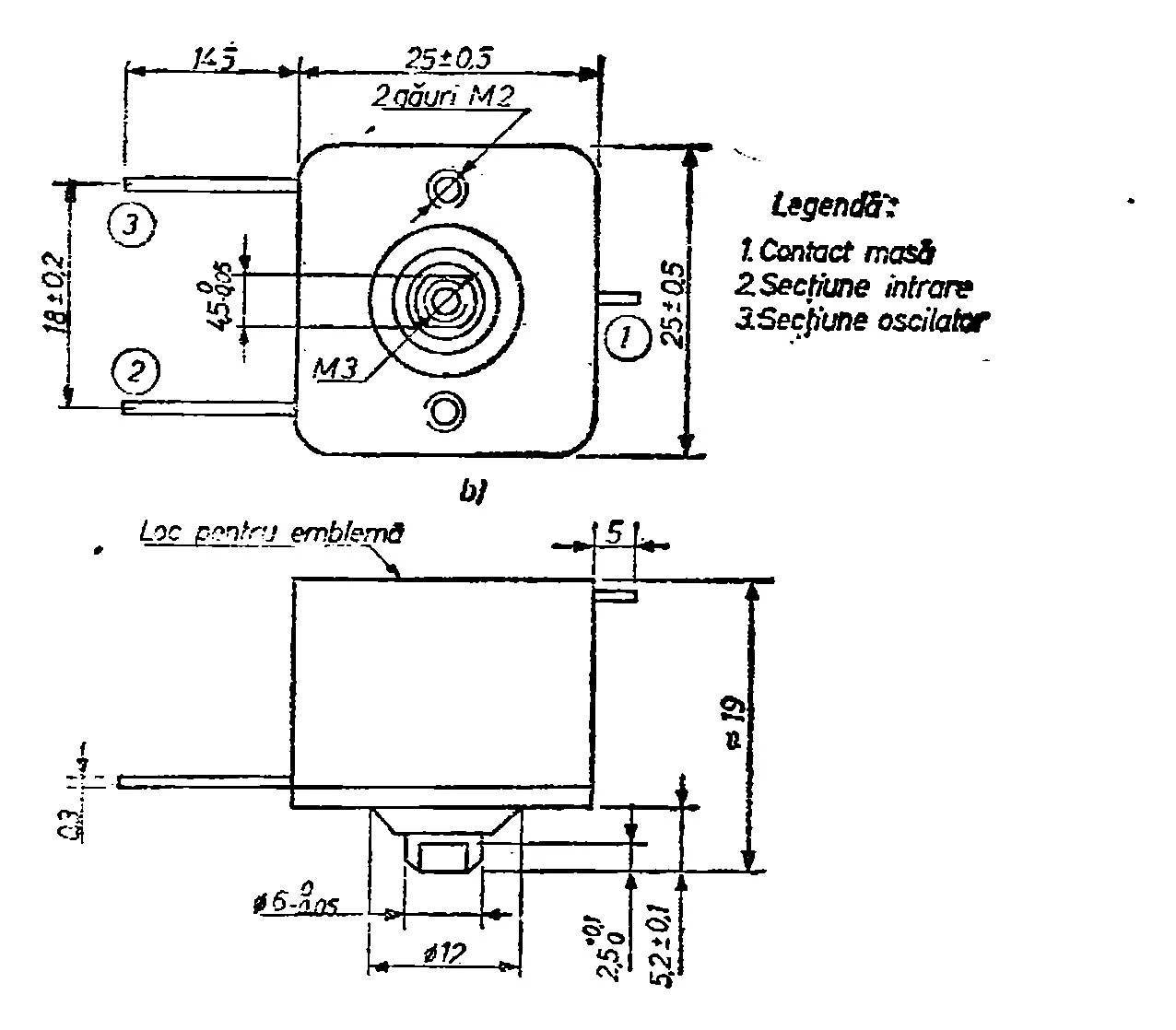
| P 10.903 | fig. 20.70 b, clockwise | 1 | 296 | — | 20.70 f | — | — | AM | ||
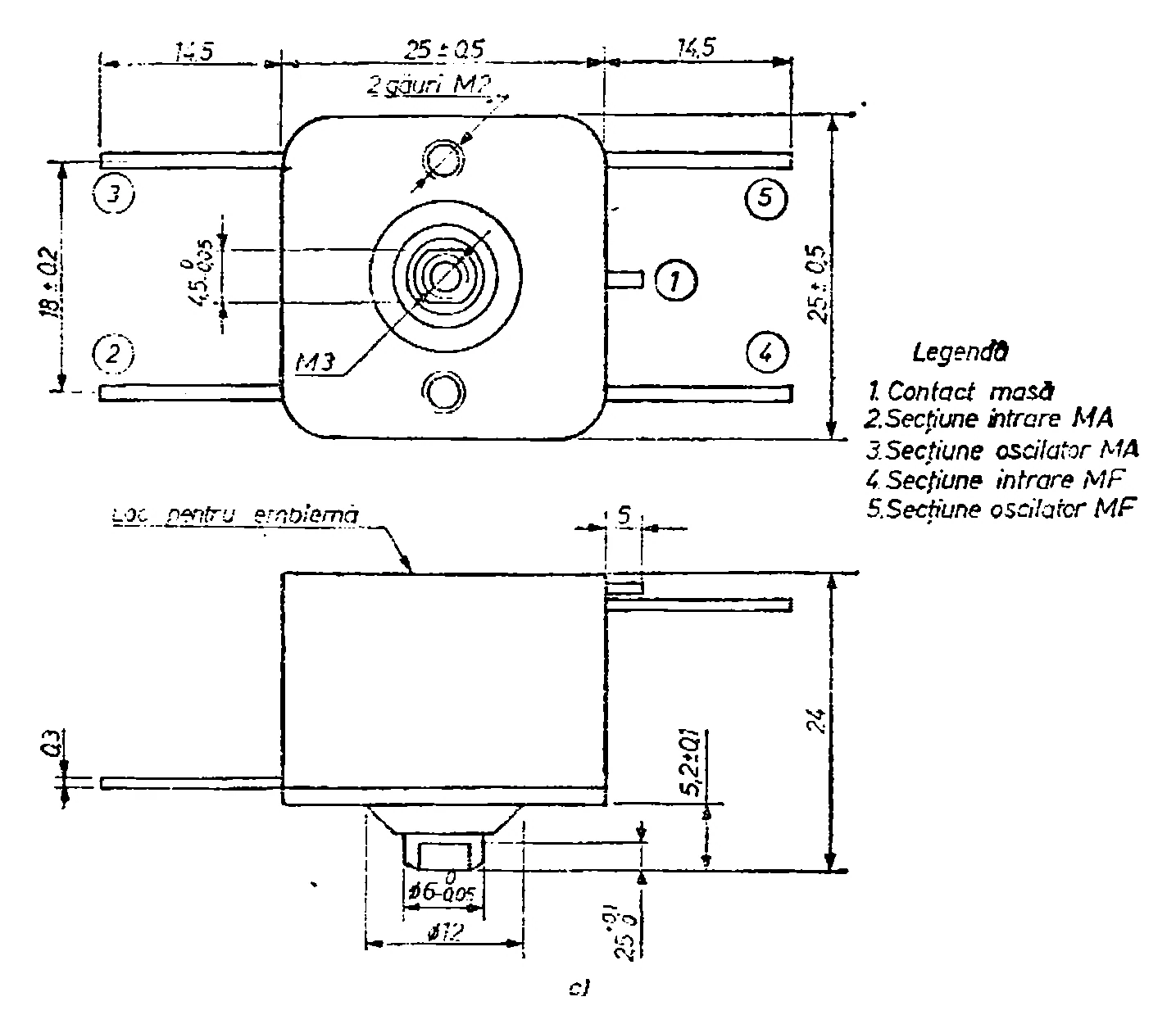
| P 10.890 | fig. 20.70 c, clockwise | 1 | 296 | 10.5 | 20.70 f | 20.70 g | — | AM, FM | ||
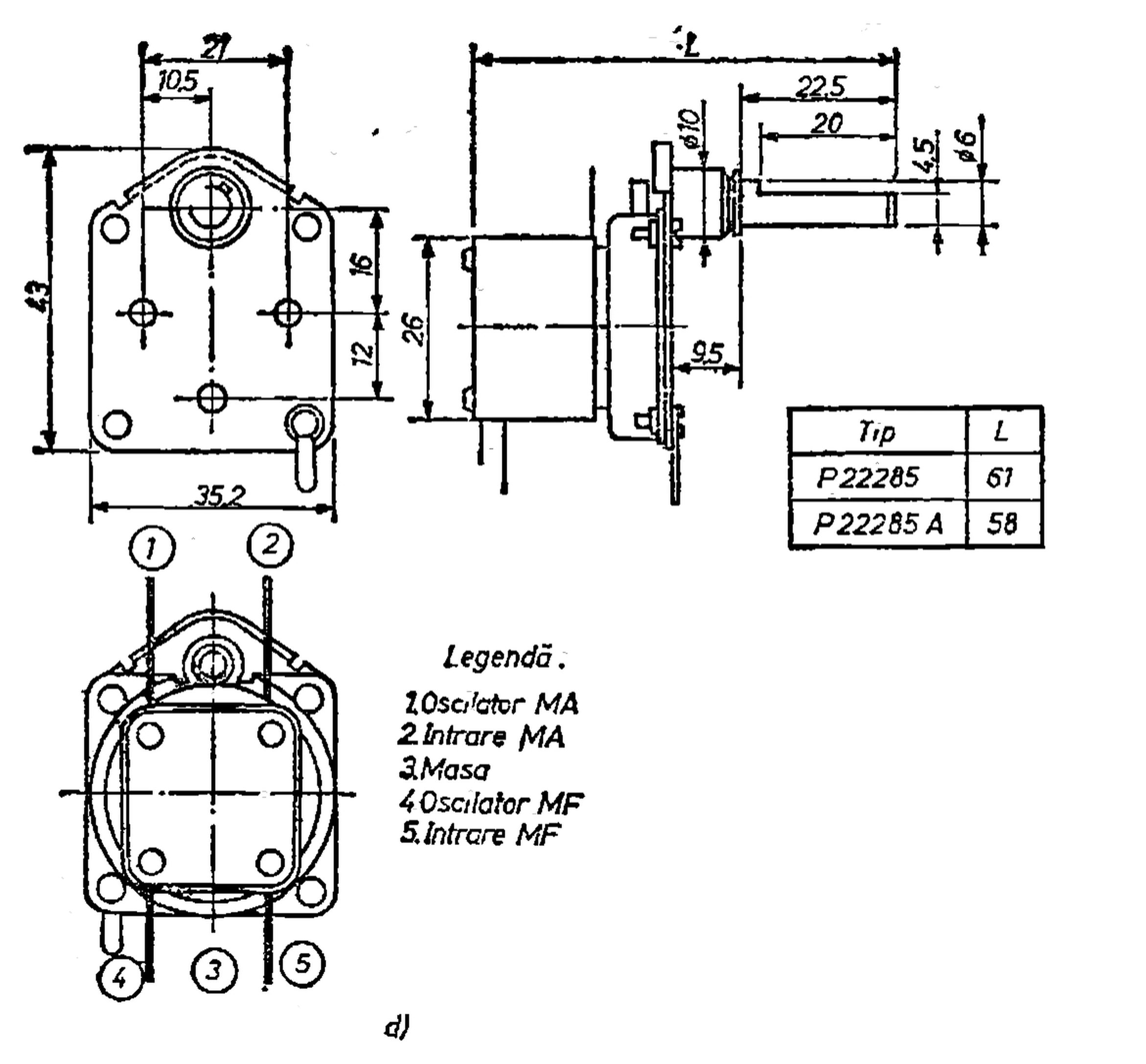
| P 22.285 | fig. 20.70 d | 1 | 296 | 10.5 | 20.70 f | 20.70 g | 61 | AM, FM | printed in one row with P 22.285 A („P 22.285, A”); L from the table of fig. 20.70 d; the list under curve g names only P 22285 A | |
| P 22.285 A | fig. 20.70 d, counter-clockwise | 5.66 | 296 | 10.5 | 20.70 f | 20.70 g | 58 | AM, FM | printed in one row with P 22.285 („P 22.285, A”); L from the table of fig. 20.70 d |
Click a column heading to sort. „+” adds a variant to the comparison (P solid-dielectric variable capacitors).
Description
The P solid-dielectric variable capacitors are the variable capacitors with a solid dielectric listed in the Agenda radioelectronistului (2nd edition, 1989), made to STAS 7938-76 for the tuning circuits of miniature transistor AM or AM/FM radio receivers, rated 50 V [1]. Its table has four rows – P 10.589, P 10.903, P 10.890 and „P 22.285, A” (P 22.285 and P 22.285 A) – each with its drawing, its use (AM, or AM and FM) and the curves ΔC = f(α) of its sections [1].
Each capacitor has two kinds of sections, input („de intrare”) and oscillator („de oscilator”), and each kind has one section for AM (MA) or two, for AM and FM (MF) [1]. The AM sections have an initial capacitance C0 of 35 pF and a residual capacitance CR of at most 7 pF, the FM sections 20 pF and at most 5 pF; the alignment factor is printed „G : 1” for both sections [1]. The effective rotation angle is 174° + 3° and the operating torque 5·10⁻³…40·10⁻³ N·m, clockwise for P 10.903 and P 10.890 and counter-clockwise for P 10.589 and P 22.285 A; the drive ratio is 1 : 1, and 5.66 : 1 for P 22.285 A [1].
The Agenda does not say which works made the series: for the whole section on capacitors made in Romania it lists IPEE Electroargeș of Curtea de Argeș, Tehnoton of Iași, IIS Electronica of Bucharest and IPRS Băneasa as producers, and the 1st edition (1983) names only the first three [3][4]. It is listed here as made by Electronica. Electronica românească. O istorie trăită, vol. I, says that the first variable capacitors were put into production when the factory was still Radio Popular, and describes an air-dielectric one [5].
Coded as [3]:
| Part | Meaning |
|---|---|
| P 21.720 | maker’s code („codul producătorului”) |
| A | constructive variant („variantă constructivă”) |
The book’s example is „P — 21.720 A”; it does not explain the letter P or the digits [3].
The variation of capacitance ΔC with the rotation angle α (fig. 20.70 e…g) [1]:
Curve e (AM, P 10.589):
| α (°) | ΔCosc (pF) |
|---|---|
| 20 | 23 |
| 40 | 54 |
| 60 | 87 |
| 80 | 116 |
| 100 | 145 |
| 120 | 174 |
| 140 | 206 |
| 160 | 243 |
| 180 | 270 |
Curve f (AM, P 10.903, P 10.890, P 22.285):
| α (°) | ΔCosc (pF) | ΔCcor (pF) |
|---|---|---|
| 0 (1st edition: 6) | 0 | 0 |
| 23 | 8.5 | 8 |
| 43 | 19 | 17.8 |
| 63 | 36.5 | 35.6 |
| 83 | 62.4 | 62.6 |
| 113 | 119.3 | 122.3 |
| 143 | 195.3 | 198.8 |
| 180 | 296 | 296 |
Blurred in the 2nd edition and taken from the 1st (and from the axis of the graph): ΔCosc at 23° and at 180°, and the fifth angle, printed „63” a second time [1][2].
Curve g (FM, P 10.890, P 22.285 A):
| α (°) | ΔCosc (pF) |
|---|---|
| 0 | 0 |
| 26 | 0.5 |
| 55 | 1.5 |
| 85 | 3.1 |
| 115 | 5.35 |
| 145 | 7.6 |
| 175 | 10.1 |
| 180 | 10.5 |
The last angle is blurred in the 2nd edition and taken from the 1st [1][2].
The code table heads the figure column „Fig. nr. 20.70” but prints the drawings as „68 a”…„68 d”, the numbers of the 1st edition (fig. 3.5.68) [1][2]. The 5.66 : 1 ratio and the counter-clockwise rotation are given only for P 22.285 A; for P 22.285 the book gives only its own length, L = 61 mm (P 22.285 A: 58 mm) [1]. The axis labels of graph g (0.5…18 pF, 6…180°) do not match its table, which ends at 10.5 pF; the same in the 1st edition [1][2].
Curve f names P 22285 among its AM types in the 2nd edition and P 22285 A in the 1st [1][2]. Under the axis of graph e a second row of angles, (18.5) to (177), is printed without explanation [1]. In fig. 20.70 d the 2nd edition prints 27 and 26 where the 1st edition has 21 and 25, and in fig. 20.70 a 10.5 and M2 where the 1st edition has ≈ 10.5 and M3 [1][2].
Dimensions in mm are in the drawings (fig. 20.70 a…d); the overall length L of P 22.285 and P 22.285 A (61 and 58) is given in a small table in fig. 20.70 d. „ΔC AM” and „ΔC FM” in the Variants table are the largest values of the curves [1].
Gallery
 No image available
 No image available
 No image available
 No image available
Documents
No documents available yet.
References
- [1]N. Drăgulănescu – „Agenda radioelectronistului”, 2nd edition, Editura Tehnică, 1989, section 20.4.5.9 „Condensatoare variabile cu dielectric solid”, pp. 308–311
- [2]N. Drăgulănescu – „Agenda radioelectronistului”, 1st edition, Editura Tehnică, 1983, section 3.5.4.5.9 „Condensatoare variabile cu dielectric solid”, pp. 277–280
- [3]N. Drăgulănescu – „Agenda radioelectronistului”, 2nd edition, Editura Tehnică, 1989, sections 20.4 „Condensatoare produse în R.S.R.” (p. 248) and 20.4.5.1 „Codificare – marcare (în clar)” (p. 301)
- [4]N. Drăgulănescu – „Agenda radioelectronistului”, 1st edition, Editura Tehnică, 1983, sections 3.5.4 „Condensatoare produse în R.S.R.” (p. 218) and 3.5.4.5.1 „Codificare – marcare (în clar)” (p. 270)
- [5]D. F. Lăzăroiu, N. Millea et al. – „Electronica românească. O istorie trăită”, vol. I, AGIR, section II.6 „Componente, subansamble și ansamble conexe”, II.6.3.2.2 „Condensatoare variabile”, p. 268