P multiple potentiometers
Electronica
- Manufacturer
- Electronica

- Country
- Romania

- Year
- Unknown
- Category
- Components
- Type
- Potentiometers
- Documentation score
- 1/5
- Last edited
- 16 OCT 2026
Specifications
- Type
- multiple, for varicap tuning
- Standard
- STAS 9614/2-74
- Construction
- block of 4 identical potentiometers (see Variants)
- Resistance (Rn)
- 25 kΩ…500 kΩ
- Resistance, min
- 25000 Ω
- Resistance, max
- 500000 Ω
- Tolerance
- ±20 % (Rn ≤ 250 kΩ), ±30 % (Rn > 250 kΩ)
- Rated power (Pdn)
- 0.1–0.25 W (see Variants)
- Limit voltage (Unlim)
- 50–250 V (see Variants)
- Noise (F)
- F = 2.5 mV/V (see Variants)
- Rotation angle
- 6480–12400 ° (see Variants)
- Mechanical endurance
- ≥ 10 000 operations
- Mechanical endurance, min
- 10000 operations
- Climatic category
- 25/070/21, 10/070/21 (see Variants)
- Marking
- in clear
- Application
- tuned circuits with varicap diodes of TV receivers
Variants (3)
| Note | Compare | ||||||||||
|---|---|---|---|---|---|---|---|---|---|---|---|
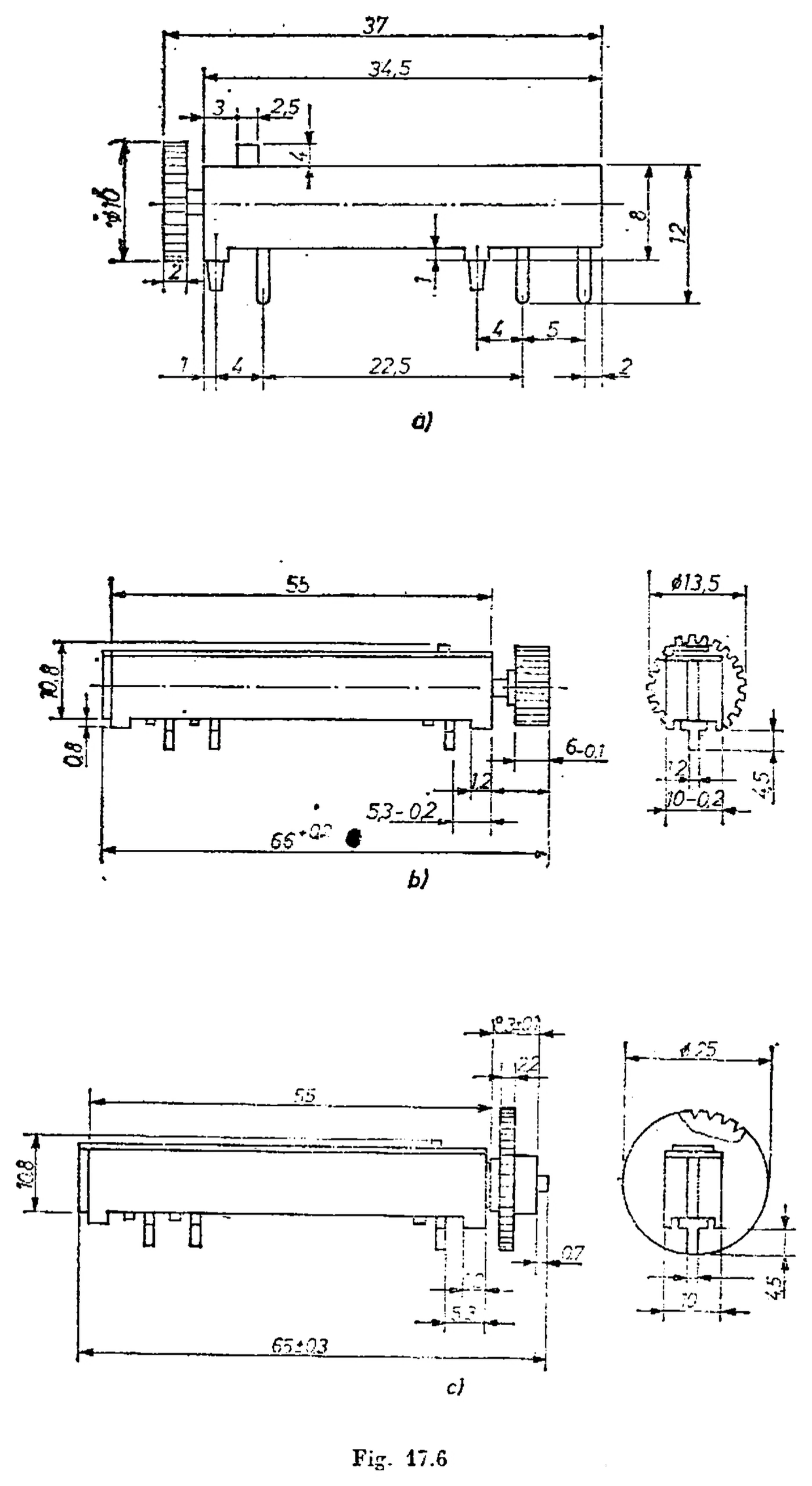
| P-35690 | — | 50, 100, 250 kΩ | 50000 | 250000 | 0.1 | 150 | — | 6480 | 25/070/21 | fig. 17.6 a; rotation angle 6480° ± 360° | |
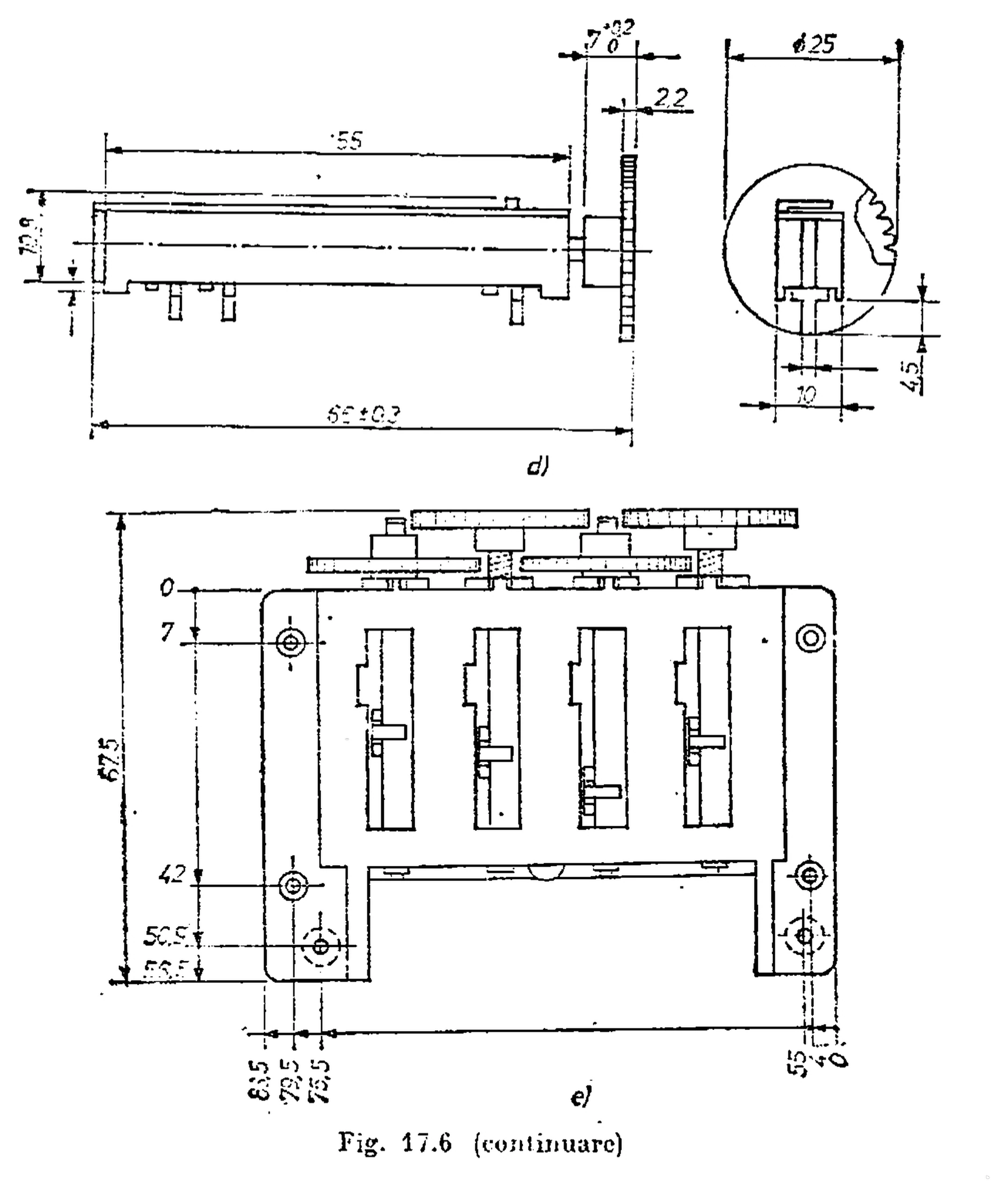
| P-33477 | — | 50…500 kΩ | 50000 | 500000 | 0.2 | 250 | F = 2.5 mV/V | — | 10/070/21 | fig. 17.6 b (A), c (J, L), d (K, M, N, O); versions —, A, J, K, L, M, N, O; rotation angle 7200° (A, J, K, L, M) or 14400° (N, O) | |
| P-36254 | block of 4 identical potentiometers | 25 kΩ (±30 %) | 25000 | 25000 | 0.25 | 50 | — | 12400 | 10/070/21 | fig. 17.6 e; rotation angle 12400° ± 360° |
Click a column heading to sort. „+” adds a variant to the comparison (P multiple potentiometers).
Description
The P multiple potentiometers („potențiometre multiple”) are potentiometers with total rotation angles of 6480° to 14400° for the tuned circuits with varicap diodes of TV receivers, made to STAS 9614/2-74 [1]. The Agenda radioelectronistului (2nd edition, 1989) lists three: P-35690 (50, 100 or 250 kΩ, 6480°), P-33477 (50…500 kΩ, 7200° or 14400° according to the version) and P-36254, a block of four identical 25 kΩ potentiometers (12400°) [1].
The Agenda radioelectronistului names IPEE Electro-Argeș of Curtea de Argeș and IIS Electronica of Bucharest as the producers of the potentiometers in its section on potentiometers made in Romania, in both editions, without saying which works made which type; they are listed here under Electronica [3][4]. Electronica românească. O istorie trăită, vol. I, says that Electronica imported in 1969 a production line for film potentiometers from Siemens (West Germany), and that it made single potentiometers with or without a mains switch, tandem and push-button potentiometers, defined by its internal norm NID 2195-67 [5].
The book does not explain the codes [1]. The 2nd edition prints the figure in the heading as „fig. 17. a … e” (1st edition: fig. 3.2.6 a… e); the table is the same in both editions, but the 1st edition’s fig. 3.2.6 also has a circuit diagram and mounting-hole details that the 2nd edition leaves out [1][2].
Rotation angle: total, in degrees. Dimensions in mm: see the drawings (fig. 17.6 a…e) [1].
Gallery
 No image available
 No image available
Documents
No documents available yet.
References
- [1]N. Drăgulănescu – „Agenda radioelectronistului”, 2nd edition, Editura Tehnică, 1989, section 17.2.1.6 „Potențiometre multiple”, pp. 219–221
- [2]N. Drăgulănescu – „Agenda radioelectronistului”, 1st edition, Editura Tehnică, 1983, section 3.2.2.1.6 „Potențiometre multiple”, pp. 188–191
- [3]N. Drăgulănescu – „Agenda radioelectronistului”, 2nd edition, Editura Tehnică, 1989, section 17.2 „Potențiometre și rezistențe semireglabile produse în R.S.R.”, p. 202
- [4]N. Drăgulănescu – „Agenda radioelectronistului”, 1st edition, Editura Tehnică, 1983, section 3.2.2 „Potențiometre și rezistențe semireglabile produse în R.S.R.”, p. 166
- [5]D. F. Lăzăroiu, N. Millea et al. – „Electronica românească. O istorie trăită”, vol. I, AGIR, section II.6 „Componente, subansamble și ansamble conexe”, p. 230, and II.6.3.2.1 „Potențiometre”, p. 267