PT
Electronica
- Also known as
- PT-16; PT-25; PT-50; PT-75; PT-100; PT-160
- Manufacturer
- Electronica

- Country
- Romania

- Year
- Unknown
- Category
- Components
- Type
- Potentiometers
- Documentation score
- 1/5
- Last edited
- 16 OCT 2026
Specifications
- Type
- wire-wound, glazed
- Standard
- STAS 9288-79
- Resistance (Rn)
- 10 Ω…47 kΩ
- Resistance, min
- 10 Ω
- Resistance, max
- 47000 Ω
- Law (taper)
- lin
- Tolerance
- ±10 %, ±20 %
- Rated power (Pdn)
- 16–160 W (see Variants)
- Limit voltage (Unlim)
- 450–2000 V (see Variants)
- Insulation resistance (Riz)
- ≥ 100 MΩ
- Dielectric strength
- 2500 V rms / 60 s
- Temperature coefficient
- ±200·10⁻⁶/°C
- Climatic category
- 40/200/56
- Marking
- in clear
- Max. diameter (Dmax)
- 30–110 mm (see Variants)
- Max. height (Hmax)
- 20–55 mm (see Variants)
- Max. dimension (Amax)
- 35–124 mm (see Variants)
- Application
- professional electronic circuits
Variants (6)
| Compare | ||||||||
|---|---|---|---|---|---|---|---|---|
| PT-16 | 10 Ω…4.7 kΩ | 4700 | 16 | 450 | 30 | 20 | 35 | |
| PT-25 | 10 Ω…10 kΩ | 10000 | 25 | 700 | 45 | 35 | 57 | |
| PT-50 | 10 Ω…22 kΩ | 22000 | 50 | 1000 | 57 | 40 | 70 | |
| PT-75 | 10 Ω…33 kΩ | 33000 | 75 | 1500 | 70 | 45 | 82 | |
| PT-100 | 10 Ω…47 kΩ | 47000 | 100 | 1800 | 90 | 50 | 102 | |
| PT-160 | 10 Ω…47 kΩ | 47000 | 160 | 2000 | 110 | 55 | 124 |
Click a column heading to sort. „+” adds a variant to the comparison (PT).
Description
The PT is a series of glazed wire-wound potentiometers, made to STAS 9288-79 for professional electronic circuits [1]. The Agenda radioelectronistului (2nd edition, 1989) lists six sizes, PT-16 to PT-160, rated 16 to 160 W, from 10 Ω to 47 kΩ (E6 and E12 series), with limit voltages of 450–2000 V [1].
The Agenda radioelectronistului names IPEE Electro-Argeș of Curtea de Argeș and IIS Electronica of Bucharest as the producers of the potentiometers in its section on potentiometers made in Romania, in both editions, without saying which works made which type; they are listed here under Electronica [3][4].
The book does not explain the codes [1]. The 1st edition (1983) gives the same data [2].
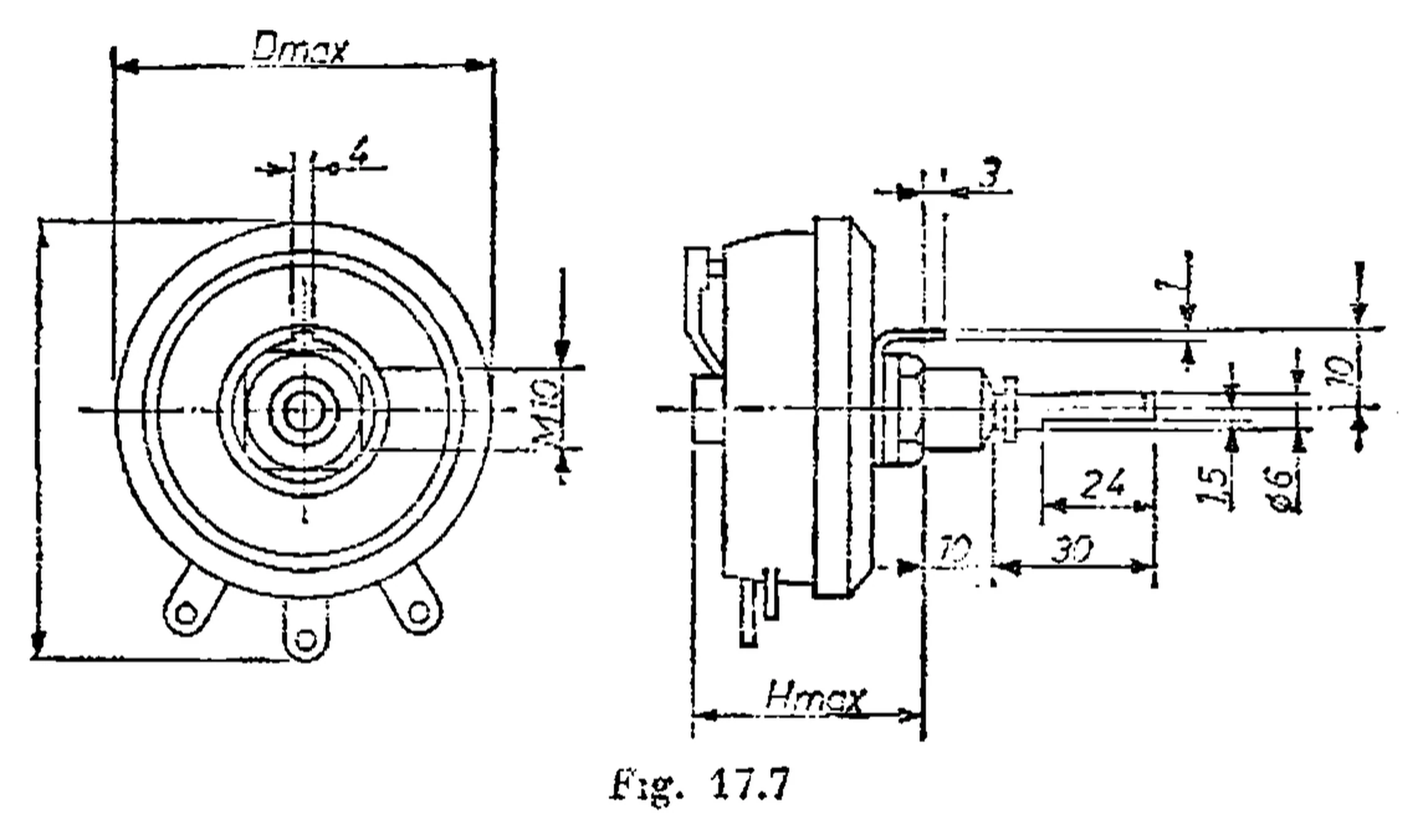
Dimensions in mm (fig. 17.7): maximum diameter Dmax and maximum height Hmax from the table; the table also gives a dimension Amax, which is not marked in the drawing of the 2nd edition (the 1st edition marks it in fig. 3.2.7); shaft Ø 6, threaded bush M10 [1][2].
Gallery
 No image available
Documents
No documents available yet.
References
- [1]N. Drăgulănescu – „Agenda radioelectronistului”, 2nd edition, Editura Tehnică, 1989, section 17.2.1.7 „Potențiometre bobinate glazurate”, p. 222
- [2]N. Drăgulănescu – „Agenda radioelectronistului”, 1st edition, Editura Tehnică, 1983, section 3.2.2.1.7 „Potențiometre bobinate glazurate”, pp. 191–192
- [3]N. Drăgulănescu – „Agenda radioelectronistului”, 2nd edition, Editura Tehnică, 1989, section 17.2 „Potențiometre și rezistențe semireglabile produse în R.S.R.”, p. 202
- [4]N. Drăgulănescu – „Agenda radioelectronistului”, 1st edition, Editura Tehnică, 1983, section 3.2.2 „Potențiometre și rezistențe semireglabile produse în R.S.R.”, p. 166
- [5]D. F. Lăzăroiu, N. Millea et al. – „Electronica românească. O istorie trăită”, vol. I, AGIR, section II.6 „Componente, subansamble și ansamble conexe”, p. 230, and II.6.3.2.1 „Potențiometre”, p. 267