 No image available


Specifications
- Function
- two-channel transcutaneous nerve stimulator
- Output
- 0–50 mA on 2 kΩ per channel; 200 µs pulses at 15–200 Hz, in 100 ms trains at 2 Hz
- Power supply
- 9 V battery (6F22) or AS 4 T adapter
- Dimensions
- 153 × 68 × 26 mm
- Weight
- 0.178 kg
Sources: [2]
Description
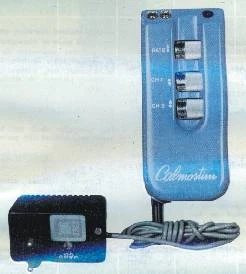
The Calmostin NTS-02 M is a transcutaneous nerve stimulator, made in the microproduction workshop of the ICE research institute in Bucharest, where it was designed [1].
Together with the Ministry of Health, ICE drew up a national medical equipment programme; the prototypes of its medical electronics laboratory went into production at IEIA Cluj-Napoca (19 types), IEMI (3), IEI (2) and in ICE’s microproduction workshop (19) [1]. As demand grew, production of some of them was taken over by IEI [1].
IEI also made it [3]. Its prospectus presents it as a replacement for painkillers in acute and chronic pain of rheumatic, neurological, vascular, post-traumatic or post-operative origin, and for sports and recovery medicine; it has two independent channels and two stimulation modes, works from a battery or the mains, and must not be used by people with an implanted pacemaker [2].
The Agenda radioelectronistului (2nd edition, 1989) lists the „CALMOSTIM NST-02 M” (spelled so; made by Întreprinderea de Electronică Industrială, Bucharest) among the medical electronic devices made in Romania [4]. It says that it efficiently replaces painkillers, relieving pain quickly for a few hours up to several days, with a clear therapeutic effect in the symptomatic treatment of acute and chronic pain of rheumatic, neurological, vascular, neoplastic and other origin, post-traumatic or post-operative; that it has two stimulation modes (with two independent channels for treating two different areas); and that the stimulation parameters do not change until the battery is exhausted [4]. It gives a current of 0…50 mA (into 1 kΩ), a pulse frequency adjustable from 15 to 200 Hz, a fixed pulse width of 200 µs, a pulse-train frequency of 2 Hz, a train length of 180 ms, a 9 V supply (from a 6 F 22 battery or an AS 41 adapter), dimensions printed as 26 × 68 × 153 „cm” (height × width × depth) and 178 g [4]. Its prospectus in „O istorie trăită” gives 2 kΩ, 100 ms trains, an AS 4 T adapter and 153 × 68 × 26 mm [4][2].
Photo Gallery
No other images available yet.
Schematics
No schematics available yet.
Documents
No documents available yet.
Prices
N/A
References
- [1]N. Millea (coord.) et al. – „Electronica românească. O istorie trăită”, vol. II „Electronica profesională”, AGIR, section II.4.3 „Laborator aparate electronice pentru medicină și biologie”, pp. 123–127
- [2]N. Millea (coord.) et al. – „Electronica românească. O istorie trăită”, vol. II „Electronica profesională”, AGIR, annex IV.2.2 „IEI – produse de uz civil: aparatură medicală”, pp. 694–701
- [3]N. Millea (coord.) et al. – „Electronica românească. O istorie trăită”, vol. II „Electronica profesională”, AGIR, chapter IV „Uzinele Electronica / Întreprinderea de Electronică Industrială – IEI”, pp. 411–422
- [4]N. Drăgulănescu – „Agenda radioelectronistului”, 2nd edition, Editura Tehnică, 1989, section 51.6 „Aparate electronice medicale”, p. 741