 No image available
Gloria
Electronica · 1974
- Manufacturer
- Electronica

- Country
- Romania

- Year
- 1974
- Decade
- 1970s
- Category
- Radio
- Type
- Radio receivers
- Documentation score
- 3/7
- Last edited
- 16 NOV 2026
Specifications
- Wavebands
- LW 150–260 kHz, MW 525–1605 kHz, SW1 5.5–9.9 MHz, SW2 11.5–18 MHz, FM 65–75 MHz
- Sensitivity
- 1 mV/m (ferrite antenna), 400 µV (car antenna)
- Output power
- min. 1.5 W on batteries, min. 2 W on mains or car supply
- Design / kits
- Romanian design
- Power supply
- 9 V (6 × R20 cells), mains, or 12 V from the car's electrical system
- Power consumption
- max. 35 mA without signal
- Dimensions
- 310 × 210 × 85 mm
- Weight
- 3.2 kg
Sources: [1]
Description
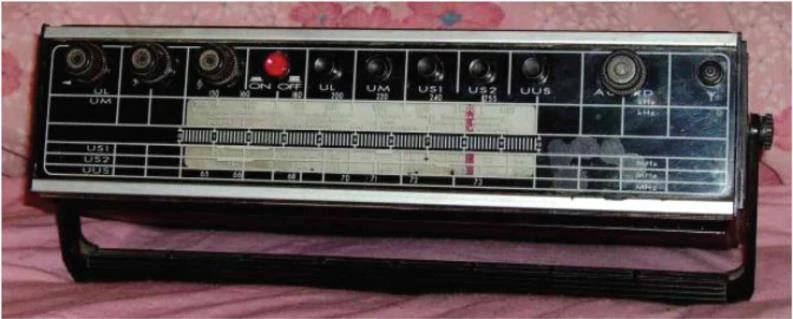
The Gloria is a multifunctional transistor radio – table, portable and car set – made by Electronica in Bucharest, running from the mains, batteries or a car battery and receiving LW, MW, two short-wave bands and FM [1]. It was designed in 15 months by engineer Cicerone Costache as a high-class portable (the book gives 1973), and was put into production in 1974 [1]. Its concept matched the top level set by firms such as Grundig, Philips and Schaub-Lorenz, and its cabinet introduced injection-moulded “bell” cabinets at Electronica [1]. It sold well for export, and was later made for many years at Tehnoton in Iași, in demand both at home and abroad [1].
Tehnoton’s production list gives it for 1976–1980, with exports in 1977 and 1978 [2].
The Agenda radioelectronistului (1st edition, 1983) names „Gloria” among the examples of families of broadcast radio receivers made in Romania for the home market that end its table of the main characteristics of AM/FM broadcast receivers (according to STAS 7711-72), in the column of portable receivers; as producers of the whole list it gives Electronica and Electromagnetica of Bucharest and Tehnoton of Iași [3].
In the source table, sensitivity is given on medium waves for 50 mW output and a 20 dB signal-to-noise ratio, selectivity for a signal ±9 kHz (AM) or ±300 kHz (FM) away, and output power at no more than 10% distortion [1].
Photo Gallery
No other images available yet.
Schematics
No schematics available yet.
Documents
No documents available yet.
Prices
N/A
References
- [1]D. F. Lăzăroiu, N. Millea et al. – „Electronica românească. O istorie trăită”, vol. I, AGIR, section II.4 „Uzinele Electronica, 1966–1981”, pp. 161–162 and annex II.4.2 „Radioreceptoare cu tranzistoare”, pp. 184–188
- [2]D. F. Lăzăroiu, N. Millea et al. – „Electronica românească. O istorie trăită”, vol. I, AGIR, section III.1 „Întreprinderea Tehnoton – Iași”, pp. 305–306, annex III.1.1 „Radioreceptoare produse de Tehnoton”, pp. 308–311
- [3]N. Drăgulănescu – „Agenda radioelectronistului”, 1st edition, Editura Tehnică, 1983, section 4.8 „Principalele caracteristici tehnice ale radioreceptoarelor pentru radiodifuziune MA/MF produse în RSR”, pp. 562–565
- [4]N. Millea, I. Constantinescu (coord.) – „Un secol de electronică în România”, Editura Academiei Române, 2020, p. 103