 No image available


Specifications
- Function
- functional tester and identifier of logic ICs (14, 16, 20 and 24 pins)
- Measuring ranges
- test max 0.6 s; identification max 4 s
- Accuracy
- detects 99.998 % of permanent faults (guaranteed)
- Power supply
- 220 V, 50 Hz
- Dimensions
- 350 × 350 × 110 mm
Description
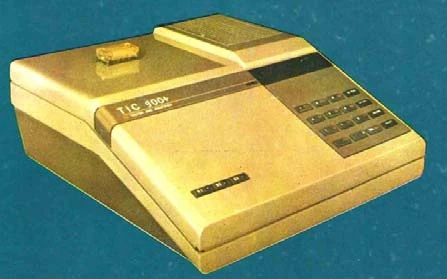
The TIC 900 PLUS is a functional tester and identifier for logic integrated circuits, made by IEMI in Bucharest [1]. It is in IEMI’s 1988 range [1].
According to annex III.2.10 it tested, identified and learned SSI and MSI circuits and some LSI circuits in TTL or MOS technology (SN 7400, 8200, 9300, 8T00 and HEF 4000 families) without needing a reference circuit, from an internal library of up to 900 types; it could learn up to 101 new types from a good reference circuit and keep them until switched off. It was portable, needed no external memory or computer and guided the operator through the test, with optional sound signals. It was meant for research and design, production, servicing, incoming inspection in IC stores and the identification of unmarked circuits; the prospectus claims that its test principle detects 99.998% of permanent faults [2].
The Agenda radioelectronistului (2nd edition, 1989) describes the „TIC 900 PLUS” („Testor identificator de circuite integrate digitale”, digital integrated circuit tester and identifier) among the automatic testers made by IEMI [3]. It says that it tests, identifies and learns any SSI or MSI digital integrated circuit (and a few LSI types) made in TTL or MOS technology, of the SN 7400, 8200, 9300, 8000 and HEF 4000 families, without needing a reference circuit; that it has an internal library of up to 900 types and can learn, from a correctly working reference circuit, up to 101 new types, which it keeps as long as it is powered, with no external memory or computer; that it tests digital ICs with 14, 16, 20 or 24 pins in at most 0.6 s and identifies them in at most 4 s; and that the detection of 99.998 % of the permanent faults of digital ICs is guaranteed; it is self-testing and designed for testability, and it runs from 220 V, 50 Hz and measures 11 × 35 × 35 cm (height × width × depth) [3]. Where annex III.2.10 of „O istorie trăită” lists the 8T00 family, the Agenda prints „8 000” [3][2].
Photo Gallery
No other images available yet.
Schematics
No schematics available yet.
Documents
No documents available yet.
Prices
N/A
References
- [1]N. Millea (coord.) et al. – „Electronica românească. O istorie trăită”, vol. II „Electronica profesională”, AGIR, sections III.2 „Producția IEMI” and III.3 „Comentarii tehnico-economice”, pp. 302–317, and annex III.2.3 „Producția IEMI – aparate electronice de măsură și industriale”, pp. 383–386
- [2]N. Millea (coord.) et al. – „Electronica românească. O istorie trăită”, vol. II „Electronica profesională”, AGIR, annex III.2.10 „Aparate pentru măsurarea parametrilor componentelor și circuitelor”, pp. 634–646
- [3]N. Drăgulănescu – „Agenda radioelectronistului”, 2nd edition, Editura Tehnică, 1989, section 50.8 „Testoare automate” (produse de IEMI – București), pp. 728–729