 No image available


Specifications
- Function
- rotational speed (rpm or c/s), speed ratio, slip, frequency-output quantities
- Measuring ranges
- 6 – 100,000 rpm (resolution down to 0.001 rpm); 0.06 – 10,000 Hz
- Accuracy
- 10⁻⁴ ± 1 unit
- Input impedance
- min 100 kΩ
- Display
- 4 digits, with memory
- Outputs / interface
- BCD (TTL) for a printer; +15 V, 0.2 A
- Power supply
- 220 V ±10 %
- Power consumption
- 70 VA
- Dimensions
- 413 × 117 × 413 mm (W × H × D)
- Weight
- 6 kg
Description
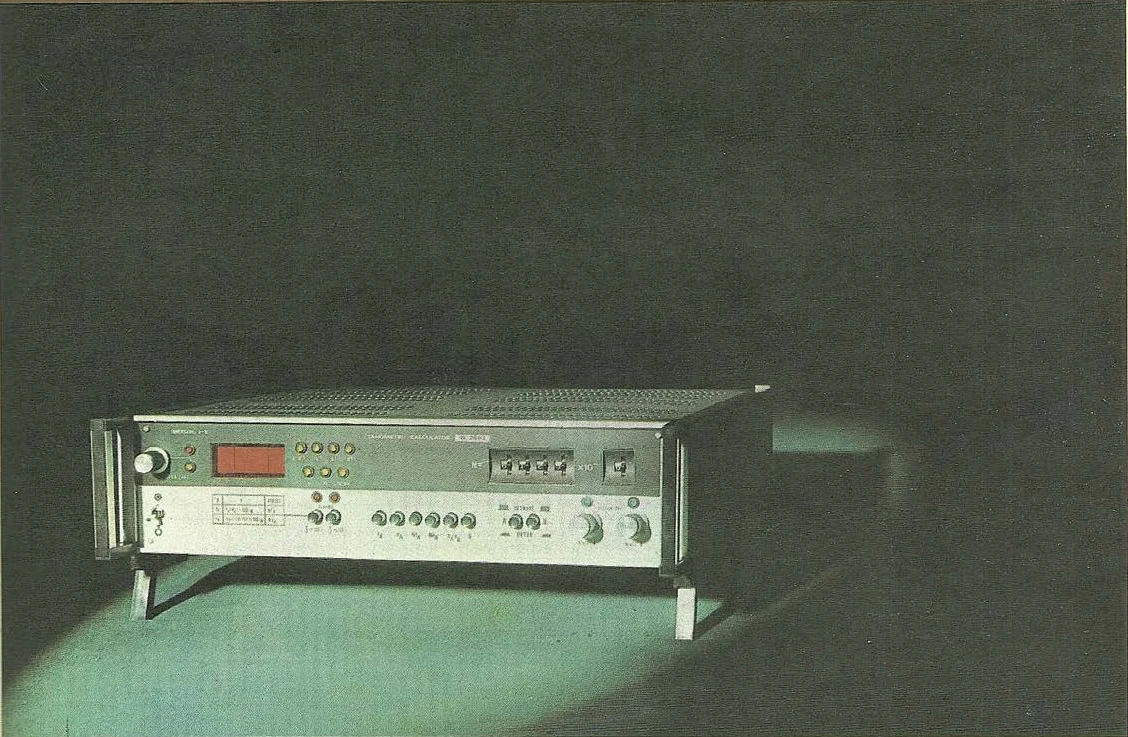
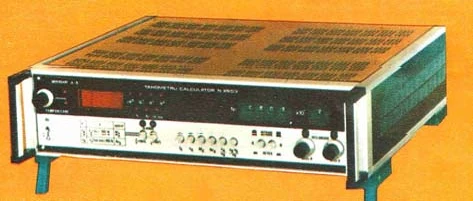
The N2603 is an electronic tachometer, made by IEMI in Bucharest [1]. IEMI’s production table lists 630 units made in 1981–1985 [1].
Its list price, set in 1982, was 20,000 lei [2].
Annex III.2.11 describes a digital tachometer for 6 – 100,000 rpm, showing the speed in rpm or in cycles per second whatever the number of pulses per revolution and the transducer used. It could also show the speed multiplied by a preset number (when the transducer could not be fitted directly on the measured gear), the percentage ratio of two speeds, the slip, or other quantities from transducers with a frequency output, such as flow or linear speed, and could signal preset speeds. It had a four-digit display with memory, automatic range and decimal-point switching, a BCD output for a printer and a stabilised +15 V output for supplying transducers; photoelectric or induction pulse transducers were supplied as accessories [3].
The 1st edition of the Agenda radioelectronistului (1983) lists the „N-2603” („Tahometru calculator”, computing tachometer) among the electronic instruments for measuring non-electrical quantities of the N-21…N-29 groups, whose producers it gives as „I.E.M.I., I.C.S.I.T.E.” (Bucharest); a note says that with a pulse transducer (photoelectric or inductive) it measures and shows digitally (4 digits) the rotational speed, the frequency or other non-electrical quantities (which need transducers with a frequency output), and signals when the measuring range is left or when preset values are reached or exceeded [4]. Its table gives a frequency band of 0.06…10⁴ Hz, a rotational speed of 6…10⁵ rpm (the superscript looks like a 6, but the prospectus gives up to 100,000 rpm), a 220 V (±10 %) supply, at most 70 VA, an ambient temperature range of +5…+40 °C, 11.7 × 41.3 × 32 cm (height × width × depth) and at most 6 kg [4]. The prospectus in annex III.2.11 of „O istorie trăită” gives 413 × 117 × 413 mm (width × height × depth), a depth of 41.3 cm where the Agenda gives 32 cm [4][3].
The IEMI catalogue 1980 presents it as the „N 2603 electronic tachometer”: it measures 6 – 1,000,000 rpm and 0.06 – 10,000 Hz with a sensitivity of 100 mV – 250 V, a 4-digit display with storage and automatic operation; its applications text gives 60 – 600,000 rpm for 1 – 10,000 Hz, displayed in rpm or cycles/s for any multiplication factor of the transducer [5]. Its integrated circuits are on five boards: P.1 (most circuits and the mode buttons, and most of the interconnections), P.2 (inside the connector), P.3 (inside the display, with some of its controls), P.4 (supply) and P.5 (connecting P.1 to P.2, inside the connector on P.1) [5].
It measures the rotation nA in rpm or cycles/s, the frequency fA of the A input, the product N·nA (or N·fA, N being any number of 0.001–9999 set on a decimal preset on the front panel, for the direct readout of gear parts to which no transducer can be connected), the ratio of two rotations or two frequencies (nA/nB · 100), the rotation or frequency nB of the B input, the shift (nB − nA)/nB · 100, and other quantities from transducers with frequency outputs (linear speed etc.), displayed directly in their units [5]. It indicates an overrange, an A–B input inversion ensuring nB ≥ nA, and an „ALARMA (ATTENTION)” signal when preset rpm or Hz values are reached or exceeded [5]. Its table gives an input impedance of 100 kΩ, an accuracy of 10⁻⁴ ± 1 unit, a measuring time equal to the period measurement (A input) plus the gate time, gate times of 0.1 s (rpm/Hz), 0.01–1.2 s (N × nA) and 0.1 ns – 1.2 s (as printed) for ratio and shift with fA > 10 Hz or one period of the B input for fA < 10 Hz, 1, 10, 100 or 1,000 measured periods for fA of 0.06–10 Hz, 8.333–100 Hz, 83.33–1,000 Hz and 833.3–10,000 Hz, and a display time adjustable from 0.25 to 5 s [5]. Its range of 6 – 1,000,000 rpm differs from the 6 – 100,000 rpm in the specifications [5].
Photo Gallery
 No image available
Schematics
No schematics available yet.
Documents
No documents available yet.
Prices
N/A
References
- [1]N. Millea (coord.) et al. – „Electronica românească. O istorie trăită”, vol. II „Electronica profesională”, AGIR, sections III.2 „Producția IEMI” and III.3 „Comentarii tehnico-economice”, pp. 302–317, and annex III.2.3 „Producția IEMI – aparate electronice de măsură și industriale”, pp. 383–386
- [2]N. Millea (coord.) et al. – „Electronica românească. O istorie trăită”, vol. II „Electronica profesională”, AGIR, annex III.2.5 „Lista cu prețurile produselor – IEMI”, pp. 393–396
- [3]N. Millea (coord.) et al. – „Electronica românească. O istorie trăită”, vol. II „Electronica profesională”, AGIR, annex III.2.11 „Aparate pentru măsurarea mărimilor neelectrice”, pp. 647–655
- [4]N. Drăgulănescu – „Agenda radioelectronistului”, 1st edition, Editura Tehnică, 1983, section 5.7 „Alte aparate electronice pentru măsurarea mărimilor neelectrice (grupele N-21…N-29)” (producători: I.E.M.I., I.C.S.I.T.E. – București), pp. 592–593
- [5]Measuring Electronic Instruments Enterprise (I.E.M.I.), Bucharest – „catalogue 1980” (in English), section III „Electronic instruments for nonelectrical quantities measurement”, „N 2603 electronic tachometer” (unnumbered pages)