 No image available


Specifications
- Function
- detector of objects hidden in walls
- Display
- LEDs
- Construction
- transistors
- Power supply
- 9 V battery (6F22); 10 mA, 30 mA while indicating
- Dimensions
- 155 × 68 × 30 mm (W × H × D)
- Weight
- 0.15 kg
Sources: [2]
Description
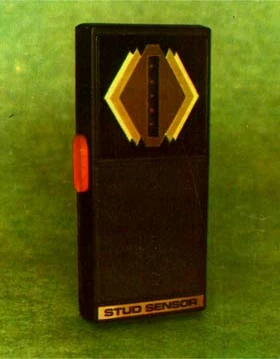
The Stud sensor is an instrument, made by IEMI in Bucharest [1]. It is listed among IEMI’s instruments for measuring physical quantities [1].
Annex III.2.11 calls it a detector of irregularities in a dielectric medium: it showed precisely the position and width of any object hidden in a wall, under plaster or non-metallic wallpaper, whatever its material – wood, concrete, pipes or plastic wall plugs – calibrating itself automatically on the material when switched on. It was a portable, fully transistorised detector in a plastic case, with LED indication, powered by a 9 V battery and weighing 150 g without the battery [2].
The Agenda radioelectronistului (2nd edition, 1989) describes the „STUD SENSOR” („Detector de neuniformități în mediu dielectric”, detector of irregularities in a dielectric medium) among the automatic testers made by IEMI [3]. It says that it shows precisely the position and width of any object in a wall (whatever its material) by lighting five LEDs in turn and that it calibrates itself when switched on [3]. The Agenda gives a supply voltage of 9 V, a current consumption of at most 10 mA at rest and at most 30 mA while the lights are on, 15.5 × 7 × 3 cm (height × width × depth) and 150 g without the battery; the prospectus in annex III.2.11 of „O istorie trăită” gives 155 × 68 × 30 mm (width × height × depth) [3][2].
Photo Gallery
No other images available yet.
Schematics
No schematics available yet.
Documents
No documents available yet.
Prices
N/A
References
- [1]N. Millea (coord.) et al. – „Electronica românească. O istorie trăită”, vol. II „Electronica profesională”, AGIR, sections III.2 „Producția IEMI” and III.3 „Comentarii tehnico-economice”, pp. 302–317, and annex III.2.3 „Producția IEMI – aparate electronice de măsură și industriale”, pp. 383–386
- [2]N. Millea (coord.) et al. – „Electronica românească. O istorie trăită”, vol. II „Electronica profesională”, AGIR, annex III.2.11 „Aparate pentru măsurarea mărimilor neelectrice”, pp. 647–655
- [3]N. Drăgulănescu – „Agenda radioelectronistului”, 2nd edition, Editura Tehnică, 1989, section 50.8 „Testoare automate” (produse de IEMI – București), pp. 728–729