 No image available


Specifications
No data yet.
Description
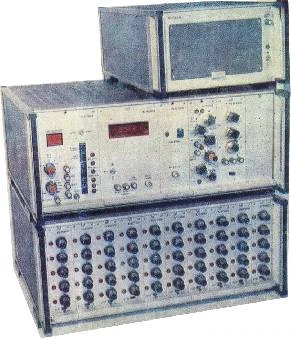
The N 23-100 is a programmable automatic strain gauge installation for consecutive measurement of mechanical quantities at 100 points, made in the microproduction workshop of the ICE research institute in Bucharest, where it was designed [1]. Together with the N 23-50, 10 units were exported to East Germany [1]. In 1986 ICE’s prototype section had a firm contract to export one to East Germany, worth 78,000 roubles [2].
ICE’s laboratory for electronic instruments for measuring non-electrical quantities designed approved prototypes for many branches of the economy: strain gauge equipment (some configurations were exported to East Germany in 1971–1974 and 1977–1989), vibration meters, dimensional gauges, ultrasonic non-destructive testers, geophysical well-logging equipment and railway equipment [1]. Its designs were made in series at IEMI (27 types) and at the Precision Mechanics Enterprise (5 types), or in ICE’s microproduction workshop (45 types) for small series and one-off models [1].
IEI’s catalogue of civilian products also lists it [3].
ICE’s list of microproduction describes its automatic strain gauge systems for 100 and 1,000 points as meant for analysing the structures of buildings and bridges [4].
The 1st edition of the Agenda radioelectronistului (1983) lists the „N-23-100” („Instalație tensometrică numerică, programabilă, pentru 100 puncte de măsură”, programmable digital strain gauge installation for 100 measuring points) among the electronic strain gauge instruments of the N-23 group, whose producers it gives as „I.E.M.I., I.C.S.I.T.E.” (Bucharest) [5]. It consisted of two blocks of 10 N-2352 switching and balancing modules each and an automatic switching module, plus a block with the N-2314 amplifier, the N-2323 digital display, the N-2338 calibration module, the N-2355 automatic balancing module and the N-2360 programming and control module of the N2300 system [5]. The 2nd edition (1989) does not list it [6].
Photo Gallery
No other images available yet.
Schematics
No schematics available yet.
Documents
No documents available yet.
Prices
N/A
References
- [1]N. Millea (coord.) et al. – „Electronica românească. O istorie trăită”, vol. II „Electronica profesională”, AGIR, section II.4.2 „Laborator aparate electronice pentru măsurarea mărimilor neelectrice și aplicații industriale”, pp. 116–122
- [2]N. Millea (coord.) et al. – „Electronica românească. O istorie trăită”, vol. II „Electronica profesională”, AGIR, annex II.2.2 „Raport ICE sem. I 1986”, pp. 232–238
- [3]N. Millea (coord.) et al. – „Electronica românească. O istorie trăită”, vol. II „Electronica profesională”, AGIR, chapter IV „Uzinele Electronica / Întreprinderea de Electronică Industrială – IEI”, pp. 411–422
- [4]N. Millea (coord.) et al. – „Electronica românească. O istorie trăită”, vol. II „Electronica profesională”, AGIR, annex II.4.4 „ICE – aparate realizate în microproducție” (list), pp. 569–570
- [5]N. Drăgulănescu – „Agenda radioelectronistului”, 1st edition, Editura Tehnică, 1983, section 5.6 „Tensometre electronice (grupa N-23)” (producători: I.E.M.I., I.C.S.I.T.E. – București), pp. 590–591
- [6]N. Drăgulănescu – „Agenda radioelectronistului”, 2nd edition, Editura Tehnică, 1989, section 50.6 „Tensometre electronice” (producător: IEMI – București), pp. 722–724