 No image available


Specifications
- Frequency range
- 156–162 MHz (marine VHF)
- Modes
- FM, simplex and duplex, 65 channels
- Max. number of channels
- 65 (55 international + 10 private)
- Channel spacing
- 25 kHz
- Output power
- 20 W
- Frequency stability
- ±10×10⁻⁶
- Max. frequency deviation
- max. ±5 kHz
- Transmitter audio response
- 300–3000 Hz
- Max. transmitter distortion
- 5 %
- Max. spurious emissions: harmonics
- 25 µW
- Max. spurious emissions: other
- 2.5 µW
- Sensitivity (SINAD)
- 0.9 µV EMF (12 dB SINAD)
- Min. selectivity, 2 signals
- 75 dB
- Min. intermodulation ratio, 3 signals
- 65 dB
- Min. image rejection
- 70 dB (spurious responses)
- Max. receiver distortion
- 7 %
- AF output power
- 2.5 W
- Power supply
- 220 V AC, 50 Hz
- Power consumption
- max. 270 VA
- Dimensions
- transceiver unit 400 × 130 × 555 mm, control unit 135 × 217 × 165 mm, distribution unit 270 × 245 × 80 mm
- Weight
- 25 kg
Description
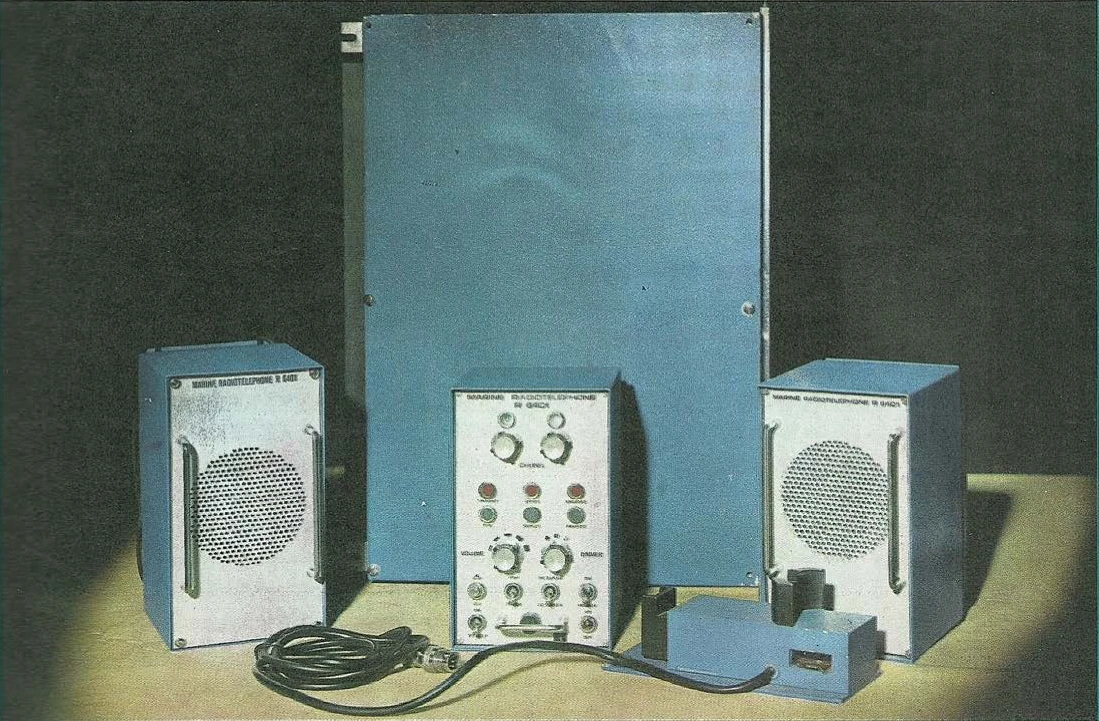
The R 6401 is a marine radiotelephone, made by Tehnoton in Iași and designed at the ICE research institute in Bucharest [1].
ICE’s aviation and marine electronics laboratory was set up to complete and diversify the equipment that Tehnoton in Iași made under licence, for ships and aircraft built in Romania and for land radio communications [1].
Annex III.2.15, among IEMI’s prospectuses, identifies the R 6401 with IEMI’s ship radiotelephone of code 10.467 (RTN 10.467) – a VHF set (156–162 MHz, 65 channels, 20 W) installed with one to five control units – and says that it became the R 6402 after modernisation; the ICE table gives Tehnoton as the maker [2].
The Agenda radioelectronistului (2nd edition, 1989) lists the „R-6401” („Radiotelefon în UUS pentru nave”, VHF radiotelephone for ships) in its chapter on the radiotelephones of IEMI, without a column in the table; a note says that it provides 55 international and 10 private channels in the 156–174 MHz marine band, simplex or duplex, with frequency synthesis [3]. The chapter names IEMI as the producer, while the ICE table quoted above names Tehnoton; the specifications, from the annex, give 156–162 MHz.
The IEMI catalogue 1980 presents it among IEMI’s professional radio-communications equipment, as the „VHF marine radiotelephone R 6401” (its photo page names it „RTN-R 6401”, its contents „RTM-R 6401”): it covers the 55 international channels plus any 10 private channels of the 156–174 MHz marine band, simplex and duplex, with an automatic dual watch on channel 16 plus one other selected channel, can be controlled from up to 50 m away and meets the requirements of the Romanian Naval Register, the Wireless Communication Regulations and the Convention for Life Protection on the Sea [4]. It is used for VHF contacts between ships or between ships and the seaport, on sea and river ships, with 1–5 control units according to the ship’s size, one of them principal; each control unit can have two handsets and an additional loudspeaker [4]. Its diagram names the T/R main unit, the control units CU, CU1–CU4, the handset with stand, the loudspeaker and the junction units for the handset and the loudspeakers [4].
Its table gives a transmitter range of 156.025–157.675 MHz and a receiver range of 156.300–157.675 MHz (simplex) or 160.625–162.275 MHz (duplex); F3 modulation; 65 channels (international 1–28 and 60–88, private 29–33 and 89–93) 25 kHz apart; a frequency allowance of ±10×10⁻⁶; 220 V AC (50 Hz) and at most 270 VA; a normal RF output of 20 W, reduced 1 W; a deviation of max. ±5 kHz; an audio response of 300–3,000 Hz; a noise level better than −40 dB; distortion within 5 %; a microphone sensitivity better than 125 mV; max. 25 µW on harmonics and 2.5 µW of spurious radiation; protection against short circuit and a disconnected aerial; a receiver sensitivity better than 0.9 µV EMF at 12 dB SINAD; a selectivity better than 75 dB (2 signals) and 65 dB (3 signals); spurious responses attenuated better than 70 dB; 2.5 W of audio output with max. 7 % distortion; receiver noise better than 40 dB; a transceiver unit of 400 × 130 × 555 mm (25 kg), a control unit of 135 × 217 × 165 mm (3 kg) and a distribution unit of 270 × 245 × 80 mm (2.8 kg) [4]. The weight in the specifications is that of the transceiver unit [4].
Photo Gallery
 No image available
Schematics
No schematics available yet.
Documents
No documents available yet.
Prices
N/A
References
- [1]N. Millea (coord.) et al. – „Electronica românească. O istorie trăită”, vol. II „Electronica profesională”, AGIR, section II.4.6 „Laborator echipamente electronice pentru aviație și marină”, pp. 132–134
- [2]N. Millea (coord.) et al. – „Electronica românească. O istorie trăită”, vol. II „Electronica profesională”, AGIR, annex III.2.15 „Echipamente de radiocomunicații profesionale”, pp. 678–689
- [3]N. Drăgulănescu – „Agenda radioelectronistului”, 2nd edition, Editura Tehnică, 1989, chapter 48 „Principalele caracteristici ale radiotelefoanelor produse în R.S.R.” (producător: I.E.M.I. – București), pp. 698–700
- [4]Measuring Electronic Instruments Enterprise (I.E.M.I.), Bucharest – „catalogue 1980” (in English), section I „Professional radio-communications equipment”, „VHF marine radiotelephone R 6401” (unnumbered pages)