 No image available


Specifications
- Frequency range
- 30–41 MHz, 56.5–58 MHz, 73–76 MHz, 146–173 MHz (see Variants)
- Modes
- FM, simplex
- Max. number of channels
- 8, 10 (see Variants)
- Channel spacing
- 25 kHz
- Max. spread between extreme channels
- 400 kHz, 500 kHz, 700 kHz, 900 kHz (see Variants)
- Output power
- 10–20 W (see Variants)
- Frequency stability
- ≤ ±2·10⁻⁵
- Max. frequency deviation
- ±5 kHz
- Transmitter audio response
- 300–3000 Hz
- Max. transmitter distortion
- 5 %
- Max. spurious emissions: harmonics
- 2.5 µW
- Max. spurious emissions: other
- 0.2 µW
- Sensitivity (SINAD)
- 0.5 µV, 0.6 µV (see Variants)
- Min. selectivity, 2 signals
- 80 dB
- Min. intermodulation ratio, 3 signals
- 70 dB
- Min. image rejection
- 80 dB
- Receiver audio response
- 300–3000 Hz
- Max. receiver distortion
- 7 %
- AF output power
- 2.5 W
- Max. current, receiving
- 0.5 A, 0.7 A (see Variants)
- Max. current, transmitting
- 5.2 A, 3.7 A (see Variants)
- Operating temperature
- −25…+40 °C
- Power supply
- 6.3, 12.6 or 25.2 V DC (−15 %…+20 %)
- Dimensions
- T-R unit 250 × 300 × 95 mm, control unit 170 × 179 × 60 mm (W × D × H)
- Weight
- 4.8 kg
Variants (4)
| Note | Compare | ||||||||
|---|---|---|---|---|---|---|---|---|---|
| RTM-1MF | 30–41 MHz | 8 | 400 kHz | 20 | 0.5 µV | 0.5 A | 5.2 A | split by band after the 1st edition | |
| RTM-2MF | 56.5–58 MHz | 8 | 500 kHz | 20 | 0.5 µV | 0.5 A | 5.2 A | split by band after the 1st edition | |
| RTM-3MF | 73–76 MHz | 8 | 700 kHz | 20 | 0.5 µV | 0.5 A | 5.2 A | split by band after the 1st edition | |
| RTM-4MF | 146–173 MHz | 10 | 900 kHz | 10 | 0.6 µV | 0.7 A | 3.7 A | split by band after the 1st edition |
Click a column heading to sort. „+” adds a variant to the comparison (RTM-MF).
Description
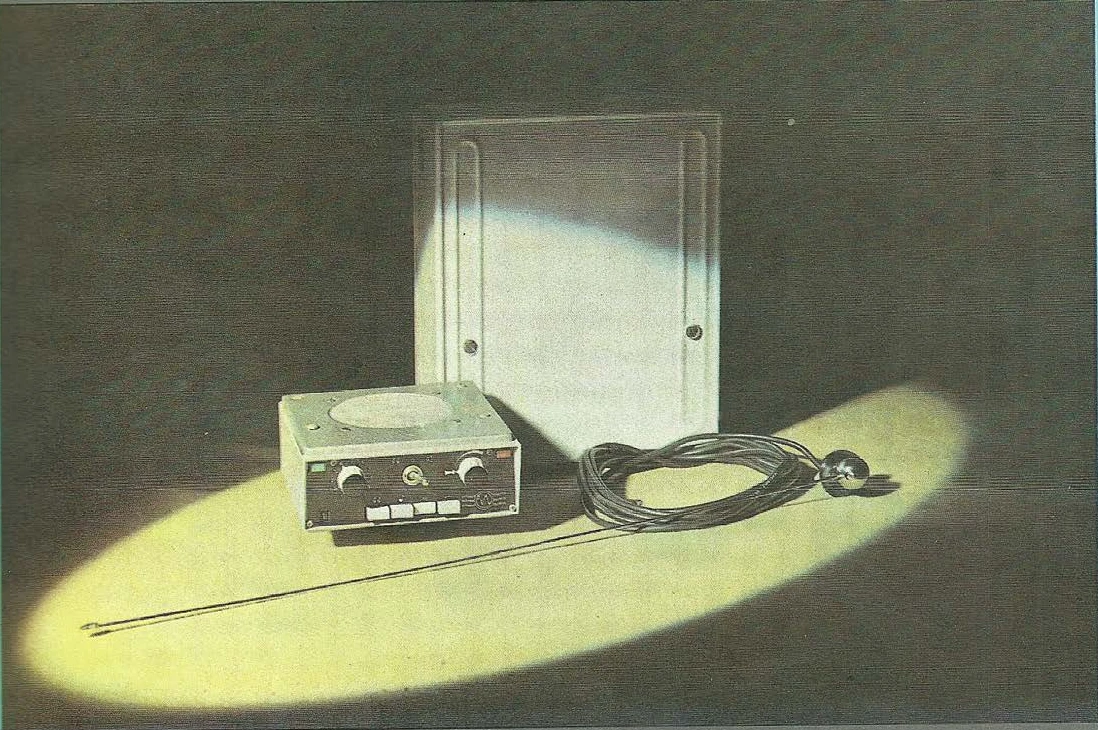
The RTM-MF is a mobile radiotelephone for vehicles, made by IEMI in Bucharest [1]. It was made in eight type variants (1 MF to 4 MF, simplex or semi-duplex) [1]. Four batches totalling 2,505 mobile radiotelephones were also equipped to order, and IEMI made 157,182 accessories for them (antennas, microphones, loudspeakers, optical alarms) [1]. IEMI made radiotelephones under a licence bought in 1968 from the Swedish firm SRA (Svenska Radio Aktiebolaget), later modernised by IEMI itself; they were used in industry, on the railways, in rescue services, agriculture, transport, construction, by the police and the fire brigade [1].
IEMI’s production table lists the transceiver units of each variant: 9,370 RTM-1MF-S-A (1974–1985), 10 RTM-2MF-S (1974), 1,073 RTM-3MF-S (1974–1985) and 30,859 RTM-4MF-S (1971–1985); for the 4MF-S it also made 43,086 control units, 46,744 microphones and 37,630 antennas [2]. A transceiver unit cost 7,500 lei, a control unit 800 lei and a microphone 420 lei (prices set in 1982) [3].
Annex III.2.15 gives the RTM 1 MF-S, 2 MF-S and 3 MF-S as 20 W FM sets with 8 simplex channels and a sensitivity of 0.5–0.6 µV. Its frequency ranges for them – 30–41, 68–88 and „45–175” MHz – do not follow the band numbering of the portable RTP-MF sets (2 MF 56.5–58 MHz, 3 MF 68–88 MHz, 4 MF 145–175 MHz) [4].
The Agenda radioelectronistului (2nd edition, 1989) lists the „RTM-(X)MF-S” („Radiotelefon mobil”, mobile radiotelephone) among the mobile radiotelephones made by IEMI in Bucharest; its values are in the specifications [5]. Several cells give more than one value – channels „8/10”, spread „400/500 700/900” kHz, output power „20/10” W, current „0,5/0,7” and „5,2/3,7” A, sensitivity „0,5/0,6” µV; the 1st edition, with a column for each band, shows which value belongs to which band (where there are two, the second is that of the RTM-4), and the values of each band are in the Variants table [5][6].
The band ranges of the Agenda answer the question left open by the annex quoted above: for the RTM and RTF, band 3 is 73–76 MHz and band 4 146–173 MHz [5][4].
The accessories listed for it are a control unit and an installation set (antenna, cables) [5].
Coded as (the coding of the 1st edition; band ranges as in the 2nd edition) [5][6]:
| Part | Meaning |
|---|---|
| RTM | type: mobile radiotelephone (RTP = portable, RTM = mobile, RTF = fixed radiotelephone) |
| 1 … 4 | working band (X): 1 = 30–41 MHz, 2 = 56.5–58 MHz, 3 = 68–88 MHz for the RTP or 73–76 MHz for the RTM and RTF, 4 = 145–175 MHz for the RTP or 146–173 MHz for the RTM and RTF |
| MF | modulation: frequency modulation („modulație de frecvență”) |
| S | working mode: S = simplex, SD = semi-duplex, D = duplex |
The 1st edition gives band 4 of the RTM and RTF as 146–174 MHz, the 2nd edition as 146–173 MHz [6][5].
The IEMI catalogue 1980 presents it as the „Mobile radiotelephone RTM-MF-S (SD)”, a fully transistorised mobile transceiver for all types of cars, with up to 10 radio channels in the 40, 60, 80 or 160 MHz bands, also available for semi-duplex operation; selective calling, simultaneous watch on two channels and a carrier alarm could be incorporated [7]. It works from 6, 12 or 24 V; the supply voltage is electronically stabilised, so that battery variations of ±20 % do not affect it, and the catalogue mentions vibration and bump tests of 20,000 bumps at 50 times the weight of the set [7]. The set comprises the T-R unit, a control unit with a built-in loudspeaker (a separate, very small box for the cabin, holding all the controls, including those for future extensions such as selective calling), a hand microphone with a T-R switch and a roof-mounted aerial [7].
The catalogue describes the circuit: an oscillator selecting among ten crystals by switching diodes, an amplifier stage, a diode phase modulator and frequency multiplier stages giving a total multiplication of 24 (or 12); an output stage with a doubler, an amplifier, a driver, a power amplifier, a low-pass filter and an aerial relay, its power transistors on a metal chassis, giving 10 W ±1 dB (or 20 W ±1 dB); a transmitter AF amplifier with a limiter stage against overmodulation and a low-pass filter rejecting frequencies above 3,000 Hz [7]. The receiver is a double superheterodyne in three sections: the RF section (two stages with five tuned circuits and a ring-modulator first mixer), the first oscillator (a crystal oscillator selecting among ten crystals by switching diodes, followed by a tripler and an amplifier), and the HF-AF section, with a 10.7 MHz crystal filter 13 kHz wide (at −6 dB), a cascade amplifier, the second mixer, RC-coupled amplifier and limiter stages at 455 kHz, a frequency discriminator and the AF amplifier [7]. In simplex systems the minimum spacing between the transmitter and receiver frequencies is 25 kHz [7].
Its table gives, for the RTM-1MF, RTM-2MF, RTM-3MF and RTM-4MF: 30–41, 56.5–58, 68–88 and 145–175 MHz; 8 channels; a maximum permissible spacing between channels of 500, 700, 700 and 900 kHz; a minimum channel separation of 25 kHz; −25 to +55 °C; a frequency stability better than 20×10⁻⁶; FM (phase); an RF output power of 20, 20, 20 and 10 W (±1 dB) with a frequency multiplication of 12, 12, 12 and 24; a maximum deviation of 5 kHz; an audio response of 300–2,000 Hz (printed „increasing 60 dB/octave”); harmonics of 2.5 µW and other radiations of 0.2 µW; a sensitivity of 0.5 ±2 dB µV (0.6 ±2 dB for the RTM-4MF); a selectivity of ≥80 dB with 2 signals and ≥70 dB with 3 signals; an audio range of 300–2,600 (3,000) Hz; 2.5 W in 16 Ω (5 W in 8 Ω); a spurious response of −80 dB; a supply from a 6, 12 or 24 V battery or from 110–240 V with a separate AC/DC converter unit; a T-R unit of 250 × 300 × 95 mm (W × D × H), 4.8 kg, and a control unit of 170 × 179 × 60 mm, 1.3 kg [7]. These differ from the specifications and the Variants table in the band of the RTM-3MF (68–88 MHz, not 73–76 MHz) and the RTM-4MF (145–175 MHz, not 146–173 MHz), the number of channels of the RTM-4MF (8, not 10) and the maximum spread between the extreme channels of the RTM-1MF and RTM-2MF (500 and 700 kHz, not 400 and 500 kHz); the dimensions and the weight (of the T-R unit) in the specifications are the catalogue’s [7].
Photo Gallery
No other images available yet.
Schematics
No schematics available yet.
Documents
No documents available yet.
Prices
N/A
References
- [1]N. Millea (coord.) et al. – „Electronica românească. O istorie trăită”, vol. II „Electronica profesională”, AGIR, sections III.2 „Producția IEMI” and III.3 „Comentarii tehnico-economice”, pp. 302–317, and annex III.2.3 „Producția IEMI – aparate electronice de măsură și industriale”, pp. 383–386
- [2]N. Millea (coord.) et al. – „Electronica românească. O istorie trăită”, vol. II „Electronica profesională”, AGIR, annex III.2.4 „Producția IEMI – radiotelefoane”, pp. 387–392
- [3]N. Millea (coord.) et al. – „Electronica românească. O istorie trăită”, vol. II „Electronica profesională”, AGIR, annex III.2.5 „Lista cu prețurile produselor – IEMI”, pp. 393–396
- [4]N. Millea (coord.) et al. – „Electronica românească. O istorie trăită”, vol. II „Electronica profesională”, AGIR, annex III.2.15 „Echipamente de radiocomunicații profesionale”, pp. 678–689
- [5]N. Drăgulănescu – „Agenda radioelectronistului”, 2nd edition, Editura Tehnică, 1989, chapter 48 „Principalele caracteristici ale radiotelefoanelor produse în R.S.R.” (producător: I.E.M.I. – București), pp. 698–700
- [6]N. Drăgulănescu – „Agenda radioelectronistului”, 1st edition, Editura Tehnică, 1983, section 4.9 „Principalele caracteristici ale unor radiotelefoane produse în RSR” (producător: I.E.M.I. – București), pp. 566–569
- [7]Measuring Electronic Instruments Enterprise (I.E.M.I.), Bucharest – „catalogue 1980” (in English), section I „Professional radio-communications equipment”, „Mobile radiotelephone RTM-MF-S (SD)” (unnumbered pages)