 No image available
HPA
IPRS Băneasa · 1972
- Manufacturer
- IPRS Băneasa

- Country
- Romania

- Year
- 1972
- Decade
- 1970s
- Category
- Components
- Type
- Capacitors
- Equivalents
- N/A
- Documentation score
- 4/7
- Last edited
- 06 NOV 2026
Specifications
- Type
- oil-impregnated paper, for AC
- Standard
- STAS 9190-73
- Capacitance (Cn)
- 4…25 µF
- Capacitance, min
- 4 µF
- Capacitance, max
- 25 µF
- Tolerance
- ±10 %
- Rated AC voltage (Un~)
- 220 V
- Dissipation factor (tan δ)
- ≤ 8·10⁻⁶ (+25 °C, 50 Hz; as printed)
- Dielectric strength
- 2.15 Un (AC); 4.3 Un (DC)
- Dissipation factor, max. (tan δ)
- 0.008 (see Variants)
- Dielectric strength, terminals–case
- 6 Un (AC, min.) (see Variants)
- Reliability (failure rate λ)
- ≤ 1·10⁻⁶/h
- Case outline (catalogue)
- C 2 (see Variants)
- Capacitance change with temperature
- 3 % (−25 °C), 1.5 % (+85 °C), against 25 ± 5 °C
- Climatic category
- 25/085/21
- Temperature range
- −25…+85 °C
- Package
- cylindrical can, two solder tags, M8 stud
- Diameter (D)
- 30–50 mm (see Variants)
- Length (L)
- 68–146 mm (see Variants)
- Application
- gas-discharge (fluorescent) lamps
Variants (8)
| Compare | |||||||||
|---|---|---|---|---|---|---|---|---|---|
| HPA 30.24 | 4.2 µF | 4.2 | 4.2 | 0.008 | 6 Un (AC, min.) | C 2 | 30 | 84 | |
| HPA 35.06 | 4 µF | 4 | 4 | 0.008 | 6 Un (AC, min.) | C 2 | 35 | 68 | |
| HPA 33.06 | 4.5 µF | 4.5 | 4.5 | 0.008 | 6 Un (AC, min.) | C 2 | 35 | 68 | |
| HPA 35.24 | 5 µF | 5 | 5 | 0.008 | 6 Un (AC, min.) | C 2 | 35 | 84 | |
| HPA 35.30 | 7 µF | 7 | 7 | 0.008 | 6 Un (AC, min.) | C 2 | 35 | 92 | |
| HPA 40.58 | 10 µF | 10 | 10 | 0.008 | 6 Un (AC, min.) | C 2 | 40 | 120 | |
| HPA 50.70 | 20 µF | 20 | 20 | — | — | — | 50 | 132 | |
| HPA 50.84 | 25 µF | 25 | 25 | — | — | — | 50 | 146 |
Click a column heading to sort. „+” adds a variant to the comparison (HPA).
Description
The HPA is a series of oil-impregnated paper capacitors for alternating current (220 V), in a cylindrical can with two solder tags and an M8 mounting stud, made to STAS 9190-73 for gas-discharge (fluorescent) lamps [1]. The Agenda radioelectronistului (2nd edition, 1989) lists eight codes, HPA 30.24 to HPA 50.84, with 4–25 µF [1].
Un secol de electronică în România says that the HPA is a ballast capacitor type of IPRS Băneasa’s own design, put into production in 1972 together with the HSA type [5]. The Agenda does not say which works made the series: for the whole section on capacitors made in Romania it lists IPEE Electroargeș of Curtea de Argeș, Tehnoton of Iași, IIS Electronica of Bucharest and IPRS Băneasa as producers, and the 1st edition (1983) names only the first three [3][4].
The letters HPA are not in the book’s list of letter codes, and the book does not explain the digits; in the table the first two digits are the diameter in millimetres, except for HPA 33.06, which is also 35 mm in diameter (in both editions) [3][1][2]. The capacitors are marked in clear; the drawing shows the marking area on the can [3][1].
Both editions print the dissipation factor as „8·10⁻⁶” (the HSA series has 8·10⁻³, at +85 °C); it is kept as printed [1][2]. The 1st edition has the same table; its application line reads only „lămpi cu descărcări în gaze” (gas-discharge lamps), without „(fluorescente)” [2].
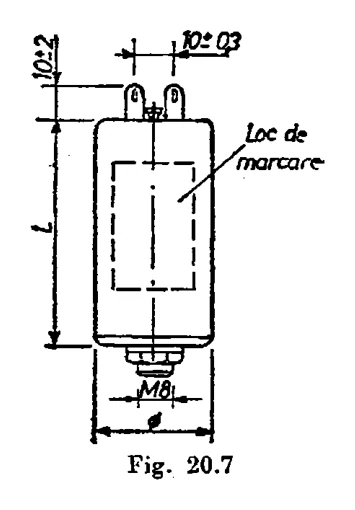
Dimensions in mm (fig. 20.7): diameter Ø and length L from the table; solder tags 10 ± 2 mm high and 10 ± 0.3 mm apart; M8 stud at the base [1].
The I.P.R.S. Băneasa Full Line Condensed Catalog (1990) lists the HPA 3506, HPA 3024, HPA 3524, HPA 3530 and HPA 4058 (6 rows) among its „AC oil impregnated paper capacitors” [6]. The catalog values this page did not have (tan δ, VizTC, case outline) are under Variants [6]. The columns are Cn (uF), VN (Vac), D and L (mm), loss angle tangent (max.), VizT and VizTC (min., Vac) and CASE; the notes under the table: „Climatic category : 25/085/21”; „Capacitance tolerance ( for HPA… ) : +/- 10 %”; „Capacitance tolerance ( for HSA… ) : +/- 10 % or +/- 4 %”; „Loss angle tangent @ TA = 20 oC ; f = 1 kHz”; „Proof voltage test condition : t = 1 min.” [6]. In the table, „#” marks the limited-quantity rows: „# Limited quantity” [6].
Compared with the other values on this page: the HPA 33.06 (4.5 µF, 220 V) is printed „HPA 3506” in the catalog [6].
In the catalog, the HPA 30.24, HPA 33.06 and HPA 35.30: „#”: limited quantity [6].
This page’s HPA 50.70 and HPA 50.84 are not in the catalog [6].
The I.P.R.S. Băneasa Capacitors catalogue (1978–1979) lists the HPA among its paper and mixed-dielectric capacitors, as „A.C. oil-filled paper capacitors” („Condensatoare cu hîrtie uleiată pentru c.a.”); use: for lighting installations with gas-discharge lamps: the capacitor raises the starting voltage of the lamp and improves the power factor; the products are made to NI 3734/75 [7].
Construction, as given in the 1978–1979 catalogue: electrodes of thin aluminium strip; dielectric: paper impregnated with trichlorodiphenyl (3CD); terminals: tags passing through the resin; protection: aluminium tube sealed with epoxy resin [7].
Technical data (1978–1979 catalogue): temperature range −25…+85 °C; climatic category 25/085/21; rated capacitance 4; 4.2; 4.5; 5; 7; 10*; 20*; 25* µF; capacitance change with temperature, against the value at 25 ± 5 °C 3 % at −25 °C, 1.5 % at +85 °C; capacitance tolerance ±10 %; rated voltage 220 V AC; tan δ at 85 °C, 50 Hz, maximum Un ≤ 8·10⁻³; permissible overvoltages 1.16 Un at +85 °C in steady state; 1.2 Un for at most 6 hours in 24; reliability λ ≤ 1·10⁻⁶/h; proof voltage (1 min, 85 °C) between terminals 2.15 Un AC or 4.3 Un DC; between the interconnected terminals and the case 6 Un AC (capacitors with a built-in resistor are tested in AC only) [7].
The 1978–1979 catalogue’s table lists 8 rows, HPA 3024…HPA 5084 (7 codes); ordering code example „HPA + rated capacitance in µF + rated voltage in V + with or without discharge resistor + with or without fixing screw” [7].
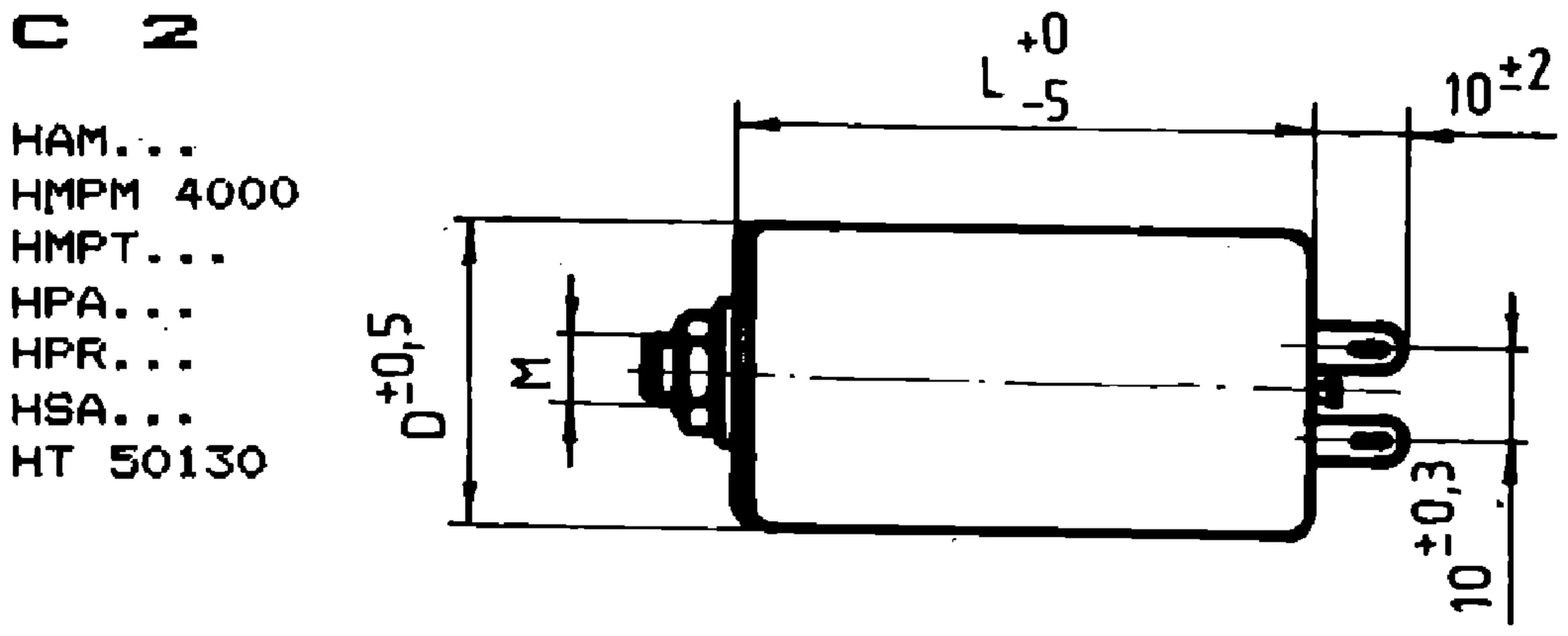
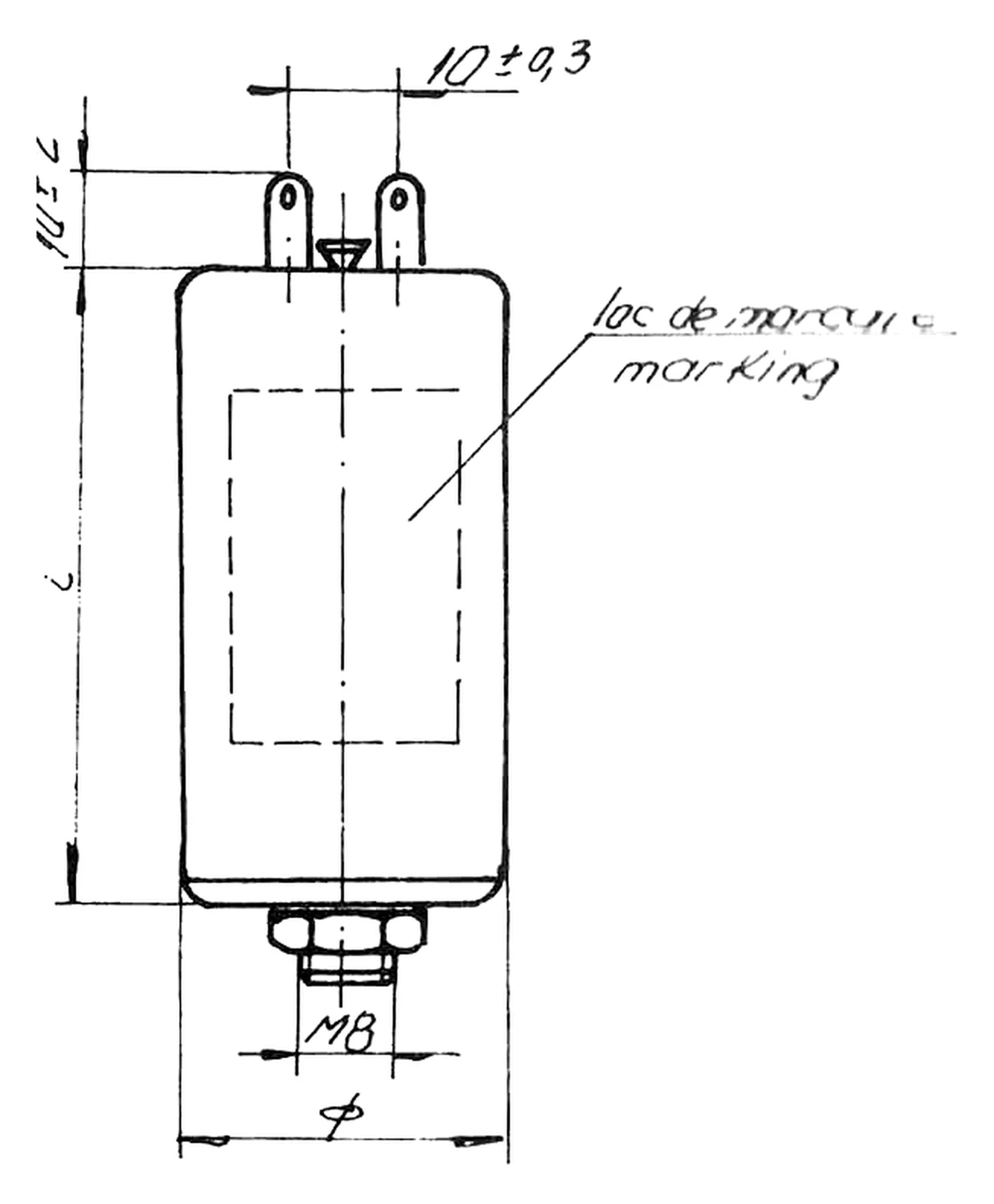
Dimensions in mm (fig. 4), 1978–1979 catalogue: M8 fixing stud; tag terminals 10 ± 0.3 mm apart, 10 ± 2 mm high [7]. The drawing from the 1978–1979 catalogue is under Drawing Gallery [7].
Compared with the other values on this page, the 1978–1979 catalogue: for the HPA 33.06 gives code „HPA 3506” (elsewhere on this page: „HPA 33.06”); gives the tan δ as ≤ 8·10⁻³ (50 Hz, +85 °C, Un) (elsewhere on this page: ≤ 8·10⁻⁶ (+25 °C, 50 Hz; as printed)); gives the standard as NI 3734/75 (elsewhere on this page: STAS 9190-73) [7].
In the 1978–1979 catalogue, in the table the units of the capacitance and voltage columns are swapped („Rated voltage (µF)”, „Rated capacitance (Vca)”); the values are 4.2…25 µF and 220 V AC; „*”: products under development („în curs de omologare”) [7].
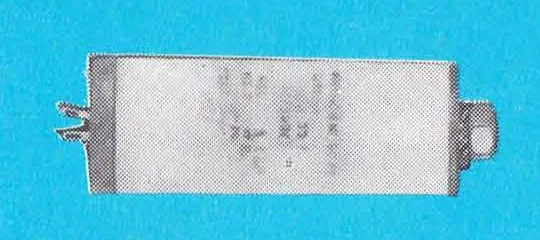
The photo is from the 1978–1979 catalogue’s page of photos of paper and mixed-dielectric capacitors (p. 29) [7].
The catalogue’s introduction to paper and mixed-dielectric capacitors (1978–1979) gives the general conditions: for DC capacitors the rated voltage is the DC voltage that can be applied permanently at 40 °C and 65 % relative humidity; with an AC component superimposed, the DC voltage plus the AC peak must not exceed Un, and the AC peak must not exceed 20 % of Un at 50 Hz, 15 % at 100 Hz, 3 % at 1000 Hz and 1 % at 10 000 Hz; for AC capacitors the rated voltage is the one marked on the capacitor, which can be applied permanently at the maximum temperature of its climatic category. The capacitance is measured at 1 kHz and 25 °C, tan δ at 1 kHz; the insulation resistance is measured 1 min after applying 10 ± 1 V (Un < 100 V), 100 ± 15 V (Un 100…500 V) or 500 ± 50 V (Un ≥ 500 V) at 20 °C, falls exponentially with temperature (R20 = Rt·2^((t−20)/10)) and, measured at 18…27 °C, is corrected with factors from 0.87 to 1.62. The capacitors are stored at normal pressure and humidity, away from corrosive substances, and are marked in clear; the example is an HPR 3056 marked „0,47 µF ± 10% 800 Vca” and „40/070/21” [8].
Drawing Gallery
 No image available
 No image available
 No image available
Photo Gallery
No other images available yet.
Documents
No documents available yet.
Prices
N/A
References
- [1]N. Drăgulănescu – „Agenda radioelectronistului”, 2nd edition, Editura Tehnică, 1989, section 20.4.1.7 „Condensatoare cu hîrtie uleiată pentru curent alternativ seria HPA”, pp. 253–254
- [2]N. Drăgulănescu – „Agenda radioelectronistului”, 1st edition, Editura Tehnică, 1983, section 3.5.4.1.7 „Condensatoare cu hîrtie uleiată pentru curent alternativ seria HPA”, pp. 223–224
- [3]N. Drăgulănescu – „Agenda radioelectronistului”, 2nd edition, Editura Tehnică, 1989, sections 20.4 „Condensatoare produse în R.S.R.” and 20.4.1.1 „Codificare – marcare (în clar)”, p. 248
- [4]N. Drăgulănescu – „Agenda radioelectronistului”, 1st edition, Editura Tehnică, 1983, sections 3.5.4 „Condensatoare produse în R.S.R.” and 3.5.4.1.1 „Codificare – marcare (în clar)”, p. 218
- [5]N. Millea, I. Constantinescu (coord.) – „Un secol de electronică în România”, Editura Academiei Române, 2020, section VIII.1.2.6, pp. 408–411
- [6]I.P.R.S. Băneasa – „Full Line Condensed Catalog”, 1990, section 8 „Capacitors”, „AC oil impregnated paper capacitors”, p. 8-04
- [7]I.P.R.S. Băneasa – „Condensatoare / Capacitors”, catalogue 1978–1979 (published by ICCE), section „Paper and mixt dielectric capacitors”, „A.C. oil-filled paper capacitors” HPA, pp. 36–38
- [8]I.P.R.S. Băneasa – „Condensatoare / Capacitors”, catalogue 1978–1979 (published by ICCE), section „Paper and mixt dielectric capacitors”, „Generalități – Principalii parametri de lucru”, pp. 23–25