PMZ
IPRS Băneasa · 1975
- Also known as
- PMZ 54.00
- Manufacturer
- IPRS Băneasa

- Country
- Romania

- Year
- 1975
- Decade
- 1970s
- Category
- Components
- Type
- Capacitors
- Equivalents
- N/A
- Documentation score
- 3/7
- Last edited
- 06 NOV 2026
Specifications
- Type
- polyethylene terephthalate film, for interference suppression
- Capacitance (Cn)
- 0.22…3.3 µF
- Capacitance, min
- 0.22 µF
- Capacitance, max
- 3.3 µF
- Tolerance
- ±20 % (E6)
- Rated voltage (Un)
- 250 V
- Dielectric strength
- 2 Un (+20 °C)
- Insulation resistance (Ri)
- Riz·Cn ≥ 4·10³ s (+20 °C)
- Reliability (failure rate λ)
- ≤ 1·10⁻⁶/h
- Climatic category
- 40/100/21
- Temperature range
- −40…+100 °C
- Package
- cylindrical, fixing bracket, one flexible lead with ring terminal
- Max. length (Lmax)
- 30–40 mm (see Variants)
- Application
- reduction of radio interference on motor vehicles
Variants (8)
| Compare | |||||
|---|---|---|---|---|---|
| PMZ 54.06 | 0.22 µF | 0.22 | 0.22 | 30 | |
| PMZ 54.08 | 0.33 µF | 0.33 | 0.33 | 30 | |
| PMZ 54.10 | 0.47 µF | 0.47 | 0.47 | 30 | |
| PMZ 54.12 | 0.68 µF | 0.68 | 0.68 | 30 | |
| PMZ 54.14 | 1 µF | 1 | 1 | 30 | |
| PMZ 54.16 | 1.5 µF | 1.5 | 1.5 | 40 | |
| PMZ 54.18 | 2.2 µF | 2.2 | 2.2 | 40 | |
| PMZ 54.20 | 3.3 µF | 3.3 | 3.3 | 40 |
Click a column heading to sort. „+” adds a variant to the comparison (PMZ).
Description
The PMZ is a series of interference-suppression capacitors for motor vehicles, with a polyethylene terephthalate dielectric, rated 250 V DC; the body has a fixing bracket and a single flexible lead ending in a ring terminal [1]. The Agenda radioelectronistului (2nd edition, 1989) calls it PMZ 54.00 and lists eight codes, PMZ 54.06 to PMZ 54.20, with 0.22–3.3 µF; the 1st edition (1983) has the same data [1][2].
Un secol de electronică în România says that the PMZ is an anti-interference (suppression) capacitor type of IPRS Băneasa’s own design, put into production in 1975 [5]. The Agenda does not say which works made the series: for the whole section on capacitors made in Romania it lists IPEE Electroargeș of Curtea de Argeș, Tehnoton of Iași, IIS Electronica of Bucharest and IPRS Băneasa as producers, and the 1st edition (1983) names only the first three [3][4].
Coded as [3]:
| Part | Meaning |
|---|---|
| PMZ | construction type (structure, dielectric, terminals): interference-suppression capacitor for motor vehicles |
| 54 | technological family („familia tehnologică”) |
| 06…20 | package code („codul capsulei”) |
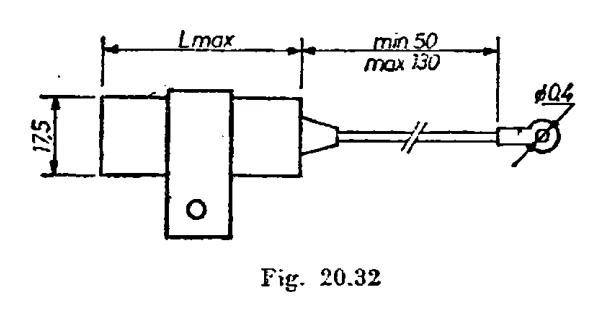
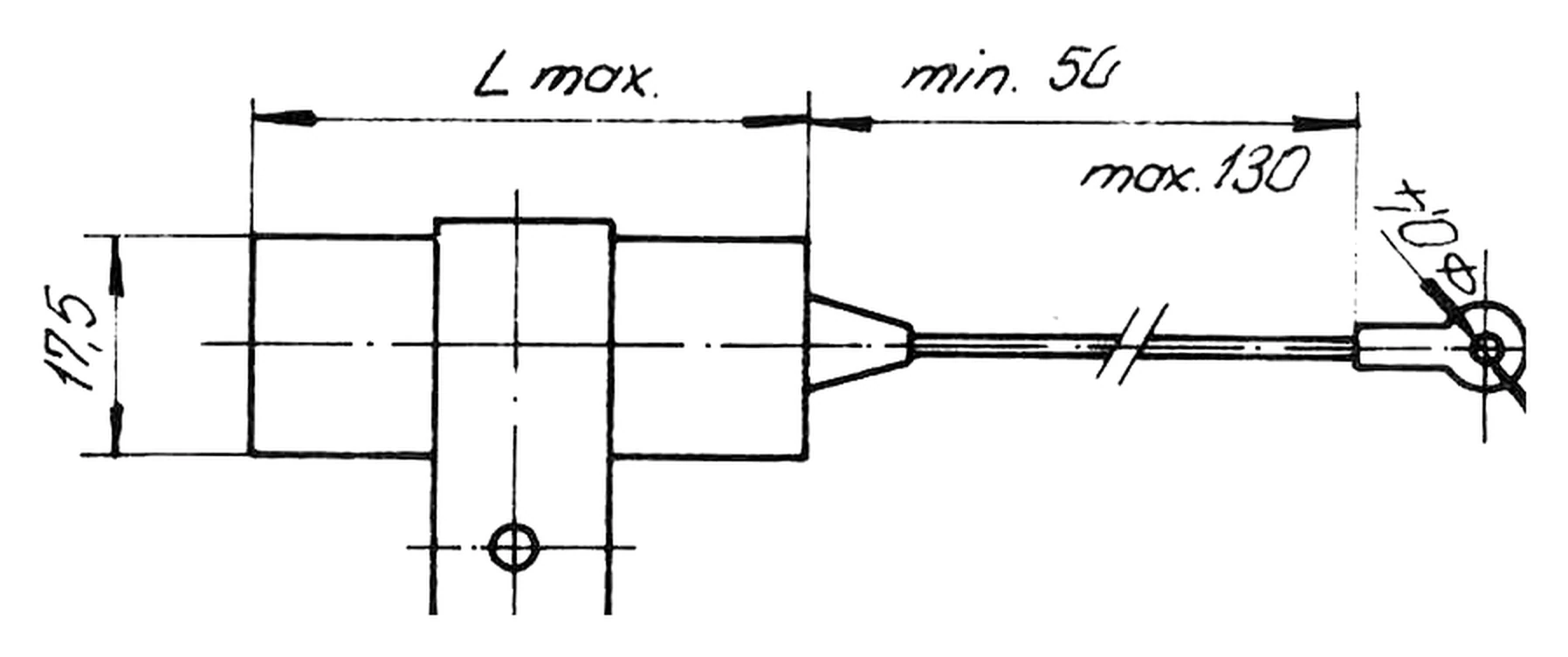
The book gives no STAS, no dissipation factor and no marking for this series [1]. The ring terminal of the drawing is dimensioned „ø04” in the 2nd edition and „ø0,4” in the 1st [1][2].
Rated voltages are DC („Vcc”). Dimensions in mm (fig. 20.32): maximum body length Lmax from the table, body 17.5; the lead is at least 50 and at most 130 mm long [1].
The I.P.R.S. Băneasa Capacitors catalogue (1978–1979) lists the PMZ 54.00 among its plastic film capacitors, as „Suppression capacitors for motor-cars” („Condensatoare de antiparazitare pentru autovehicule”); use: on motor vehicles, to reduce the radio interference produced by the electrical equipment; they can also be used to suppress other equipment [6].
Construction, as given in the 1978–1979 catalogue: electrodes of aluminium films, vacuum-deposited; dielectric: polyethylene terephthalate; protection: metal tube sealed with rubber [6].
Technical data (1978–1979 catalogue): temperature range −40…+100 °C; climatic category 40/100/21; capacitance range 0.22…3.3 µF; capacitance tolerance ±20 %; rated voltage 250 V DC, varying with temperature according to fig. 47 (250 V up to +90 °C, falling to 100 V at +125 °C); category voltage 500 V DC, for 10 s, Tamb = 100 °C (as printed); insulation resistance at 20 °C Riz·Cn ≥ 4·10³ s; proof voltage at 20 °C 2 Un; reliability λ ≤ 1·10⁻⁶/h [6].
The 1978–1979 catalogue’s table lists 8 rows, PMZ 54.06…PMZ 54.20 (8 codes); ordering code example „PMZ 54.12 — 0,68/250” [6].
Dimensions in mm (fig. 46), 1978–1979 catalogue: L max. from the table; body Ø 17.5; a flexible lead at least 50 and at most 130 mm long, with a Ø 4 (+0.4) ring terminal; fixing bracket with a hole [6]. The 1978–1979 catalogue also has fig. 47 („Variation of the voltage with temperature”); the drawings and graphs are under Drawing Gallery [6].
The catalogue’s introduction to plastic film capacitors (1978–1979) describes them as wound capacitors whose electrodes are thin aluminium or tin foils, or aluminium deposited on a plastic film; the dielectric is the plastic film: polyethylene terephthalate („mylar”), polystyrene („styroflex”), polycarbonate or polypropylene, and the electrodes are either offset and metallised at the ends of the winding, or not offset. The rated voltage is the DC voltage that can be applied permanently at 40 °C; with an AC component superimposed, the DC voltage plus the AC peak must not exceed Un, and the AC peak must not exceed 20 % of Un at 50 Hz, 15 % at 100 Hz, 3 % at 1000 Hz and 1 % at 10 000 Hz for polyester capacitors, or 0.4 Uc (25 and 63 V), 0.3 Uc (160 and 250 V) and 0.2 Uc (630 and 1000 V) for styroflex capacitors. The capacitance changes with temperature and frequency (figs. 15–16 for polyester, 19–20 for polystyrene capacitors), and so does tan δ (figs. 17–18, polyester). The insulation resistance is measured 1 min after applying the test voltage at 20 °C: 20 ± 1 V (polyester) or 10 ± 1 V (styroflex) for Un < 100 V, 100 ± 15 V for Un 100…500 V and 500 ± 50 V for Un ≥ 500 V; it falls exponentially with temperature (Rt = Rt0·e^(k(t−t0))), as R20 = Rt·2^((t−20)/15) for polyester and R20 = Rt·2^((t−20)/20) for styroflex capacitors, and a value measured at another temperature is corrected with a coefficient. The capacitors are stored at normal pressure and relative humidity, away from corrosive substances, and are marked in clear; the example „PMP 0701 — 0,1/250” gives the construction (PMP: metallised polyester), the technological family (07), the case code (01), the capacitance in µF and the rated voltage in V [7].
Drawing Gallery
 No image available
 No image available
 No image available
Photo Gallery
No other images available yet.
Documents
No documents available yet.
Prices
N/A
References
- [1]N. Drăgulănescu – „Agenda radioelectronistului”, 2nd edition, Editura Tehnică, 1989, section 20.4.2.19 „Condensatoare de antiparazitare pentru autovehicule, seria PMZ 54.00”, p. 272
- [2]N. Drăgulănescu – „Agenda radioelectronistului”, 1st edition, Editura Tehnică, 1983, section 3.5.4.2.19 „Condensatoare de antiparazitare pentru autovehicule, seria PMZ 54.00”, p. 242
- [3]N. Drăgulănescu – „Agenda radioelectronistului”, 2nd edition, Editura Tehnică, 1989, sections 20.4 „Condensatoare produse în R.S.R.” (p. 248) and 20.4.2.1 „Codificare – marcare (în clar)” (p. 259)
- [4]N. Drăgulănescu – „Agenda radioelectronistului”, 1st edition, Editura Tehnică, 1983, sections 3.5.4 „Condensatoare produse în R.S.R.” (p. 218) and 3.5.4.2.1 „Codificare – marcare (în clar)” (p. 229)
- [5]N. Millea, I. Constantinescu (coord.) – „Un secol de electronică în România”, Editura Academiei Române, 2020, section VIII.1.2.6, pp. 408–411
- [6]I.P.R.S. Băneasa – „Condensatoare / Capacitors”, catalogue 1978–1979 (published by ICCE), section „Plastic film capacitors”, „Suppression capacitors for motor-cars” PMZ 54.00, pp. 121–122
- [7]I.P.R.S. Băneasa – „Condensatoare / Capacitors”, catalogue 1978–1979 (published by ICCE), section „Plastic film capacitors”, „Generalități – Principalii parametri de lucru”, pp. 65–69