EFD107
IPRS Băneasa
- Also known as
- AA130
- Manufacturer
- IPRS Băneasa

- Country
- Romania

- Year
- Unknown
- Category
- Components
- Type
- Diodes
- Equivalents
- N/A
- Documentation score
- 2/7
- Last edited
- 09 OCT 2026
Specifications
- Material
- Ge
- Type
- point-contact detector diode
- Peak reverse voltage (VRM)
- 15 V
- Max. average forward current (IFAVM)
- 0.02 A
- Forward voltage (VF)
- 1 V
- Marking on the case
- rings white–yellow („alb-galben”), read from C to A
- Package
- DO-7 (F-2), glass
Description
The EFD107 is a germanium point-contact detector diode made in section 2200 (germanium devices) of IPRS Băneasa [1]. The licence for the section’s alloyed indium–germanium transistors – the SFT/EFT, AC and AD series and the ASZ18, AUY31 and AUY32 power transistors in TO3 cases – and for its EFD point-contact diodes belonged to the French firm SESCOSEM of Saint-Égrève, near Grenoble [1]. The section’s lines came from the Electronica works in 1962, and it stopped making germanium devices in 1982; having only the cover of IPRS’s germanium catalogue, the book reconstructs the list of the section’s products from prospectuses and publications up to 1989 [1].
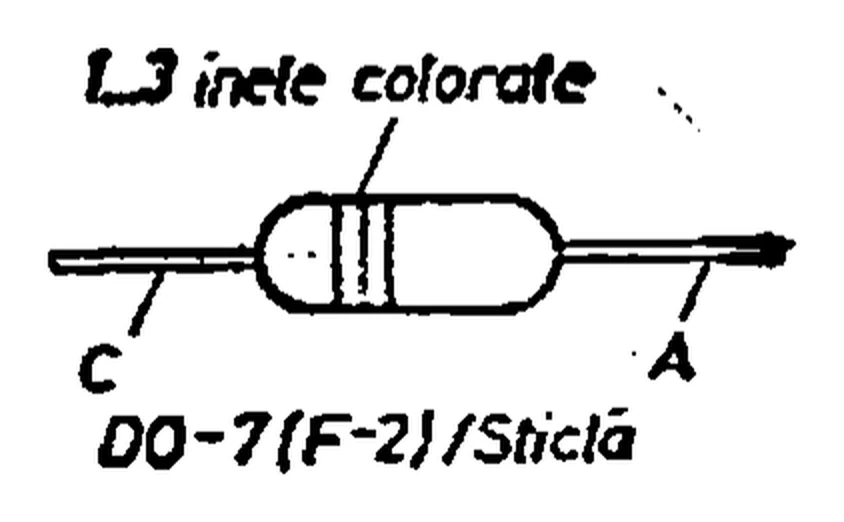
The Agenda radioelectronistului (2nd edition, 1989) lists the „EFD 107 (AA 130)” among the germanium signal and switching diodes made by IPRS Băneasa, in a DO-7 (F-2) glass package with 1…3 coloured rings (drawing in the Gallery): peak reverse voltage VRM 15 V, average forward current IFAV 20 mA, forward voltage VF 1 V at IF = 5 mA; its rings are white–yellow („alb-galben”), read from the cathode to the anode [2].
Drawing Gallery
 No image available
Photo Gallery
No other images available yet.
Documents
No documents available yet.
Prices
N/A
Used in (1)
References
- [1]N. Millea, I. Constantinescu (coord.) – „Un secol de electronică în România”, Editura Academiei Române, 2020, section VIII.1.2.2, pp. 395–396
- [2]N. Drăgulănescu – „Agenda radioelectronistului”, 2nd edition, Editura Tehnică, 1989, section 27.3.2 „Diode pentru semnale de mică putere produse în RSR” (producător: IPRS-Băneasa), „Diode cu germaniu, de semnal și comutație”, p. 511