 No image available


Specifications
- Function
- reciprocal frequency meter
- Measuring ranges
- 20 mV – 2 V rms (sine), 0.3–10 Vpp (pulses)
- Frequency range
- 1 Hz – 100 kHz
- Accuracy
- resolution from 0.1 mHz (1–10 Hz) to 1 Hz (10–100 kHz); time base ±5 × 10⁻⁶ / 24 h
- Input impedance
- 1 MΩ ∥ 50 pF
- Display
- 5 digits, LED
- Power supply
- 220 V ±10%, 50/60 Hz
- Power consumption
- max 50 VA
- Dimensions
- 310 × 105 × 415 mm (W × H × D)
- Weight
- 6 kg
Description
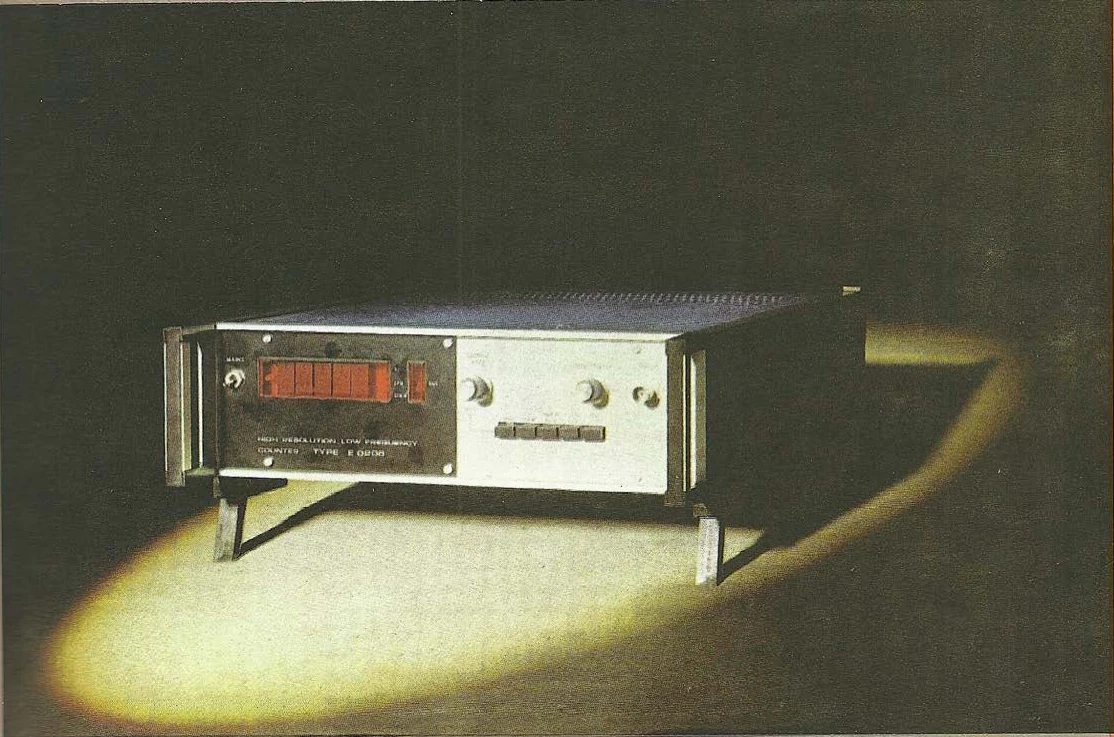
The E0205 is a digital frequency meter, made by IEMI in Bucharest and designed at the ICE research institute [1]. It was also made in variants [1].
ICE’s laboratory for electronic instruments for measuring electrical quantities designed all the institute’s generations of oscilloscopes, voltmeters, multimeters, signal generators, frequency meters, logic analysers, RLC bridges and stabilised AC power supplies; they went into production at IEMI or in ICE’s own microproduction workshop, and equipped industrial laboratories and production lines as well as teaching and research laboratories [1]. In the 1970s and 1980s about half of the components of measuring instruments were imported; after 1980 about three quarters were Romanian [1].
It is a reciprocal frequency meter with a five-digit LED display [2]. IEMI’s production table lists 1,647 units made in 1979–1985 [2].
Its list price, set in 1982, was 16,380 lei [3].
Annex III.2.7 says it measured low frequencies (1 Hz – 100 kHz) and rotational speeds with high resolution, for adjusting and calibrating oscillators in automation and power systems and for testing motors and other rotating parts; it chose its range automatically, showed the decimal point and the unit and could hold the displayed result. The prospectus gives a mean time between failures of about 1,000 hours [4].
The Agenda radioelectronistului (2nd edition, 1989) lists the „E-0205” („Frecvențmetru reciproc (5 cifre)”, reciprocal frequency meter with 5 digits) among the digital frequency meters of the E-02 group made by IEMI, with a light-emitting-diode display [5]. Its table gives a 10 MHz reference oscillator, a frequency range of 1 Hz…100 kHz with a sensitivity of 20 mV, a period range of 1 Hz…100 kHz with a sensitivity of 20 mV, a 220 V ±10 % supply, at most 50 VA, 10 × 41 × 31 cm (height × width × depth) and at most 6 kg [5].
The IEMI catalogue 1980 presents it as the „E 0205 counter/timer” („Reciprocal frequencymeter E 0205” in the contents), with a high resolution at low frequencies, for accurately measuring low frequencies and RPM in automation and in testing engines and other devices with rotating parts [7]. It consists of an input amplifier, a shaping circuit, an automatic range selection block, a gate circuit, a reciprocal count block and a recycling circuit (all on board P1), an internal calibration (P3), the supply circuits (P5 and P6) and the display circuits (P2) [7].
Its table gives a range of 1.1 Hz – 99.9 kHz in the Hz mode, the RPM mode converting Hz into counts per minute; a sensitivity of 20 mV rms or 300 mVpp pulses (5 µs wide), continuously variable up to 2 V rms, and an attenuator (÷1 or ÷100) raising it by a factor of 100 (20 mV – 2 V to 2 V – 200 V); low-pass filters (−20 dB ±4 dB at 1 kHz); 1 MΩ shunted by 50 pF without filters; an AC-coupled amplifier; an overload protection of 250 V rms to 50 Hz and 20 V rms up to 100 kHz; a trigger level selected positive or negative; gate times of 0.35–8 s; an accuracy of ±1 count ± the time base accuracy ± the trigger error (±3×10⁻³ for 1.1–10 Hz, ±2×10⁻⁴ for 10.1–100 Hz, ±3×10⁻⁵ for 100.1 Hz – 1 kHz, at 40 dB signal-to-noise) ± the inverted error (±3×10⁻⁵); a 5-digit LED display with an automatically placed decimal point, flashing on overflow; a 10 MHz time base stable within ±5×10⁻⁶ / 24 h and ±2×10⁻⁵; +5 to +40 °C; 50 VA, 220 V ±10 %, 50/60 Hz; 365 × 90 × 305 mm and 5 kg [7]. Its range (1.1 Hz – 99.9 kHz), size and weight differ from the specifications (1 Hz – 100 kHz, 310 × 105 × 415 mm, 6 kg) [7].
Photo Gallery
 No image available
Schematics
No schematics available yet.
Documents
No documents available yet.
Prices
N/A
References
- [1]N. Millea (coord.) et al. – „Electronica românească. O istorie trăită”, vol. II „Electronica profesională”, AGIR, section II.4.1 „Laborator aparate electronice pentru măsurarea mărimilor electrice”, pp. 109–115
- [2]N. Millea (coord.) et al. – „Electronica românească. O istorie trăită”, vol. II „Electronica profesională”, AGIR, sections III.2 „Producția IEMI” and III.3 „Comentarii tehnico-economice”, pp. 302–317, and annex III.2.3 „Producția IEMI – aparate electronice de măsură și industriale”, pp. 383–386
- [3]N. Millea (coord.) et al. – „Electronica românească. O istorie trăită”, vol. II „Electronica profesională”, AGIR, annex III.2.5 „Lista cu prețurile produselor – IEMI”, pp. 393–396
- [4]N. Millea (coord.) et al. – „Electronica românească. O istorie trăită”, vol. II „Electronica profesională”, AGIR, annex III.2.7 „Frecvențmetre”, pp. 614–617
- [5]N. Drăgulănescu – „Agenda radioelectronistului”, 2nd edition, Editura Tehnică, 1989, section 50.2 „Frecvențmetre numerice” (producător: IEMI – București), pp. 708–710
- [6]N. Millea, I. Constantinescu (coord.) – „Un secol de electronică în România”, Editura Academiei Române, 2020, p. 119
- [7]Measuring Electronic Instruments Enterprise (I.E.M.I.), Bucharest – „catalogue 1980” (in English), section II „Electronic instruments for electric quantities measurement”, „E 0205 counter/timer” (unnumbered pages)