 No image available


Specifications
- Bandwidth
- 10 MHz
- Channels
- 1
- Vertical sensitivity, max
- 20 mV/div
- Vertical deflection range
- 20 mV – 20 V/div, 10 steps (1, 2, 5)
- Vertical accuracy
- ±3%
- Input impedance
- 1 MΩ ∥ 40 pF
- Input voltage, max
- 250 Vpp
- Overshoot
- 5%
- Time base, fastest
- 0.2 µs/div
- Time base range
- 0.2 µs – 0.5 s/div
- Time base accuracy
- ±5 … ±7%
- Triggering
- automatic or triggered; internal or external
- Trigger input
- 100 kΩ ∥ 25 pF
- X amplifier bandwidth
- 1 MHz
- X deflection coefficient
- 1 V/div
- X input
- 300 kΩ ∥ 35 pF, max 100 Vpp
- Calibrator
- 80 mV ±5% (into 1 MΩ), 1 kHz ±0.5%
- Screen
- 7 × 10 div (1 div = 7 mm)
- Post-acceleration voltage
- 6 kV
- Operating conditions
- +5 … +40 °C, relative humidity 80%
- Power supply
- 220 V, 50–60 Hz, or external 24 V DC, 0.7 A
- Power consumption
- 35 VA
- Dimensions
- 23 × 26 × 38 cm (W × H × D)
- Weight
- 11 kg
Description
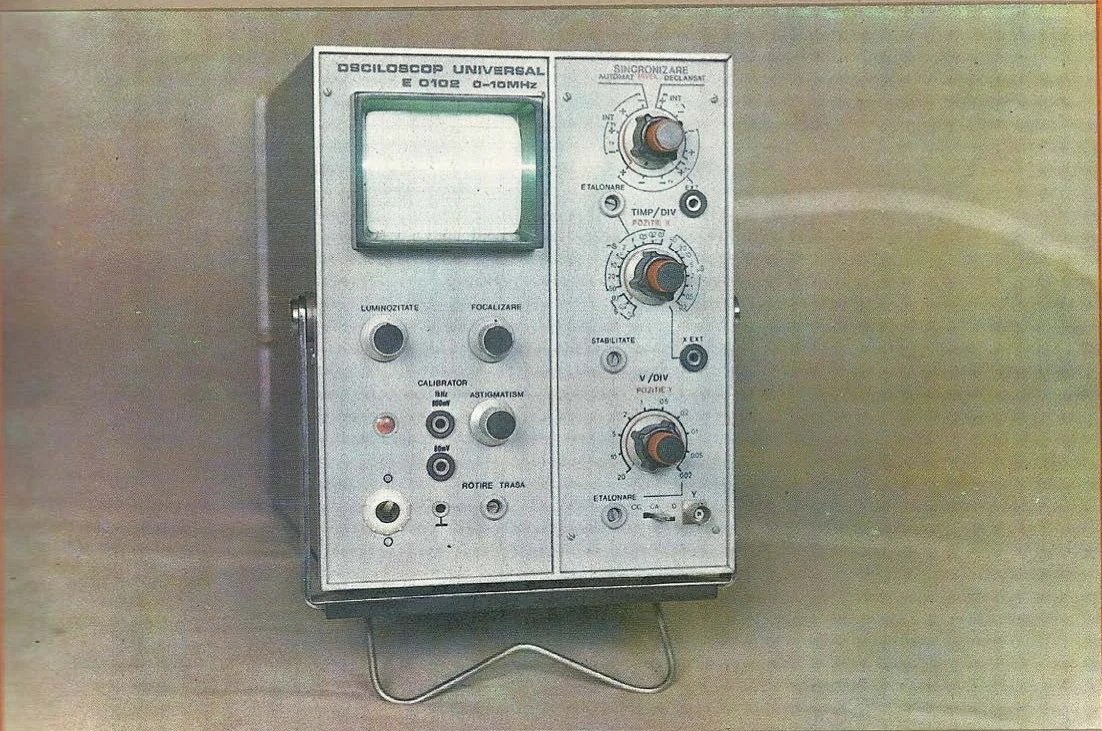
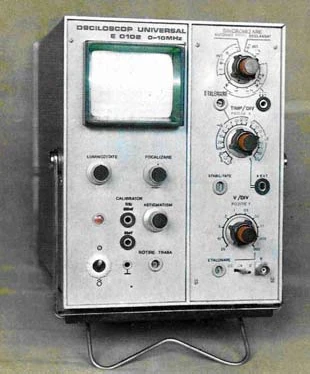
The E0102 is a general-purpose (“universal”) oscilloscope made by IEMI in Bucharest. It was produced from 1974 to 1985, in 5,909 units [1]. Like the other IEMI oscilloscopes, it was designed at ICE, the Romanian institute for electronics research, in its electrical measurements laboratory [1].
It was fully transistorised and was intended for displaying and measuring electrical signals when testing and repairing electronic equipment [3]. It could be powered from the mains or from an external 24 V supply [2][3].
Where the sources differ, the values from Electronica românească [3], taken from the manufacturer’s brochures, are shown.
Its list price, set in 1982, was 16,150 lei [4].
The IEMI catalogue 1980 presents it as the „E 0102 oscilloscope” („Universal oscilloscope E 0102” in the contents), for measuring, checking and repairing electronic equipment in research and plant laboratories [5]. It consists of a vertical amplifier, a horizontal amplifier, a time base, a voltage converter for the power supply, a voltage and frequency calibrator and a cathode-ray tube with a rectangular screen, and works from the 220 V, 50 Hz mains or from an external 24 V DC source (0.7 A) [5].
Its table gives a 100 mm CRT with a measuring area of 6 × 10 div (1 div = 7 mm), a 6 kV post-acceleration voltage and a medium-persistence green screen; a vertical band of 0–10 MHz at −3 dB, deflection coefficients of 20 mV/div – 20 V/div in 10 steps (1, 2, 5), an error of ±3 % after calibration, an input impedance of 1 MΩ ±2 % parallel to max. 40 pF and a maximum input of 250 Vpp; a triggered or automatic time base of 0.2 µs/div – 0.5 s/div in 20 steps (1–2–5), with errors of ±5 % for 1 µs – 50 ms/div and ±7 % for 0.2–0.5 µs/div and 0.1–0.5 µs/div; synchronisation from an internal or external signal (±) in the 50 Hz – 10 MHz band and on TV fields in the automatic mode, 10 Hz – 10 MHz in the triggered mode, the „SINCRO EXT” input being min. 100 kΩ parallel to max. 25 pF, max. 50 Vpp; a horizontal band of 0–1 MHz at −3 dB, 1 V/div, an input impedance of max. 350 kΩ parallel to max. 35 pF (as printed) and max. 100 Vpp; a calibrator of 800 mV ±2.5 % and 80 mV ±0.5 % on 1 MΩ, at 1 kHz ±0.5 %; a supply of 220 V ±10 %, 50 Hz, max. 35 VA, or an external 24 V ±10 %, 0.7 A source; +5 to +40 °C, max. 80 % humidity; 220 × 260 × 385 mm (W × H × D) and 10 kg [5]. Its 6 × 10 div measuring area, its 10 kg weight and its X input (350 kΩ, 35 pF) differ from the 7 × 10 div, the 11 kg and the 300 kΩ ∥ 35 pF in the specifications [5].
Photo Gallery
 No image available
 No image available
 No image available
Schematics
No schematics available yet.
Documents
No documents available yet.
Prices
N/A
References
- [1]N. Millea, I. Constantinescu – „Un secol de electronică în România (II). Electronica profesională”, NOEMA XVIII, 2019
- [2]N. Drăgulănescu – „Agenda radioelectronistului”, 2nd edition, 1989, p. 707 (table „Osciloscoape (grupa E-01)”, producer IEMI București)
- [3]„Electronica românească. O istorie trăită”, vol. II – Electronica profesională, AGIR, 2013, annex III.2.6 „Osciloscoape” (list and tables of technical characteristics from the manufacturer's brochures, pp. 610–611)
- [4]N. Millea (coord.) et al. – „Electronica românească. O istorie trăită”, vol. II „Electronica profesională”, AGIR, annex III.2.5 „Lista cu prețurile produselor – IEMI”, pp. 393–396
- [5]Measuring Electronic Instruments Enterprise (I.E.M.I.), Bucharest – „catalogue 1980” (in English), section II „Electronic instruments for electric quantities measurement”, „E 0102 oscilloscope” (unnumbered pages)