 No image available


Specifications
- Bandwidth
- 50 MHz
- Channels
- 2
- Vertical sensitivity, max
- 20 mV/div
- Vertical deflection range
- 20 mV – 20 V/div (1, 2, 5), E0103B plug-in
- Vertical accuracy
- ±3%
- Input impedance
- 1 MΩ ∥ 47 pF
- Input voltage, max
- 250 Vpp
- Time base, fastest
- 0.2 µs/div
- Time base range
- 0.2 µs – 0.5 s/div (E-0103C plug-in)
- Time base accuracy
- ±5 … ±10%
- Triggering
- internal or external
- Trigger input
- 500 kΩ ∥ 50 pF, max 100 Vpp
- X amplifier bandwidth
- 5 MHz
- X deflection coefficient
- 0.1 V/div
- X input
- 1 MΩ ∥ 47 pF, max 250 Vpp
- Z modulation (frequency / voltage)
- 1 kHz / +5 V
- Calibrator
- 120 mV ±5% (into 1 MΩ), 1 kHz ±0.5%
- Screen
- 8 × 10 div (1 div = 10 mm)
- Post-acceleration voltage
- 10 kV
- Rise time
- 7 ns
- Operating conditions
- +5 … +40 °C, relative humidity 80%
- Power supply
- 220 V, 50 Hz
- Power consumption
- 140 VA
- Dimensions
- 25 × 35 × 56 cm (W × H × D)
- Weight
- 26 kg
Description
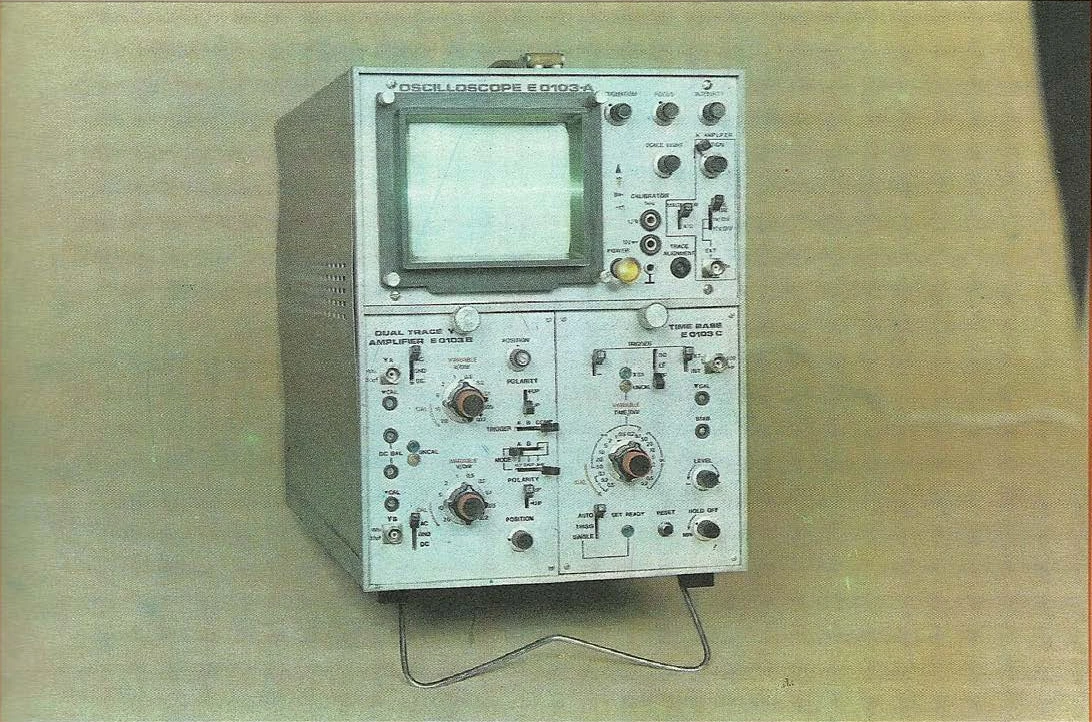
The E0103 is a laboratory oscilloscope made by IEMI in Bucharest, built around interchangeable plug-in units (“drawers”). Like the other IEMI oscilloscopes, it was designed at ICE, the Romanian institute for electronics research, in its electrical measurements laboratory [1].
Plug-ins
The Agenda radioelectronistului lists five plug-ins for the E0103 [2]:
- E-0103B – two-channel Y amplifier
- E-0103C – single time base
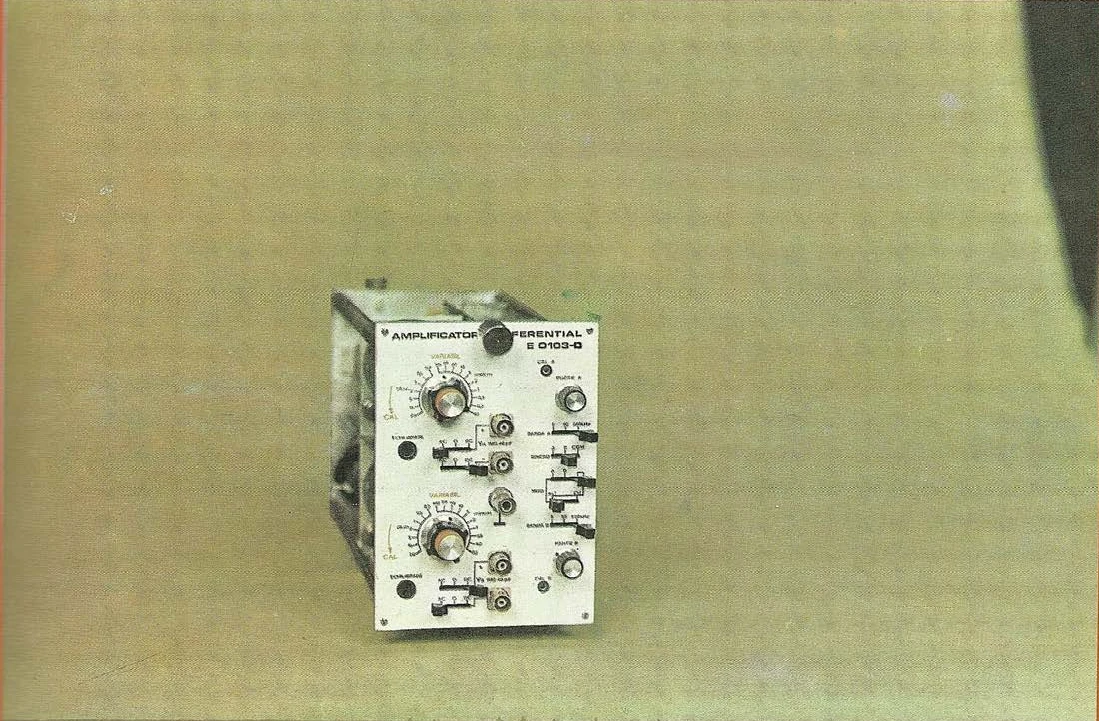
- E-0103D – differential amplifier (100 µV/div, 500 kHz), for measuring very small voltages at relatively low frequencies [2][3]
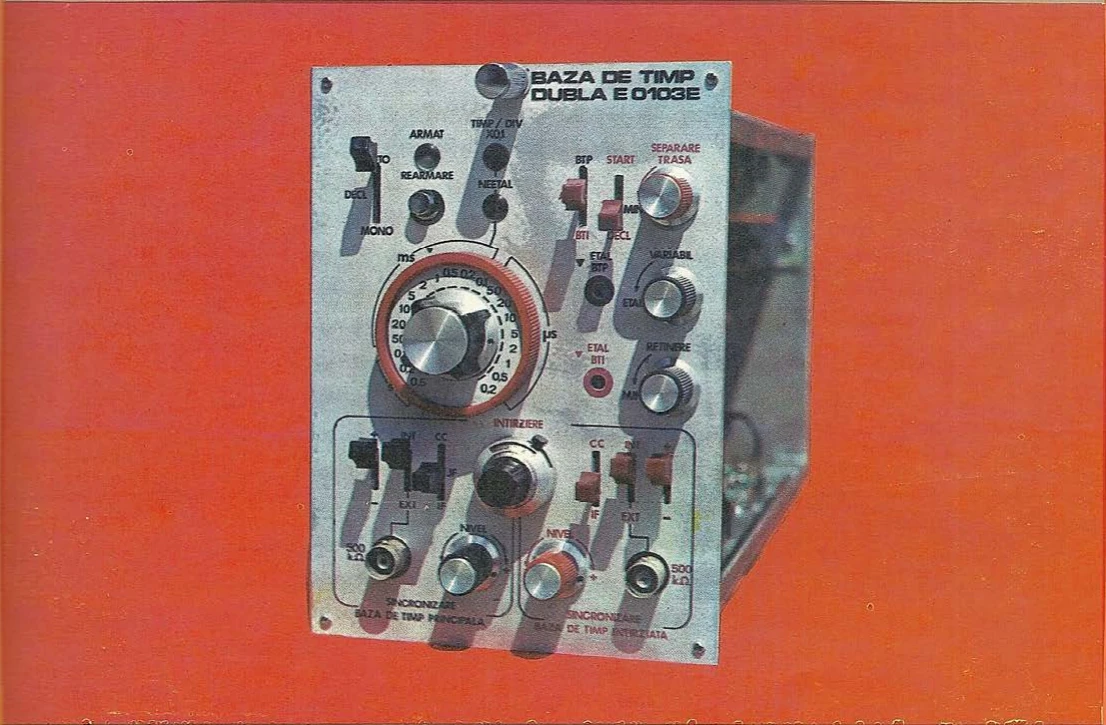
- E-0103E – dual time base (0.2 µs/div, adjustable), for comparing two signals: it has a main and a delayed sweep generator, the delayed sweep being started at a set point of the main sweep [2][3]
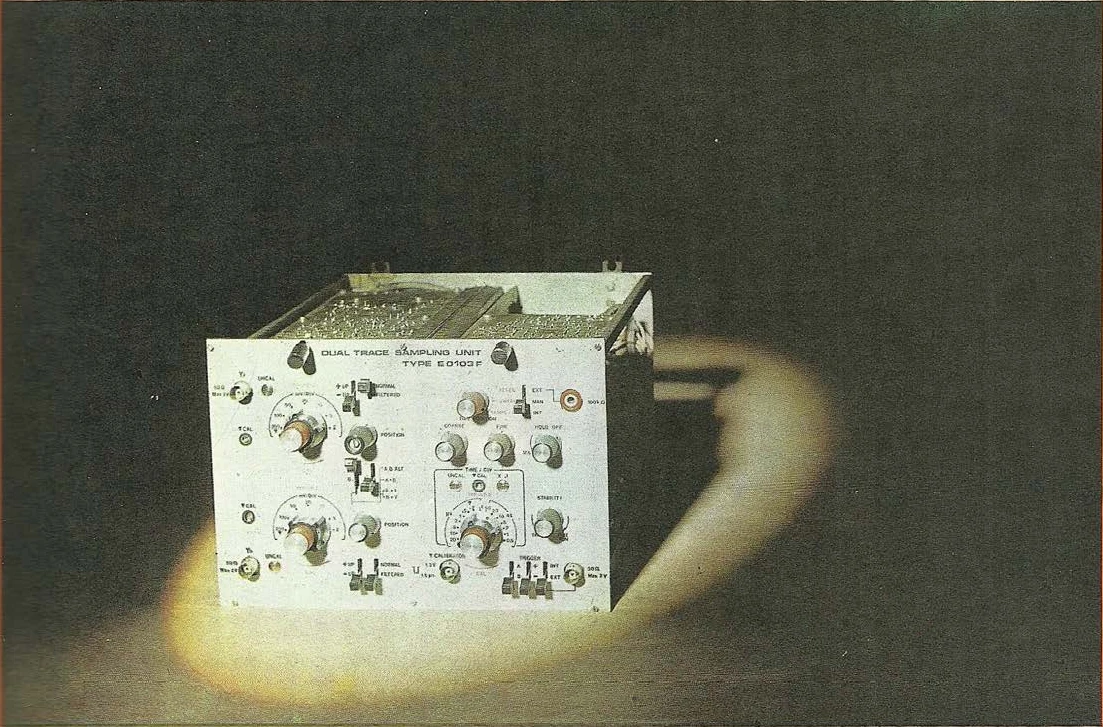
- E-0103F – sampling unit (100 kHz – 1 GHz, 2 mV/div) [2]
The sampling unit was used, for example, to measure the switching characteristics of transistors, diodes and TTL and ECL logic circuits; to display, measure and record fast pulses with a low repetition rate, replacing storage and high-writing-speed oscilloscopes in some applications; and to measure phase shifts at high frequencies with Lissajous figures [3].
In the Agenda’s table, the bandwidth of 0–50 MHz is given for the E-0103B and the sensitivity of 20 mV/div for the E-0103C [2]. Where the sources differ, the values from Electronica românească [3], taken from the manufacturer’s brochures, are shown.
Production
The E0103 was produced from 1975 to 1984, with a break in 1982–1983. IEMI made 1,568 base units, 385 amplifier plug-ins, 385 time-base plug-ins and 20 sampling units, the latter all in 1979 [1].
The IEMI catalogue 1980 presents it as the „E 0103 oscilloscope” („Dual trace HF oscilloscope E 0103” in the contents), fully transistorised, with a 0–50 MHz band, 20 mV/div – 20 V/div and a rectangular-screen CRT; it is a laboratory oscilloscope with interchangeable plug-in units [4]. The basic frame holds the Y final amplifier with the delay line, the X amplifier, the calibrator, the cathode-ray tube and the supply; it takes 2-channel Y amplifiers, a differential Y amplifier, a simple time base, a double time base and a calibrating unit, and the catalogue’s data are for the basic frame with the 2-channel Y amplifier and the simple time base [4].
Its table gives a measuring surface of 8 × 10 div (1 div = 10 mm) and a 10 kV post-acceleration voltage; for the E 0103 B two-channel Y amplifier, 20 mV/div – 20 V/div (1, 2, 5), an error of ±3 % after calibration on 20 mV/div, a 0–50 MHz band, a 7 ns rise time, 1 MΩ parallel to max. 47 pF, the modes A, B, ALT, CHOPPED and A+Z, and max. 250 Vpp; for the E 0103 C simple time base, 0.2 µs/div – 0.5 s/div (1, 2, 5) with a ×10 magnifier, errors of ±5 % (1 µs – 50 ms/div) or ±8 % with ×10, ±7 % (other steps) or ±10 % with ×10; automatic, triggered or single-trigger synchronisation, internal or external, positive or negative, DC 0–50 MHz, LF 10 Hz – 2 MHz or HF 2 MHz – 50 MHz, the SINCRO-EXT input min. 500 kΩ parallel to max. 50 pF, max. 100 Vpp; a horizontal amplifier of 0–5 MHz, 0.1, 1 or 10 V/div, 1 MΩ parallel to max. 50 pF, max. 100 Vpp; a Z input with a minimum blanking level of +5 V, min. 100 Ω parallel to max. 50 pF, 0–1 MHz, max. 100 Vpp; a calibrator of 120 mVpp (±0.5 % on min. 1 MΩ) and 1.2 Vpp (±2.5 %), 1 kHz ±1 %; 140 VA, 220 V ±10 %, 50 Hz ±5 %, +5 to +40 °C; 250 × 350 × 560 mm (W × H × D) and 26 kg [4]. Its X input of 1 MΩ ∥ 50 pF and its calibrator (120 mVpp ±0.5 %, 1 kHz ±1 %) differ from the 47 pF and the 120 mV ±5 %, 1 kHz ±0.5 % in the specifications [4].
The catalogue also presents three plug-ins; their photos are in the Gallery [4]:
- E 0103 D („Differential amplifying plug-in unit E 0103 D”) – for very low voltages at relatively low frequencies: 100 µV/div – 20 V/div (1–2–5), ±3 %, bands calibrated in steps of 0–500 kHz, 0–50 kHz and 0–5 kHz (DC coupled) or 2 Hz – 500 kHz, 2 Hz – 50 kHz and 2 Hz – 5 kHz (AC coupled), 1 MΩ parallel to 51 pF, a common-mode rejection (DC coupling, 0–10 kHz) of 50,000, decreasing in proportion to the deflection factor down to 100 µV/div; two input attenuators and two high-sensitivity preamplifiers, electronic channel switching (channel A, channel B, alternate, chopped at about 100 kHz); 120 × 165 × 340 mm (W × H × D), 3 kg [4]. The catalogue contrasts it with the E 0103 B two-channel plug-in (50 MHz, 20 mV/div) [4].
- E 0103 E („E 0103 E double time base plug-in unit”, „Twin time base unit” in the contents) – a main and a delayed sweep, the delay set by the DELAY potentiometer, START or TRIGG delayed modes, the selected detail shown brightened on the main sweep, and the main time base (MTB), the delayed time base (DTB) or both alternately (ALT, with TRACE SEPARATION); the main time base gives 0.2 µs/div – 0.5 s/div (±3 % for 1 µs – 50 ms/div, ±5 % for 0.2 µs – 0.5 ms/div and 0.1–0.5 s/div), the delayed one from 0.2 µs/div (±3 % / ±5 %); automatic or triggered synchronisation, internal (1 div) or external (1 Vpp), DC 10 Hz (0 Hz triggered) – 50 MHz, LF 10 Hz – 2 MHz, HF 2 MHz – 50 MHz; max. 100 Vpp at the external sync input (min. 500 kΩ parallel to max. 47 pF); an apparent delay of min. 20 µs; 165 × 120 × 355 mm (H × W × D), 3 kg [4].
- E 0103 F („E 0103 F sampling unit”, used with the basic frame of the E 0103 A, as printed) – samples high-frequency signals into a low-frequency one keeping the waveform and the levels, for the switching characteristics of transistors, diodes and TTL or ECL ICs, time-domain reflectometry (TDR) with a pulse generator, phase measurements at high frequencies with Lissajous figures, fast pulses with a low repetition rate (instead of a storage oscilloscope in some uses) and small signals on larger ones (up to 1:1,000): 200–2 mV/div (±3 % to 10 mV/div, ±5 % at 5 and 2 mV/div), a 350 ps rise time, ±5 % overshoot, the modes A, B, alternate and added and an A–B (X–Y) mode, 50 Ω ±1 %, a displayed noise of max. 2 mV (normal) or 1 mV (filtered), triggered or automatic synchronisation on channel A (internal, 50 mVpp, useful down to 5 mVpp) or B (external, 5 mVpp), 100 kHz – 1 GHz for sine waves, max. ±2 V, an internal 1.2 Vpp ±1 % pulse calibrator, min. 2 ns delayed sweep, min. 40 dB isolation between channels, max. 100 ps channel delay difference, sweep factors of 20 µs – 0.5 ns/div (2 ns – 50 ps/div with ×10), and internal (100–1,000 points), manual or external scanning [4].
Photo Gallery
 No image available
 No image available
 No image available
 No image available
Schematics
No schematics available yet.
Documents
No documents available yet.
Prices
N/A
References
- [1]N. Millea, I. Constantinescu – „Un secol de electronică în România (II). Electronica profesională”, NOEMA XVIII, 2019
- [2]N. Drăgulănescu – „Agenda radioelectronistului”, 2nd edition, 1989, p. 707 (table „Osciloscoape (grupa E-01)”, producer IEMI București)
- [3]„Electronica românească. O istorie trăită”, vol. II – Electronica profesională, AGIR, 2013, annex III.2.6 „Osciloscoape” (list and tables of technical characteristics from the manufacturer's brochures, pp. 610–611)
- [4]Measuring Electronic Instruments Enterprise (I.E.M.I.), Bucharest – „catalogue 1980” (in English), section II „Electronic instruments for electric quantities measurement”, „E 0103 oscilloscope” (unnumbered pages)