 No image available


Specifications
- Bandwidth
- 10 MHz
- Channels
- 1
- Vertical sensitivity, max
- 10 mV/div
- Vertical deflection range
- 10 mV – 22 V/div (as printed), 10 steps (1–2–5)
- Vertical accuracy
- ±5%
- Input impedance
- 1 MΩ ∥ 47 pF
- Input voltage, max
- 250 Vpp
- Time base, fastest
- 0.5 µs/div
- Time base range
- 0.5 µs – 0.5 s/div
- Time base accuracy
- ±5%
- Triggering
- automatic or triggered
- Trigger input
- 100 kΩ ∥ 47 pF, max 100 Vpp
- X amplifier bandwidth
- 0.5 MHz
- X deflection coefficient
- 1 V/div
- X input
- 100 kΩ ∥ 47 pF, max 100 Vpp
- Screen
- rectangular CRT, 8 × 10 div (1 div = 5 mm)
- Operating conditions
- +5 … +40 °C, relative humidity 80%
- Power supply
- 220 V, 50 Hz, or external 10–15 V DC
- Power consumption
- ≤ 18 VA
- Dimensions
- 23 × 14 × 32 cm (W × H × D)
- Weight
- 6 kg
Description
The E0104, known as the Miniscop, is a compact oscilloscope made by IEMI in Bucharest, with more modest specifications than the laboratory models. It was made in very large numbers: 5,381 units between 1977 and 1985 [1]. Like the other IEMI oscilloscopes, it was designed at ICE, the Romanian institute for electronics research, in its electrical measurements laboratory [1].
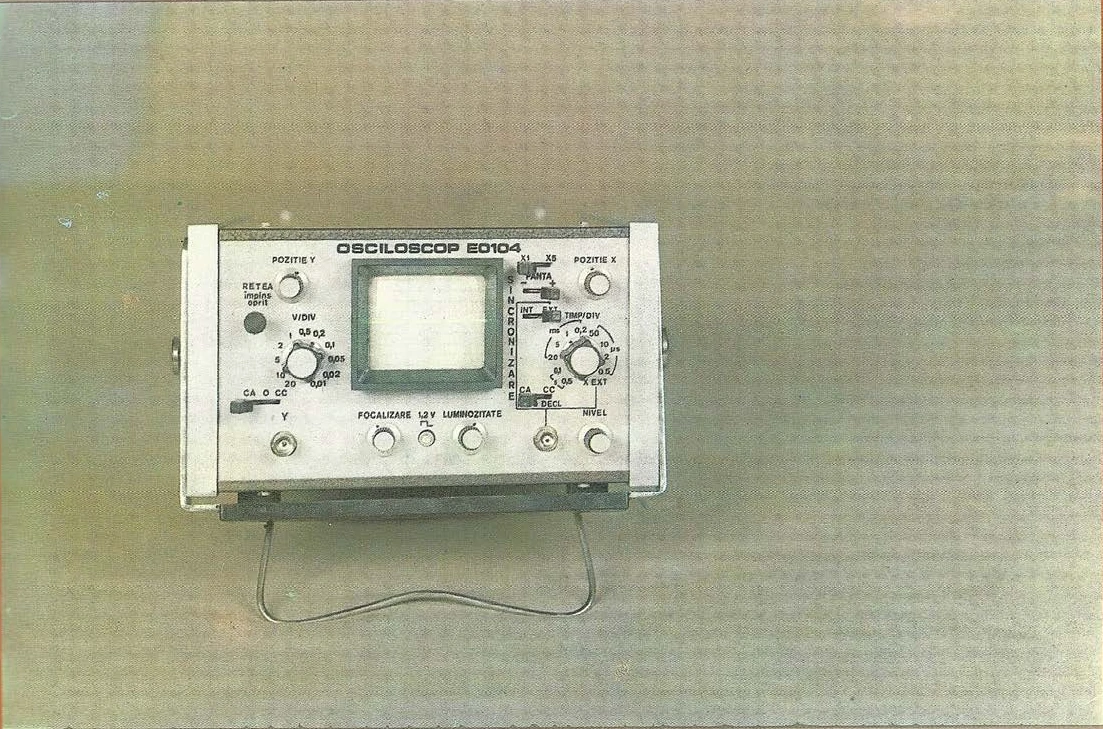
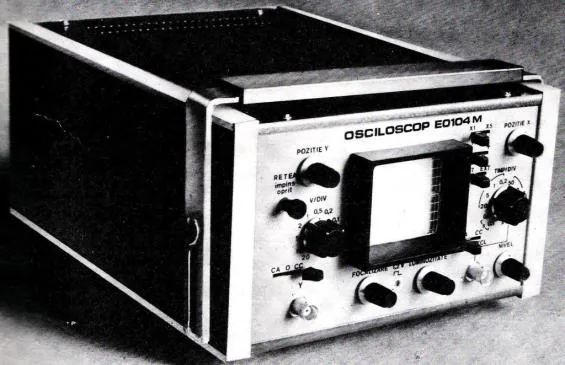
The picture above shows the E0104M version; the Agenda radioelectronistului gives its characteristics for the “E-0104(M)”, which could also be powered from a 10–15 V DC supply [2][3].
Its list price, set in 1982, was 16,600 lei [4].
Electronica românească describes the E0104 as a small instrument with a 0–10 MHz bandwidth, widely used in automation, education and factories, and the E0104M as its modernised version [3]. Where the sources differ, the values from Electronica românească [3], taken from the manufacturer’s brochures, are shown.
The IEMI catalogue 1980 presents it as the „E 0104 portable oscilloscope”, small and light, fully transistorised, with a rectangular-screen tube, 0–10 MHz and 10 mV/div, for automation, education, radio transmission, television, electronic production and plant laboratories [5]. It consists of the vertical deflection system (attenuator and DC amplifier), the horizontal deflection system (synchronising circuits, time base, X amplifier), the supply (a low- and high-voltage converter) and the cathode-ray tube, and works from the 220 V mains or from an external 12 V DC source [5].
Its table gives a vertical band of 0–10 MHz, deflection factors printed „10 mV/div – 22 V/div” in 10 steps (1–2–5), ±5 %, 1 MΩ ±2 % parallel to max. 36 pF, max. 250 Vpp; a time base of 0.5 µs/div – 0.5 s/div in 10 steps (printed „1–5–20 sequence”), ±5 %, and 0.1 µs/div – 0.1 s/div with the ×5 magnifier, ±5 %; automatic synchronisation, internal 10 Hz – 10 MHz or external 10 Hz – 10 MHz for a 2 Vpp signal, positive or negative, the input min. 100 kΩ parallel to max. 36 pF, max. 100 Vpp; a horizontal amplifier of 0–500 kHz, 1 V/div and 0.2 V/div, min. 100 kΩ parallel to max. 36 pF, max. 100 Vpp; an aluminised rectangular screen with a measuring surface of 8 × 10 div (1 div = 5 mm); 220 V ±10 % (50 Hz ±5 %) mains or an external 10–15 V DC source; +5 to +40 °C; 235 × 140 × 320 mm and 6 kg [5]. Its input capacitances (36 pF) differ from the 47 pF in the specifications [5].
Photo Gallery
 No image available
 No image available
Schematics
No schematics available yet.
Documents
No documents available yet.
Prices
N/A
References
- [1]N. Millea, I. Constantinescu – „Un secol de electronică în România (II). Electronica profesională”, NOEMA XVIII, 2019
- [2]N. Drăgulănescu – „Agenda radioelectronistului”, 2nd edition, 1989, p. 707 (table „Osciloscoape (grupa E-01)”, producer IEMI București)
- [3]„Electronica românească. O istorie trăită”, vol. II – Electronica profesională, AGIR, 2013, annex III.2.6 „Osciloscoape” (list and tables of technical characteristics from the manufacturer's brochures, pp. 610–611)
- [4]N. Millea (coord.) et al. – „Electronica românească. O istorie trăită”, vol. II „Electronica profesională”, AGIR, annex III.2.5 „Lista cu prețurile produselor – IEMI”, pp. 393–396
- [5]Measuring Electronic Instruments Enterprise (I.E.M.I.), Bucharest – „catalogue 1980” (in English), section II „Electronic instruments for electric quantities measurement”, „E 0104 portable oscilloscope” (unnumbered pages)