 No image available


Specifications
- Function
- DC regulated voltage supply, constant voltage or current limit mode
- Measuring ranges
- 7.5 V, 2 A
- Accuracy
- stabilisation factor at least 5000; ripple 1 mVpp
- Outputs / interface
- crowbar protection
- Power supply
- 220 V +10% / −15%, 50/60 Hz
- Power consumption
- max 50 VA
- Dimensions
- 100 × 195 × 277 mm (W × H × D)
- Weight
- 4.7 kg
Description
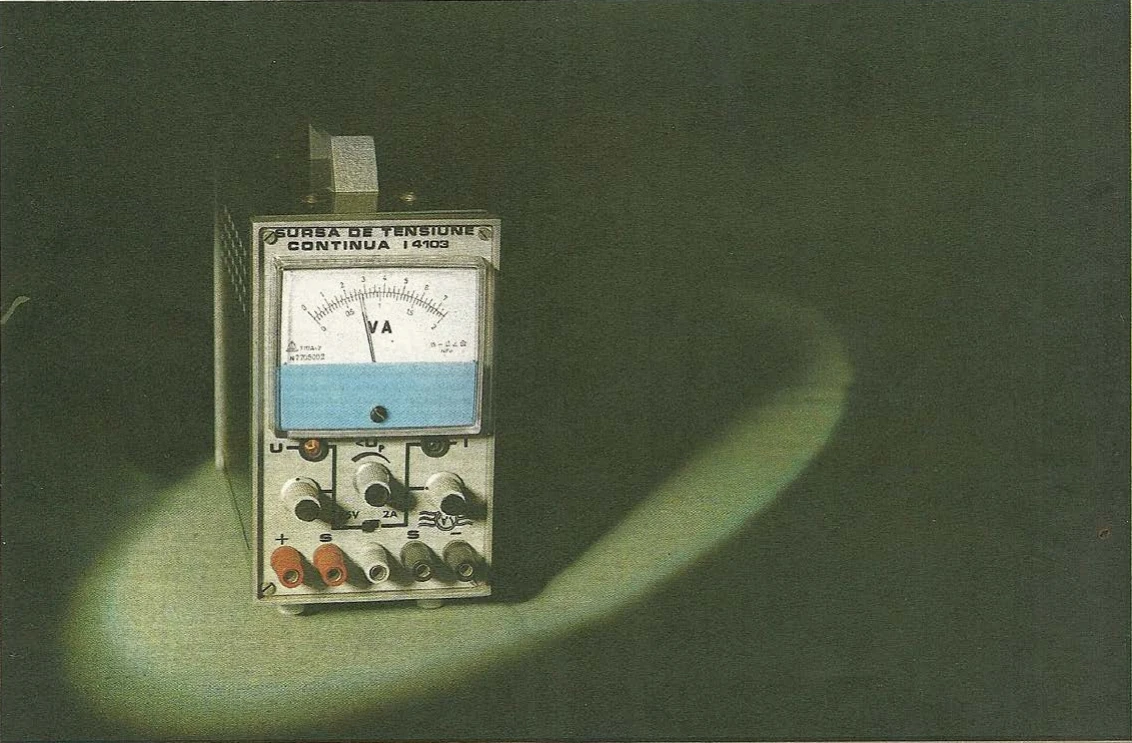
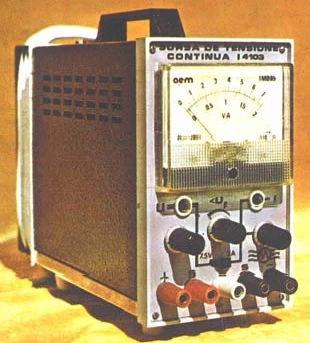
The I4103 is a DC voltage source, made by IEMI in Bucharest and designed at the ICE research institute [1]. The ICE laboratory’s table gives its code as J 4103 [1].
ICE’s laboratory for electronic instruments for measuring electrical quantities designed all the institute’s generations of oscilloscopes, voltmeters, multimeters, signal generators, frequency meters, logic analysers, RLC bridges and stabilised AC power supplies; they went into production at IEMI or in ICE’s own microproduction workshop, and equipped industrial laboratories and production lines as well as teaching and research laboratories [1]. In the 1970s and 1980s about half of the components of measuring instruments were imported; after 1980 about three quarters were Romanian [1].
It gives 7.5 V at 2 A and uses integrated circuits [2]. IEMI’s production table lists 4,154 units made in 1974–1985 [2].
Its list price, set in 1982, was 4,375 lei [3].
Annex III.2.14 says it was meant for supplying integrated circuits and transistors that needed special protection against overloads and voltage surges, with a separate crowbar circuit, and could also work as a current source limited to 50 mA – 2 A; the output was adjustable from 0 to 7.5 V [4].
The Agenda radioelectronistului (2nd edition, 1989) lists the „I-4103” („Sursă de tensiune continuă (7,5 V/2 A)”, DC voltage source) among the stabilised power supplies made by IEMI (group I-41, DC supplies) [5]. Its table gives 0…7.5 V at 0…2 A, a stabilisation factor of at least 5·10³, a temperature coefficient of 0.03 %/°C, a ripple of 10⁻³ V peak-to-peak, a 220 V (−15 %…+10 %) supply, at most 50 VA, 19 × 10 × 27 cm (height × width × depth) and at most 4.7 kg [5].
The 1st edition (1983), which gives the producers as „I.E.M.I., I.C.S.I.T.E.” (Bucharest), also gives an output impedance of up to 10 Ω (the exponent of its lower limit cannot be read with certainty), an ambient temperature range of +5…+40 °C and a size of 19.5 × 10 × 27.7 cm, which matches the 100 × 195 × 277 mm (width × height × depth) of the prospectus in annex III.2.14 [6][4].
The IEMI catalogue 1980 presents it as the „I 4103 D.C. voltage supply” („D.C. voltage source I 4103” on its photo page): 7.5 V regulated, 0–2 A, a stabilisation factor of min. 5,000, crowbar overvoltage protection and an overload protection adjustable over 50 mA – 2 A, with integrated and transistorised circuits, for research and factory laboratories and technological processes [7]. A rectifier in series with an adjustment transistor feeds the output; the error signals from the output voltage and current go to two differential amplifiers whose outputs, through an OR circuit, drive the series transistor, keeping either the voltage (0–7.5 V) or the current (50 mA – 2 A) constant and changing mode automatically with the load, so that a short circuit is safe; a separate crowbar circuit protects the connected circuits against overvoltage, and an individual stabilised block feeds the amplifier stages [7].
Its table gives, in the constant-voltage mode, 0–7.3 V (as printed), a stabilisation factor of min. 5,000, a max. ripple of 1 mVpp, a long-term drift ≤ 50 mV and a short-term one ≤ 20 mV, a temperature coefficient ≤ 0.03 %/°C, a DC output resistance of 1 mΩ, an output impedance of ≤ 10 mΩ (0–1,000 Hz), ≤ 20 mΩ (1–10 kHz), ≤ 100 mΩ (10–100 kHz), ≤ 2 Ω (100 kHz – 1 MHz) and ≤ 10 Ω (1–10 MHz), a settling time of max. 20 µs for 2 A load changes and an overvoltage protection acting in max. 10 µs; in the current-limit mode, 50 mA – 2 A, a long-term drift of ±1 % and a short-term one of ±0.25 % at 2 A, ≤ 0.03 %/°C; 50 VA, 220 V (+10 % / −15 %), 50/60 Hz, +5 to +40 °C, max. 80 % humidity, 100 × 160 × 240 mm (W × H × D) and 4.7 kg [7]. Its height and depth (160 and 240 mm) differ from the 195 and 277 mm in the specifications [7].
Photo Gallery
 No image available
Schematics
No schematics available yet.
Documents
No documents available yet.
Prices
N/A
References
- [1]N. Millea (coord.) et al. – „Electronica românească. O istorie trăită”, vol. II „Electronica profesională”, AGIR, section II.4.1 „Laborator aparate electronice pentru măsurarea mărimilor electrice”, pp. 109–115
- [2]N. Millea (coord.) et al. – „Electronica românească. O istorie trăită”, vol. II „Electronica profesională”, AGIR, sections III.2 „Producția IEMI” and III.3 „Comentarii tehnico-economice”, pp. 302–317, and annex III.2.3 „Producția IEMI – aparate electronice de măsură și industriale”, pp. 383–386
- [3]N. Millea (coord.) et al. – „Electronica românească. O istorie trăită”, vol. II „Electronica profesională”, AGIR, annex III.2.5 „Lista cu prețurile produselor – IEMI”, pp. 393–396
- [4]N. Millea (coord.) et al. – „Electronica românească. O istorie trăită”, vol. II „Electronica profesională”, AGIR, annex III.2.14 „Surse de alimentare”, pp. 674–677
- [5]N. Drăgulănescu – „Agenda radioelectronistului”, 2nd edition, Editura Tehnică, 1989, section 50.7 „Surse stabilizate de alimentare în c.c./c.a.” (producător: IEMI – București), pp. 725–727
- [6]N. Drăgulănescu – „Agenda radioelectronistului”, 1st edition, Editura Tehnică, 1983, section 5.8 „Surse stabilizate de alimentare c.c./c.a. (grupele I-41 și I-42)” (producători: I.E.M.I., I.C.S.I.T.E. – București), pp. 594–595
- [7]Measuring Electronic Instruments Enterprise (I.E.M.I.), Bucharest – „catalogue 1980” (in English), section IV „Power sources”, „I 4103 D.C. voltage supply” (unnumbered pages)