 No image available


Specifications
- Function
- DC regulated voltage supply, constant voltage or current limit
- Measuring ranges
- 40 V, 5 A
- Accuracy
- load 0.01% + 6 mV; mains 0.005% + 2 mV; ripple 1 mV rms
- Display
- digital, 0.1 V steps
- Construction
- silicon semiconductors
- Power supply
- 220 V +10% / −15%, 50/60 Hz
- Power consumption
- max 400 VA
- Dimensions
- 222 × 230 × 460 mm (W × H × D)
- Weight
- 20 kg
Description
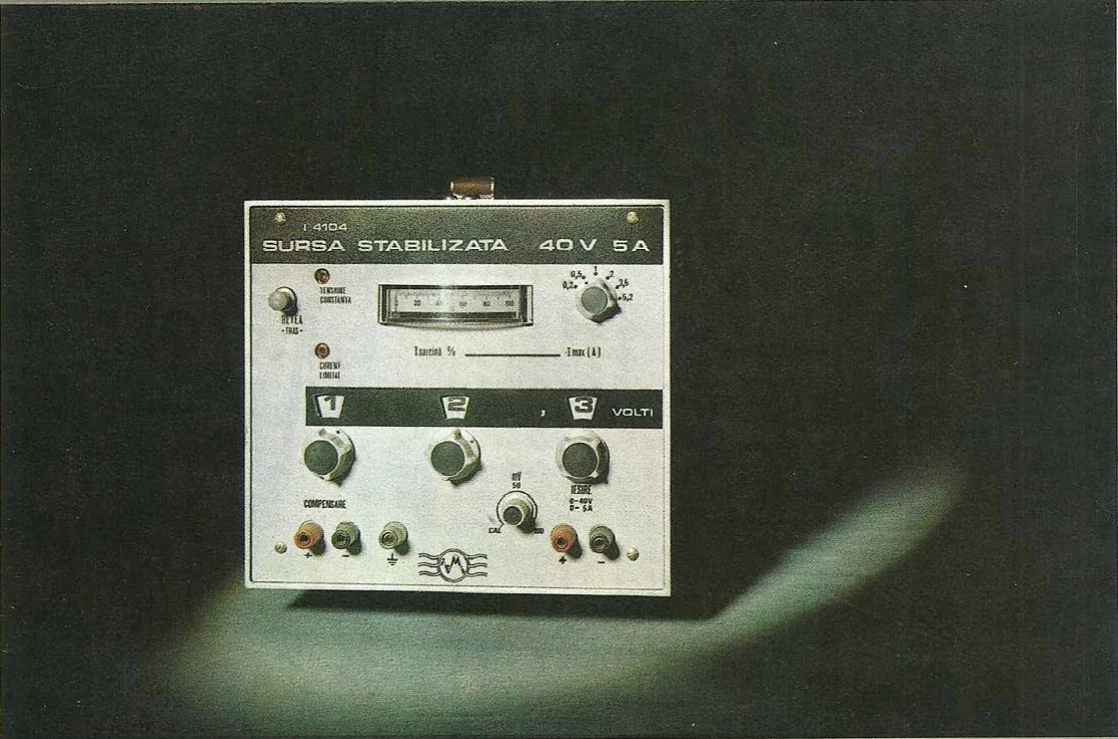
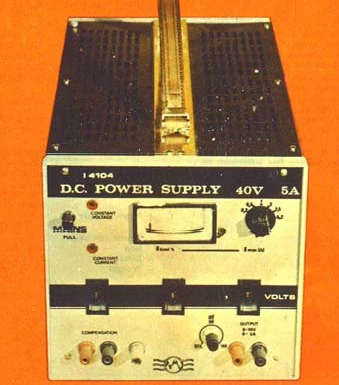
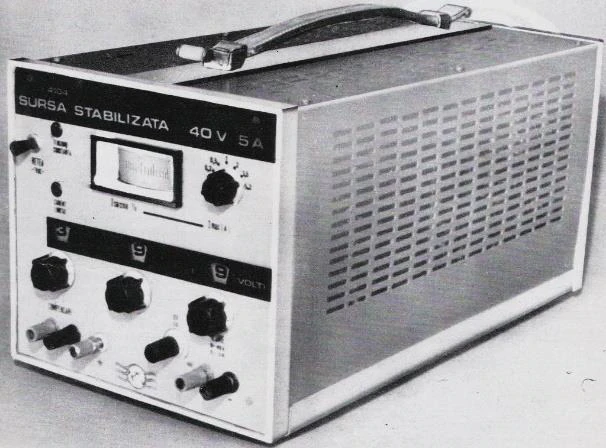
The I4104 is a DC voltage source, made by IEMI in Bucharest and designed at the ICE research institute [1]. The ICE laboratory’s table gives its code as J 4104 [1].
ICE’s laboratory for electronic instruments for measuring electrical quantities designed all the institute’s generations of oscilloscopes, voltmeters, multimeters, signal generators, frequency meters, logic analysers, RLC bridges and stabilised AC power supplies; they went into production at IEMI or in ICE’s own microproduction workshop, and equipped industrial laboratories and production lines as well as teaching and research laboratories [1]. In the 1970s and 1980s about half of the components of measuring instruments were imported; after 1980 about three quarters were Romanian [1].
It gives up to 40 V at 5 A [2]. IEMI’s production table lists 7,382 units made in 1975–1985 [2].
Its list price, set in 1982, was 11,400 lei [3].
Annex III.2.14 says it was built entirely with silicon semiconductors, for supplying electronic circuits with a stable DC voltage adjustable from 0 to 40 V in 0.1 V steps, at up to 5 A [4].
The Agenda radioelectronistului (2nd edition, 1989) lists the „I-4104” („Sursă de tensiune continuă (40 V/5 A)”, DC voltage source) among the stabilised power supplies made by IEMI (group I-41, DC supplies) [5]. Its table gives 0…40 V at 0…5 A, a stabilisation of 0.005 %, an output impedance of 15·10⁻³…2 Ω, a temperature coefficient of 0.01 %/°C, a ripple of 10⁻³ V peak-to-peak (the prospectus in annex III.2.14 gives 1 mV rms), a 220 V (−15 %…+10 %) supply, at most 400 VA, 23 × 22 × 46 cm (height × width × depth) and at most 20 kg [5][4].
The 1st edition (1983), which gives the producers as „I.E.M.I., I.C.S.I.T.E.” (Bucharest), gives the same values where it gives them, an ambient temperature range of +5…+40 °C and a size of 23 × 22.5 × 46 cm, close to the 222 × 230 × 460 mm (width × height × depth) of the prospectus [6][4].
The IEMI catalogue 1980 presents it as the „I 4104 D.C. voltage source”: 0–40 V stabilised, max. 5 A, overload protection, fully transistorised with silicon devices [8]. A linear series regulator is driven by an amplifier which, with an OR logic circuit, either keeps the voltage constant or limits the current depending on the load; a high-efficiency switching pre-regulator (a switching transistor driven by current pulses of variable width, a recovery diode and a filter choke) keeps the series element working steadily; the output voltage is shown digitally in 0.1 V steps, and a front-panel potentiometer gives a fine adjustment within 0.1 V [8].
Its table gives 0–40 V calibrated in steps of 10 V, 1 V and 0.1 V, max. 5 A, a stability of 0.005 % + 2 mV for mains variations and 0.01 % + 6 mV for load variations, an output impedance printed „Z ≤ 15 Mohms” (0–1 kHz), „≤ 50 Mohms” (1–10 kHz), „≤ 0.2 Mohms” (10–100 kHz) and ≤ 2 Ω (100 kHz – 1 MHz), a max. ripple of 1 mV, a temperature coefficient of 0.02 %/°C + 1 mV/°C, current limiting at 5 A, a response time printed „100 s” (0–100 % load); 220 V ±10 % (50 Hz), max. 280 VA, +5 to +40 °C, max. 80 % humidity, a size printed „200 mm × 22 mm × 400 mm” and 18 kg [8]. Its consumption, size and weight differ from the max. 400 VA, 222 × 230 × 460 mm and 20 kg in the specifications [8].
Photo Gallery
 No image available
 No image available
Schematics
No schematics available yet.
Documents
No documents available yet.
Prices
N/A
References
- [1]N. Millea (coord.) et al. – „Electronica românească. O istorie trăită”, vol. II „Electronica profesională”, AGIR, section II.4.1 „Laborator aparate electronice pentru măsurarea mărimilor electrice”, pp. 109–115
- [2]N. Millea (coord.) et al. – „Electronica românească. O istorie trăită”, vol. II „Electronica profesională”, AGIR, sections III.2 „Producția IEMI” and III.3 „Comentarii tehnico-economice”, pp. 302–317, and annex III.2.3 „Producția IEMI – aparate electronice de măsură și industriale”, pp. 383–386
- [3]N. Millea (coord.) et al. – „Electronica românească. O istorie trăită”, vol. II „Electronica profesională”, AGIR, annex III.2.5 „Lista cu prețurile produselor – IEMI”, pp. 393–396
- [4]N. Millea (coord.) et al. – „Electronica românească. O istorie trăită”, vol. II „Electronica profesională”, AGIR, annex III.2.14 „Surse de alimentare”, pp. 674–677
- [5]N. Drăgulănescu – „Agenda radioelectronistului”, 2nd edition, Editura Tehnică, 1989, section 50.7 „Surse stabilizate de alimentare în c.c./c.a.” (producător: IEMI – București), pp. 725–727
- [6]N. Drăgulănescu – „Agenda radioelectronistului”, 1st edition, Editura Tehnică, 1983, section 5.8 „Surse stabilizate de alimentare c.c./c.a. (grupele I-41 și I-42)” (producători: I.E.M.I., I.C.S.I.T.E. – București), pp. 594–595
- [7]N. Millea, I. Constantinescu (coord.) – „Un secol de electronică în România”, Editura Academiei Române, 2020, p. 123
- [8]Measuring Electronic Instruments Enterprise (I.E.M.I.), Bucharest – „catalogue 1980” (in English), section IV „Power sources”, „I 4104 D.C. voltage source” (unnumbered pages)