 No image available


Specifications
- Function
- AM depth (10 / 30 / 100% ranges) and FM deviation (1.5–150 kHz ranges)
- Measuring ranges
- input level 25 mV – 1 V; modulating 50 Hz – 9 kHz
- Frequency range
- 9.5–11.5 MHz and 19–500 MHz
- Accuracy
- ±3%
- Input impedance
- 50 Ω
- Power supply
- 220 V ±10%, 50/60 Hz, or 12 V DC
- Power consumption
- max 10 VA
- Dimensions
- 275 × 98 × 410 mm (W × H × D)
- Weight
- 4 kg
Description
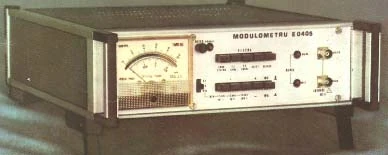
The E0405 is a modulation meter, made by IEMI in Bucharest and designed at the ICE research institute [1].
ICE’s laboratory for electronic instruments for measuring electrical quantities designed all the institute’s generations of oscilloscopes, voltmeters, multimeters, signal generators, frequency meters, logic analysers, RLC bridges and stabilised AC power supplies; they went into production at IEMI or in ICE’s own microproduction workshop, and equipped industrial laboratories and production lines as well as teaching and research laboratories [1]. In the 1970s and 1980s about half of the components of measuring instruments were imported; after 1980 about three quarters were Romanian [1].
It measures the modulation depth, with automatic tuning; it appears in IEMI’s 1988 range [2].
Annex III.2.8 says it measured both the depth of amplitude modulation and the frequency deviation of radio communication equipment, in research, production and repair, over 9.5–11.5 MHz and 19–500 MHz; it tuned itself in up to 5 s and had 3 kHz low-pass, 200 Hz high-pass, CCITT (P 53 A) and de-emphasis filters [3].
The Agenda radioelectronistului (2nd edition, 1989) lists the „E-0405” („Modulometru”, modulation meter) among the analogue voltmeters, multimeters, modulation meters and wattmeters of the E-04 group made by IEMI; a note says that with automatic tuning, it measures the AM modulation depth (m = 1…100 %, ±3 %) and the FM frequency deviation (Δf = 0.1…150 kHz, ±3 %), for modulating frequencies of 50 Hz…9 kHz, at input levels of 25 mV…1 V, and it contains four types of filters [4]. Its table gives a frequency range of 9.5…11.5 MHz and 19…500 MHz, an input resistance of 5·10⁻⁵ MΩ (50 Ω), a 220 V (12 V DC) supply, a consumption of at most 10 VA, 10 × 27 × 41 cm (height × width × depth) and at most 4 kg [4].
Its frequency ranges are printed „(9,5…11,5)·10⁶” and „(19…500)·10⁶” Hz [4].
Photo Gallery
No other images available yet.
Schematics
No schematics available yet.
Documents
No documents available yet.
Prices
N/A
References
- [1]N. Millea (coord.) et al. – „Electronica românească. O istorie trăită”, vol. II „Electronica profesională”, AGIR, section II.4.1 „Laborator aparate electronice pentru măsurarea mărimilor electrice”, pp. 109–115
- [2]N. Millea (coord.) et al. – „Electronica românească. O istorie trăită”, vol. II „Electronica profesională”, AGIR, sections III.2 „Producția IEMI” and III.3 „Comentarii tehnico-economice”, pp. 302–317, and annex III.2.3 „Producția IEMI – aparate electronice de măsură și industriale”, pp. 383–386
- [3]N. Millea (coord.) et al. – „Electronica românească. O istorie trăită”, vol. II „Electronica profesională”, AGIR, annex III.2.8 „Voltmetre – multimetre – wattmetre”, pp. 618–627
- [4]N. Drăgulănescu – „Agenda radioelectronistului”, 2nd edition, Editura Tehnică, 1989, section 50.3 „Voltmetre/multimetre numerice/analogice” (producător: IEMI – București), part C „Voltmetre/multimetre/modulometre/wattmetre analogice (grupa E-04)”, pp. 711–714